Sports Medicine’s new game plan
UND’s first-of-its kind Center for Sports Medicine adjusts to its new digs on the north end of campus
Editor’s note: This story originally appeared in the Spring 2026 edition of North Dakota Medicine, the quarterly magazine published by the UND School of Medicine & Health Sciences.
****
By Brian James Schill
Change is hard. And change can be good.
Such were the thoughts that – in this exact order – ran through Steve Westereng’s mind a few years ago when he learned that, after decades in the Hyslop Sports Center, UND’s Center for Sports Medicine (CSM) would be getting a new home.
One year in at the new location, the chair of the UND School of Medicine & Health Sciences Department of Sports Medicine hardly misses the former clinical space his team managed in a building that has since been demolished.
In fact, he doesn’t miss it at all.
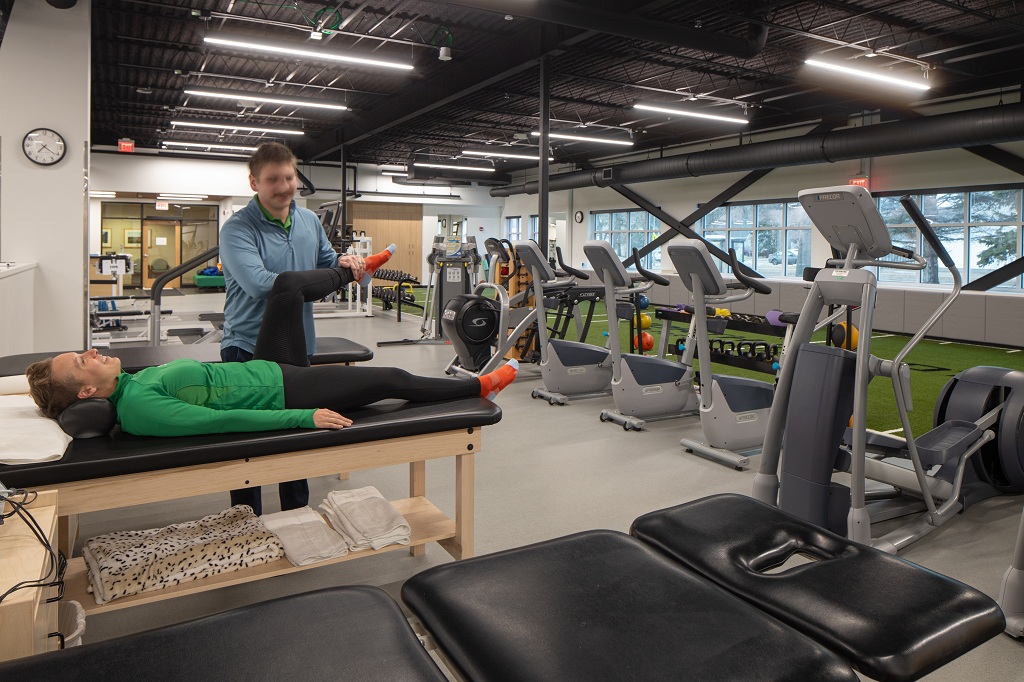
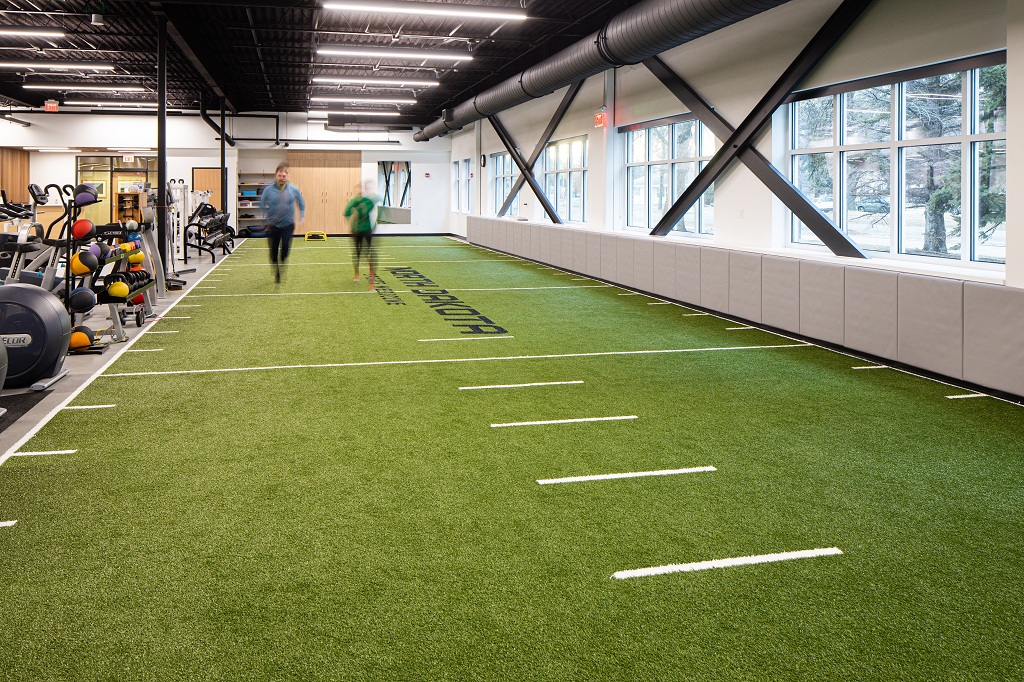
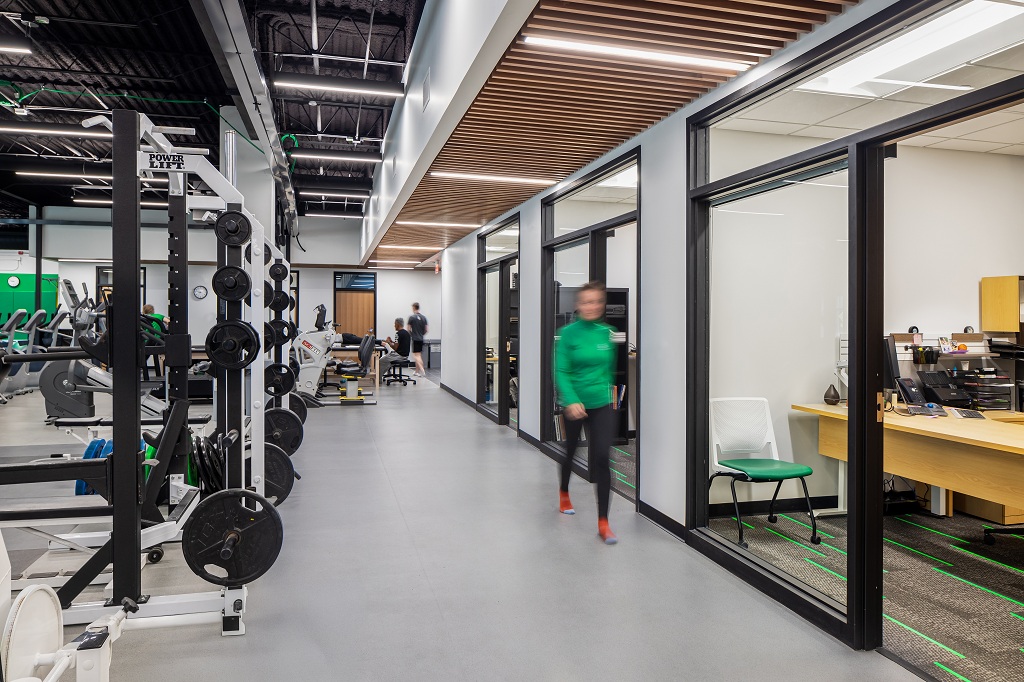
“That old space was small, hard to find for patients, and not something that could be considered a ‘health care facility,’” explains Westereng, listing all the ways in which the Hyslop clinic had ceased serving its purpose. “There was no climate control so it would get extremely hot in the summer, and patients had to move to different rooms to utilize different exercise equipment. Even parking was difficult for our non-UND patients.”
This is why, he says, the new clinic space is not just an update, but a literal game-changer for UND Athletics and UND’s Master of Athletic Training program.
“When we opened the new clinic, patients who had previously rehabbed in the old space were extremely happy with the new space,” he says of the space which is separate from the university’s athletics program. “There were certainly some ‘wow’ comments as they entered the new clinic for the first time.”
On-campus care for student athletes
Cathy Ziegler agrees.
A physical therapist by training, Ziegler has served as coordinator of UND’s fully integrated sports medicine clinic for decades, moonlighting as an instructor in Westereng’s department and an athletic trainer for local gamers.
“It’s tremendously important that our student athletes have access to this space right on campus, to come in here and do their rehab and exercise routines,” she says, crediting UND’s former head athletic trainer Jim Rudd and former team physician Dr. William Mann with getting the CSM off the ground thirty years ago.
“If you would ask our coaches who’ve worked somewhere else, they’ll tell you that it’s invaluable. An on-campus sports medicine clinic – staffed by athletic trainers and physical therapists – just gives our athletes better continuity of care, and even more advanced care, compared to having to go somewhere else two or three days a week.”
As Ziegler suggests, this model is unique in higher education. Most colleges and universities don’t have a PT- and athletic trainer-managed rehabilitation clinic targeted at student-athletes embedded within their institutions. UND pursued this model back in the early 1990s Ziegler says, because it allowed UND coaches, athletic trainers and physical therapists both oversight and best-practice management of student athletes who experience injuries that might require daily monitoring, and who live on-campus.
This model, adds Westereng, helps UND health providers guide students through what may be long rehabilitation processes, whether the post-surgical rehabbing of an acute knee injury or a lower-grade chronic injury that requires a body mechanics adjustment with the help of an athletic trainer or PT.
“The facility has been designed to leverage the expertise of our faculty, who are specialized in treating and rehabilitating athletic injuries,” Westereng says, “allowing the student to return to activity as safely and quickly as possible.”
Community health care
Even more, the facility offers services to non-students. Although the CSM cares primarily for UND athletes, it also sees general UND students and faculty, as well as patients from the Grand Forks community and the surrounding area.
“We’re just like any other outpatient physical therapy clinic,” says Ziegler, who moved from South Dakota to UND, after a stopover in Oklahoma, back in the 1990s. “We’re not set up for Medicare or Medicaid, but we see patients from the community. We see students and staff on campus, high school athletes, almost anybody.”
All of which is Ziegler’s way of saying that the clinic helps the School sustain its operations without raising tuition.
This model was what attracted Ziegler’s colleague Jake Thompson back to UND. “I did my undergrad training here but went to PT school in Kansas and then lived in Dallas for about eight years,” explains Thompson. “And I told Cathy and Steve that if this job ever opened up, I would move back to North Dakota in a heartbeat.”
And it did, so Thompson did, moving back to Devils Lake, N.D., but commuting to Grand Forks to work in the nation’s first medical school-managed sports medicine clinic.
He never looked back.
“UND and the facilities team at the School of Medicine & Health Sciences really deserve credit for believing in our vision, for putting a lot of effort into making this great facility a reality,” Ziegler concludes, listing the UND-based teams making regular use of the space – football, basketball, volleyball, track and field. “They invested in us and made sure everything was the way we wanted it for these student athletes. That’s huge and matters for outcomes both on and off the field.”
About the author:

Brian James Schill is director of Alumni & Community Relations, Communications & Engagement at the UND School of Medicine & Health Sciences.