18:83 Speaker Series: Col. Alfred Rosales’ keys to winning the day
Commander of 319th Reconnaissance Wing at Grand Forks Air Force Base shares moments from his career that shaped his approaches to leadership
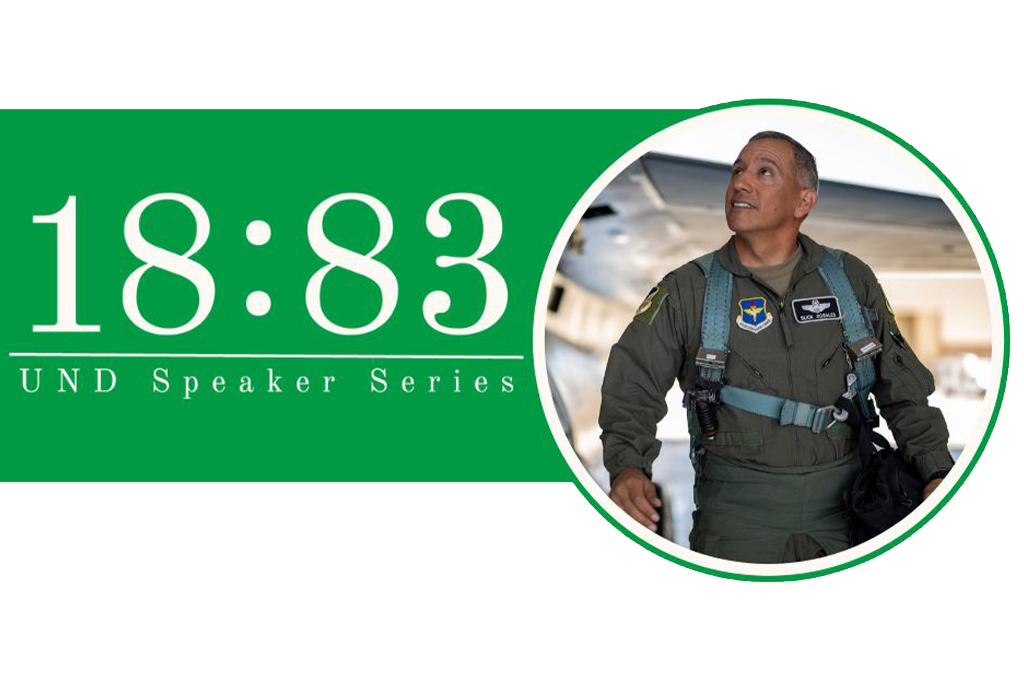
To reach where he is now, as commander of Grand Forks Air Force Base, Col. Alfred Rosales needed to “trip and fall along the way” to develop as a leader.
Early on in his career, he compared himself to what most people would imagine of Tom Cruise’s character from “Top Gun.”
“I was a steely-eyed airman,” Rosales said. “I went to multiple wars in my first few years, in many aircraft. I was aggressive. I thought I was a perfect leader to fly us into battle.”
As much as he “bled blue” at the time, putting the Air Force above all else, his path came into question when he first wasn’t selected for a new assignment to elevate himself as an officer.
What he learned then was the start of his journey in being a “practitioner of leadership, not an expert,” and Rosales shared that journey with those attending his 18:83 Speaker Series talk on Wednesday at the Memorial Union.
The series gives people from UND and the local region around 18 minutes and 83 seconds to speak about their paths and lessons in leadership. The number is in reference to UND’s founding year.
Rosales brought three key lessons to his time on stage: it’s not about me; be approachable to win; and have the attitude to win.
‘Is it about me?’
Eight or so years into his Air Force career, Rosales was furious to find out he wasn’t selected for a new assignment, one that would take him from his current squadron to an opportunity for further education and advancement as an officer.
He was furious enough to march into his boss’s office for an explanation.
How could someone so dedicated (again, “bleeding blue”) be so readily denied the chance to make the most of their talents?
First, his commanding officer made him leave the office to fix his flight suit and shoes. They weren’t worn correctly.
When the fuming Rosales came back, he heard something he wouldn’t forget:
“Slick, the Air Force is not about you, it’s about winning,” Rosales recalled, remarking that “Slick” was his callsign. “The taxpayers give us the resources, people, fuel, bullets, and it’s to win. It has nothing to do with you.”
Rosales was then told to take a week off and think about something: “Is this story about you?”
“Go home and think about this,” the officer said. “If you don’t think it’s your opportunity to stay in the service, that’s ok. We’re going to clap and cheer you on. You can go off and we’re going to ask someone else to help us win, because you’re not it.
“So, either figure that out yourself or get out. Dismissed.”
Rosales left the conversation angry and upset, but over the next week he came to realize how self-centered he was about his career and achievements.
The course correction thereafter kept his career on track, and the young officer thought he had everything to know about leadership — “it isn’t about me.”
Building leadership instincts
It didn’t take much longer in Rosales’ career to learn that there was more to leadership than setting aside a selfish mindset.
On the Memorial Union stage, he recalled further lessons both from mentors and subordinates in his path to becoming a colonel.
One of those lessons spurred from going about his morning with his typical fervor commanding a large-scale flight operation that he likened to UND’s own flight activities, putting hundreds of aircraft in the air weekly.
His role had him face-to-face with people at all hours of his time on base.
It wasn’t until close to lunchtime that he went to the restroom to find his nametag on the wrong side of his uniform, askew, and another piece upside down.
“It equates to waking up in your dorm and running to class with whiskers painted on your face,” Rosales remarked.
Nobody was willing to say to his face that his uniform was in disarray.
What he learned later that day from his boss was the need to be approachable.
“What, smiling more?” Rosales assumed.
Instead, he learned a rule of threes. Every day, interact with three different people. In each of those interactions, use that person’s name three different times while asking them three questions — each of those questions builds off what the person just said.
Cutting off his story, Rosales pointed to a few different people whom he’d just met – reciting pieces of information about how long they’d worked for UND or where they were from.
“I can do it instinctually now,” Rosales said, 15 years or so on from the uniform incident. “You have to build that muscle so you can engage with people and be approachable to win.”
Win the day
His closing point was about the attitude it takes to win.
He had learned that not everything was about him, and that he needed to practice what made leaders approachable.
But in a typical meeting, toward the end, when he asked the room for questions, nobody would speak up until after the meeting was over.
Why couldn’t he get people to engage when he opened the floor?
Rosales was known for his ready-for-war face. He remarked to his UND audience that he took things very seriously. His nonverbal reactions were easily read. It took some difficult conversations to learn that beyond approachability, he needed to soften up.
“That takes work,” he said. “You can’t fake it.”
What he learned was a routine for 90 minutes every morning: 45 minutes of some kind of physical activity, 15 minutes to get dressed and ready, then 30 minutes to eat and do something mentally enriching. It was about getting in the right mindset to win the day.
“You need to be ready to win with an attitude to be grateful for the trials and challenges that I’m in with these people — have the attitude to win,” Rosales said.
A subordinate had pulled him aside and pointed out that his nonverbal responses to people created a difficult environment in which to be frank and accountable.
Rosales was told that when his team shows up to work, he needs to assume that they’re all there to win, just as he is.
“That was the last piece I needed, Rosales said. “We all will never get it right unless we’re trying to approach every day to win. Not trying to win for a month or a year, or what does my future look like in two years, but how about being a little bit better today?”