50 years of preparing students for public service
Local Government Night connects UND students with public-sector leaders from across North Dakota
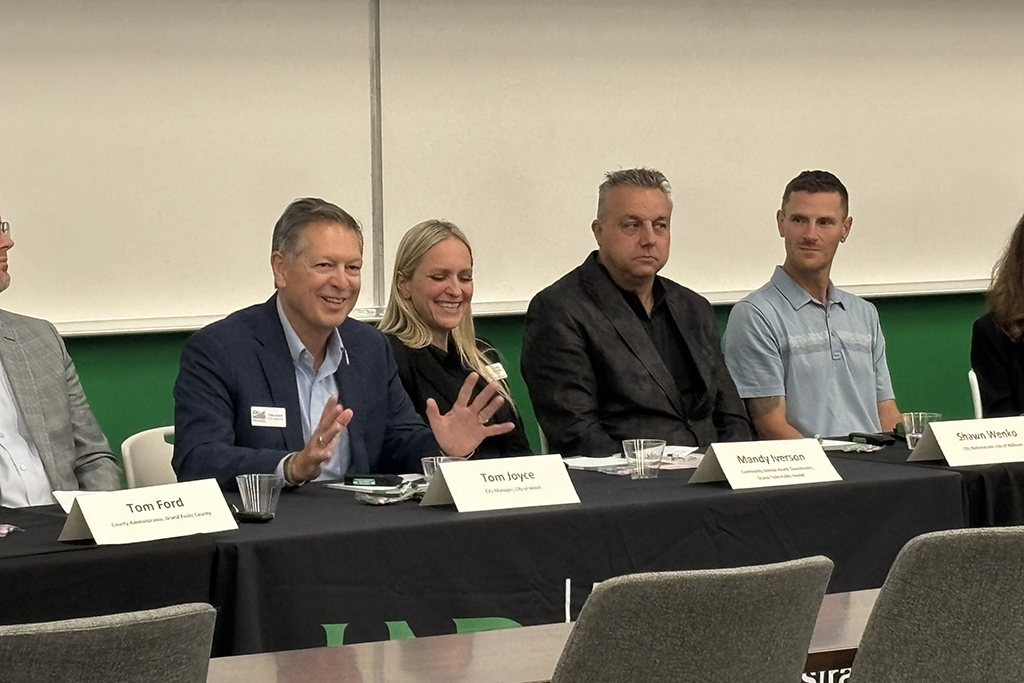
For those considering a career in local government, the message from a group of North Dakota public-sector leaders was clear: The work is about people.
That theme surfaced repeatedly during UND’s second annual Local Government Night on Sept. 15, as professionals working in city and county government, public health, law enforcement and other areas shared their experiences with students and answered questions about careers in public service.
The event, held in Nistler Hall and online, drew about 35 people in person and another 20 via Zoom. This year’s gathering also marked a milestone for UND’s Master of Public Administration program, which is celebrating its 50th anniversary.
Brian Urlacher, associate dean of the Nistler College of Business & Public Administration, said in his opening remarks that the MPA program has long helped connect the academic side of public administration with professionals doing the work across North Dakota.
The most important connection, he said, has been through students.
“We don’t get folks together in a room to sort of connect and realize what opportunities exist as often as we should,” Urlacher said.
Learning to think through the gray areas
For Grand Forks County Administrator Tom Ford, a 2018 graduate of UND’s MPA program, one of the greatest benefits of the program goes beyond what students learn from textbooks.
Ford encouraged students to build relationships with their professors and classmates and to learn from the experiences and perspectives of others. Those relationships, he said, may continue throughout their careers.
He also stressed the importance of the technical knowledge students gain in areas such as budgeting, organizational theory, public policy and strategic planning. But equally important are the skills needed to communicate, build trust, lead employees and work with elected officials and community partners.
“Public administration is not black and white. It’s gray,” Ford said.
Professionals regularly must balance limited resources, competing priorities, politics, public expectations and legal requirements, he said. Students may not immediately recognize how a particular assignment will apply to their careers, but those lessons can become valuable when they eventually find themselves developing multimillion-dollar budgets, managing personnel or navigating complex policy questions.
Shawn Wenko, Williston city administrator and a current UND MPA student, echoed that point. He said the program is teaching students not simply to find the “right” answer, but to become critical thinkers who can work through complicated problems.
“Be thoughtful in your responses, and ask good questions,” Wenko told students.
Service at the heart of the work
The evening also offered students a look at why people choose public-sector careers in the first place.
Mandy Iverson, community mental health coordinator for Grand Forks Public Health and a two-time UND graduate, connected her work in public health to the reason many people enter nursing: They want to help others.
In a traditional health care setting, she said, there is a finite number of patients a nurse can serve in a day. Working in public health gives her an opportunity to think on a much larger scale.
“The entirety of Grand Forks County are my patients,” Iverson said.
Through her work in mental health and substance-use prevention, Iverson said, she can contribute to the well-being of an entire community.
Tom Joyce, Minot city manager, described a similar motivation. After 28 years in the Air Force, followed by time in the private sector, Joyce found himself drawn back to public service.
For him, the difference came down to mission and the opportunity to contribute to a community.
“If you want to do some things for the masses, working in local government’s a great place to be,” Joyce said.
Relationships — and challenges
Panelists also gave students a candid picture of the challenges facing local governments.
They discussed rising costs and constrained budgets, difficulty recruiting and retaining employees, the loss of institutional knowledge as longtime employees retire and declining public trust in government.
Those pressures can require local governments to make difficult choices about which services and projects to fund. They also make relationships with residents increasingly important.
Danny Weigel, a lieutenant with the UND Police Department who also serves on the Grand Forks City Council, said face-to-face conversations can be particularly valuable in an era when so much communication occurs through email, text messages and social media.
“I think the more you can build relationships with your community, the better off you’re going to be,” Weigel said.
He compared those relationships to putting coins into a piggy bank: Positive interactions build trust that becomes especially important when an organization makes a mistake or encounters a difficult situation.
The importance of relationships also came up as panelists offered career advice to students. They encouraged students to pursue internships, network, take opportunities to learn and be willing to start with less glamorous assignments.
“Put yourself in the room,” Iverson said, encouraging students to join community organizations, serve on boards and make connections. “You never know where something’s going to come from.”
A commitment to community
Paul Sum, chair of UND’s Department of Political Science & Public Administration, brought those themes together as the evening concluded.
UND’s MPA program, he said, is a mission-driven program designed to develop public-service values and prepare people to enter or advance in government, nonprofit and related fields.
Listening to the panel, Sum said he heard several of those values reflected in the conversation: responsiveness, effectiveness, leadership and a willingness to make difficult decisions.
He also heard optimism.
“What struck me also was a sense of optimism that you all shared — a true optimism about what can be and what can be better,” Sum said.
Most of all, he said, he heard a commitment to community — a fitting message as UND celebrates 50 years of preparing students for careers in public service.