UND experiment takes flight to study lunar dust in microgravity
Human Spaceflight Laboratory research in Switzerland explores challenge future astronauts could face as they leave the lunar surface
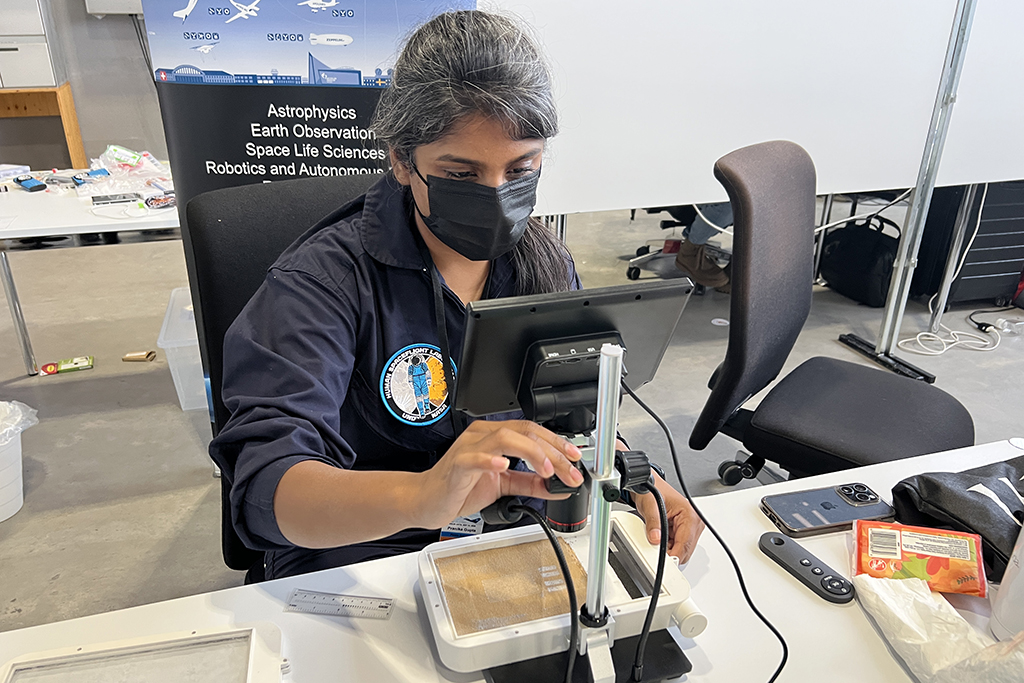
A University of North Dakota experiment designed to better understand how lunar dust could affect astronauts and their spacesuits has successfully completed a series of microgravity flights in Switzerland.
The experiment, known as ASCENT, was one of eight competitively selected for the Ohio State-Starlab Parabolic Flight Research Campaign, held Sept. 7-11 in Dübendorf, Switzerland.
Developed by Pablo de León, professor in UND’s Department of Space Studies and director of the Human Spaceflight Laboratory, ASCENT examines what could happen to lunar dust brought inside a spacecraft by astronauts returning from the surface of the moon.
Lunar dust can cling to spacesuits, boots, tools and other equipment. Once brought inside a lunar lander, that dust would settle under the moon’s gravity, which is about one-sixth that of Earth. But when the spacecraft leaves the lunar surface and enters microgravity, some of the dust could begin floating again, potentially coming into contact with spacesuits, equipment and other surfaces.
“Lunar dust is one of the environmental challenges that will have to be managed as humans return to the Moon for increasingly complex and longer-duration missions,” de León said. “We are interested in a very specific part of that problem: What happens to the dust that astronauts have already carried inside a lunar vehicle when that vehicle leaves the surface and transitions from lunar gravity to microgravity?”
The question is particularly relevant as NASA and its partners prepare for future Artemis missions that are expected to return astronauts to the lunar surface.
To recreate part of that environment, the UND experiment used a material designed to simulate lunar soil, along with samples of materials associated with spacesuits and human spaceflight operations.
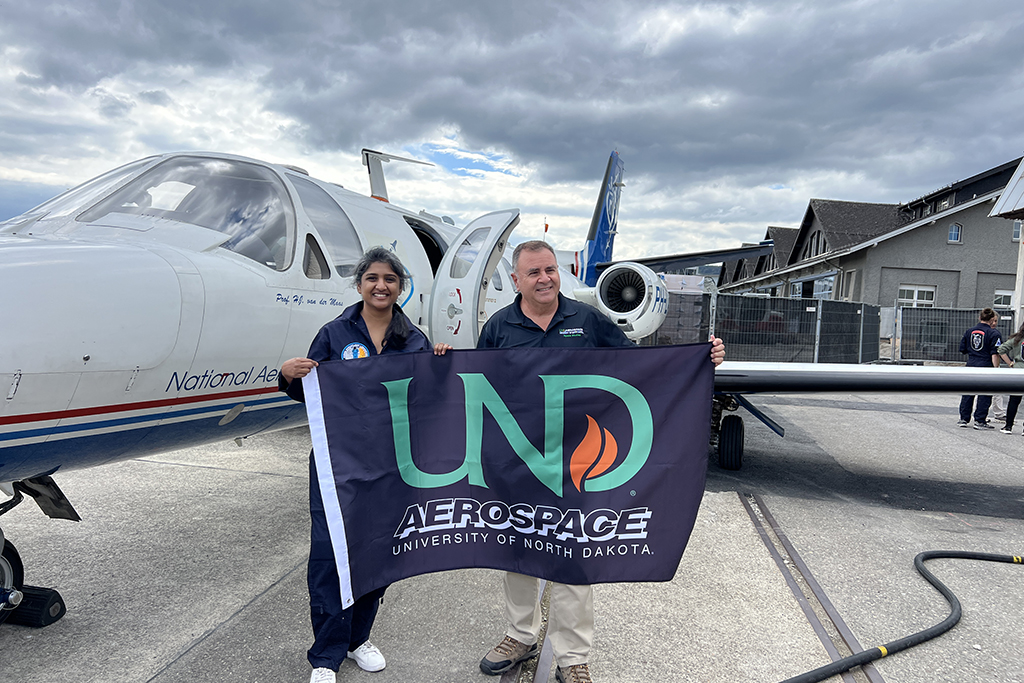
During the campaign, ASCENT flew through 20 parabolas — flight maneuvers that create brief periods of near weightlessness — with each providing more than 15 seconds of microgravity. The flights were conducted aboard a modified Citation II research aircraft operated by the Netherlands Aerospace Centre and coordinated by the University of Zurich Space Hub.
UND students take research from lab to flight
The project also provided two UND graduate students with hands-on experience developing and conducting a spaceflight-related experiment.
Aerospace Sciences doctoral student Pranika Gupta traveled to Switzerland and operated ASCENT aboard the aircraft during the microgravity flights.
Space Studies master’s student Nicolas Padovani led the experiment’s detailed mechanical design and fabricated much of its hardware using 3D printing. Working from de León’s initial concept, Padovani helped transform the idea into flight-ready hardware in just a few weeks.
“Pranika had the responsibility of actually flying and operating the experiment in microgravity, while Nicolas took our initial concept and, in only a couple of weeks, transformed it into detailed hardware that we could manufacture, integrate and fly,” de León said.
“That combination of research, engineering and hands-on flight experience is exactly the kind of opportunity we want our students to have at the Human Spaceflight Laboratory.”
UND’s participation in the campaign grew from connections with the Voyager Institute for Space, Technology and Advancement, or VISTA, an initiative that brings universities and other research organizations together with opportunities in the growing commercial space industry. The Ohio State University is an anchor institution in the initiative, which supports research for Starlab and future commercial activities in low-Earth orbit.
With the flights complete, de León and the UND research team will analyze the experiment’s data and samples. The researchers expect the findings to contribute to a future technical publication examining how lunar dust behaves as spacecraft transition from the Moon’s surface to microgravity.