UND meteorology student puts forecasting skills to work at AirVenture
Student forecaster gains hands-on experience while sharing his passion for weather in Oshkosh
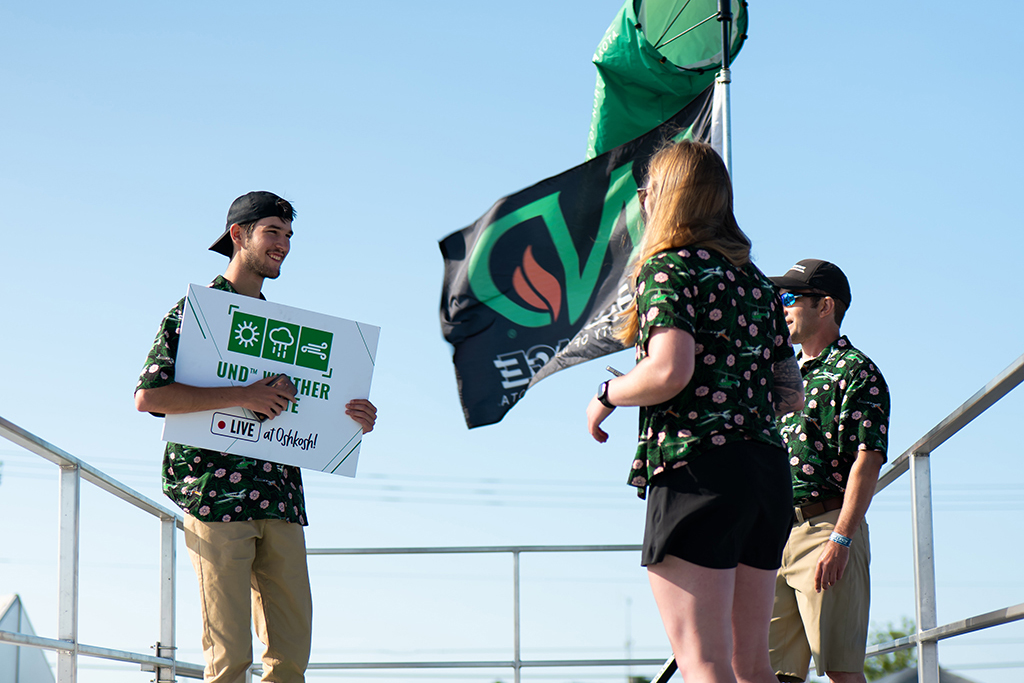
Each summer, EAA AirVenture in Oshkosh, Wisconsin, attracts aviation enthusiasts from around the world. But for UND student Anson Tippie, the weeklong event offered an opportunity to experience aviation from a different perspective — through weather.
Tippie, a junior majoring in atmospheric sciences, traveled to AirVenture to forecast and report on weather directly from the event, putting skills developed in the classroom and through UND Weather Update to work in an aviation environment.
Originally from Kansas City, Kan., Tippie said his interest in meteorology began in elementary school with a love of drawing maps by hand.
“In third grade, we had a science unit about weather,” Tippie said. “I distinctly remember my teacher pulling up on the screen that it was 86 degrees in Thailand in February. I thought to myself, ‘How is this true?’
“About this time, our district got tablets, and after that my new favorite thing to do was pull up the weather app and look at weather in different places. That got me interested in climatology, so I started adding a temperature color code to my maps.”
That early interest eventually led Tippie to UND, where his atmospheric sciences coursework has introduced him to radar, forecasting, extreme weather and the ways weather patterns relate to climatology.
Tippie also joined UND Weather Update, a student organization that produces weekday morning weather forecasts from a studio on campus. Students also provide coverage when significant weather affects the region.
“Sometimes we even do special broadcasts,” Tippie said. “You might have seen some of our blizzard videos. So even when school is canceled, we are out there in the snow reporting.”
That experience forecasting and reporting outside the studio came in handy when Tippie was given the opportunity to provide weather updates from AirVenture.
“In the mornings, I had about an hour to look at models and get my ideas for the weather for the day,” Tippie said. “I would look over them, get my ideas for the forecast and use graphics from the Aviation Weather Center to send them out to the team. Once at the booth, we would record the weather update and get it posted.”
The experience also gave Tippie an opportunity to introduce prospective students and other AirVenture visitors to UND’s atmospheric sciences program. A weather station at the UND booth and basic weather experiments for children allowed him to spend his days sharing his enthusiasm for meteorology with attendees.
“Oshkosh was incredibly cool,” Tippie said. “At first, I wasn’t sure how interesting it would be, but it was really cool learning about all the diversity in aviation. There are personal planes, trainers, military, vintage, homebuilt, and just a large passion that goes into these aircraft that was really cool to see.”
Forecasting for pilots
Tippie also discovered how different aviation forecasting can be from the weather information most people use in their daily lives.
He gained experience forecasting cloud conditions and determining which weather models were most useful for aviation. More importantly, he learned that pilots often want very different information from a forecast.
“Weather reporting was a lot different,” Tippie said. “Everyone wanted to know more about visibility and ceilings. In civilian forecasting, people are more interested in comfort, so whether it’ll rain, what temperature it is, if it’s humid — like what it will feel like walking to your car. Here, people wanted to know if they could fly, which was a completely different thing.”
Tippie also connected with researchers and forecasters attending AirVenture, while gaining a better understanding of how meteorology intersects with aviation.
For a student who spends much of his time studying weather rather than airplanes, the experience offered a new perspective on one of UND’s best-known programs.
“I really gained an appreciation for our aviation program,” Tippie said. “Most of my friends are aviation, but I’m not at the airport, so I just hear the names of everything. Now I feel like I can communicate better with aviation colleagues and understand better what aviators need from forecasters.”
About the author:
 Averie Eixenberger is a communications and writing intern for UND Aerospace.