Remembering Michael Gaffey
World-renowned asteroid researcher left lasting mark on UND, planetary science and generations of students
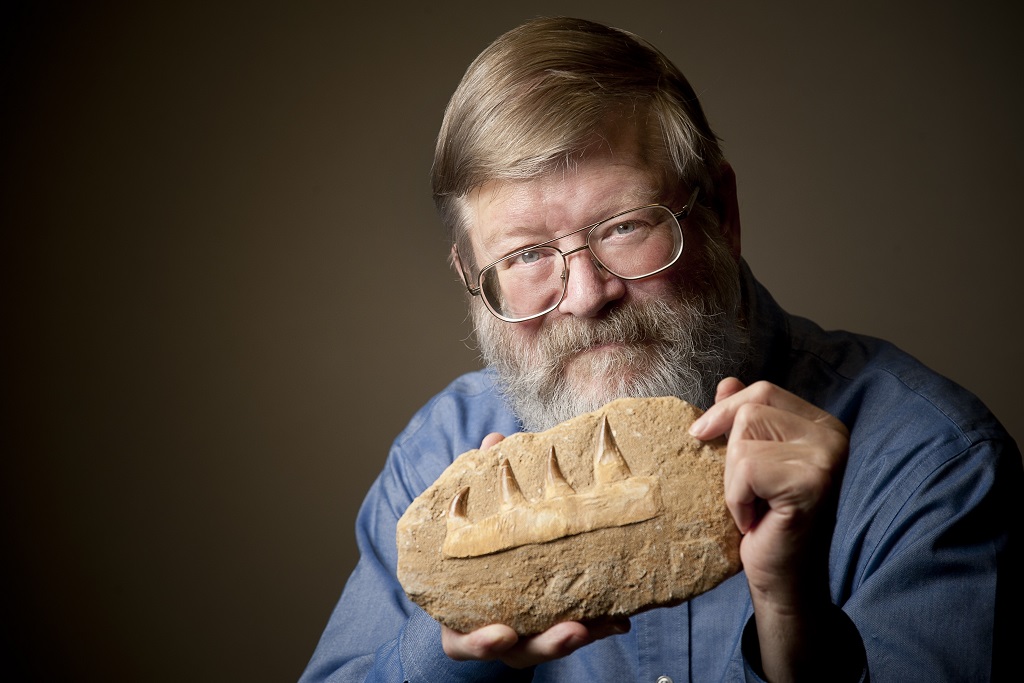
An asteroid bearing his name travels through the solar system. But Michael Gaffey’s more enduring legacy may be found in the scientists he taught during a career devoted to understanding the objects that orbit there.
Gaffey, Chester Fritz Distinguished Professor Emeritus of Space Studies at the University of North Dakota, died Sept. 20. He was 80.
An internationally recognized authority on asteroids, Gaffey joined UND’s Department of Space Studies in 2001 and spent 21 years at the University before retiring in 2022. His research helped scientists better understand the composition and history of asteroids, offering important clues about the formation of the solar system. Along the way, he helped establish UND as a center for planetary science research and inspired generations of students to pursue scientific discovery.
“Mike left a lasting mark on UND through the way he taught, mentored and cared about his students,” said Sherry Fieber-Beyer, associate professor of Space Studies and director of the UND Observatory. “He taught us that good science starts with careful, well-calibrated data and honesty to let the evidence guide our conclusions.”
A legacy written in the solar system
Much of Gaffey’s career focused on determining the mineral composition of asteroids by analyzing the light reflected from their surfaces. Beginning with doctoral research at the Massachusetts Institute of Technology in the early 1970s, he used those techniques to investigate what asteroids could reveal about the solar system’s origins, potential resources and hazards posed by near-Earth objects.
His work helped connect meteorites found on Earth to their asteroid sources and advanced scientists’ understanding of how the solar system formed and evolved.
“Mike’s work helped show just how much we could learn about asteroids from Earth,” Fieber-Beyer said.
Among his accomplishments was identifying major features on the asteroid Vesta years before they were confirmed by observations from the Hubble Space Telescope and NASA’s Dawn mission, on which he later served as a participating scientist. By the time the spacecraft entered orbit in 2011, he had already spent more than three decades studying the asteroid from Earth.
He also developed methods for distinguishing asteroid types by their mineral composition, providing researchers with new tools for studying distant objects.
His contributions earned recognition throughout the planetary science community. In 2006, he received both the Leonard Medal from the Meteoritical Society and the G.K. Gilbert Award from the Geological Society of America. At UND, he received the Thomas J. Clifford Faculty Achievement Award for Excellence in Research and was named a Chester Fritz Distinguished Professor, one of the University’s highest academic honors.
Scientist, mentor and teacher
While Gaffey’s scientific achievements earned international recognition, colleagues say his influence reached even further through the people he taught and mentored.
Fieber-Beyer first met Gaffey as a student in 2004 before becoming a colleague, research collaborator and friend. Together, they contributed to research that helped strengthen the case that the asteroid Hebe is the source of one of the most common meteorite types found on Earth, with findings published in The Planetary Science Journal in 2020.
For Fieber-Beyer, the collaboration reflected Gaffey’s approach to mentoring.
“Being sent back to the lab with dozens more papers to read could be demanding, but it taught me to be thorough, skeptical and evidence-driven,” she said. “Those habits became central to the scientist, educator and collaborator I became.”
Gaffey’s interests extended well beyond asteroids. His work encompassed planetary geology, near-Earth objects and impact hazards, and he maintained a lifelong fascination with paleontology. At UND, he taught courses ranging from Introduction to Space Studies and The Planet Mars to a popular course on dinosaurs.
His office reflected that curiosity. A former student once described it as a “treasure trove” of fossils and other objects collected by a scientist whose interests crossed disciplines.
Yet colleagues say it was his dedication to students that may have defined him most.
“Mike welcomed anyone who was genuinely eager to learn, often seeing promise in students who had been overlooked by others,” Fieber-Beyer said. “He helped them recognize their own abilities and grow into confident scientists.”
Even after retiring in 2022, Gaffey remained connected to UND as Chester Fritz Distinguished Professor Emeritus.
For those who worked alongside him, his legacy extends beyond any single discovery.
“His colleagues will remember not only these contributions, but also the principle behind them: collect the best-calibrated data possible, follow the evidence, and distinguish conclusions from speculation,” Fieber-Beyer said.
Asteroid 3545 Gaffey will continue its journey around the sun, bearing his name. At UND, colleagues say his influence will continue through the students, researchers and educators shaped by his example.
“That rare combination of rigor, patience and belief in his students will continue to shape Space Studies for years to come,” Fieber-Beyer said.