Karen Nyberg returns to UND to honor first Astronaut Scholar
Retired NASA astronaut honored Casia Steinhaus, UND’s first Astronaut Scholar, and shared what it was like to see Earth from space
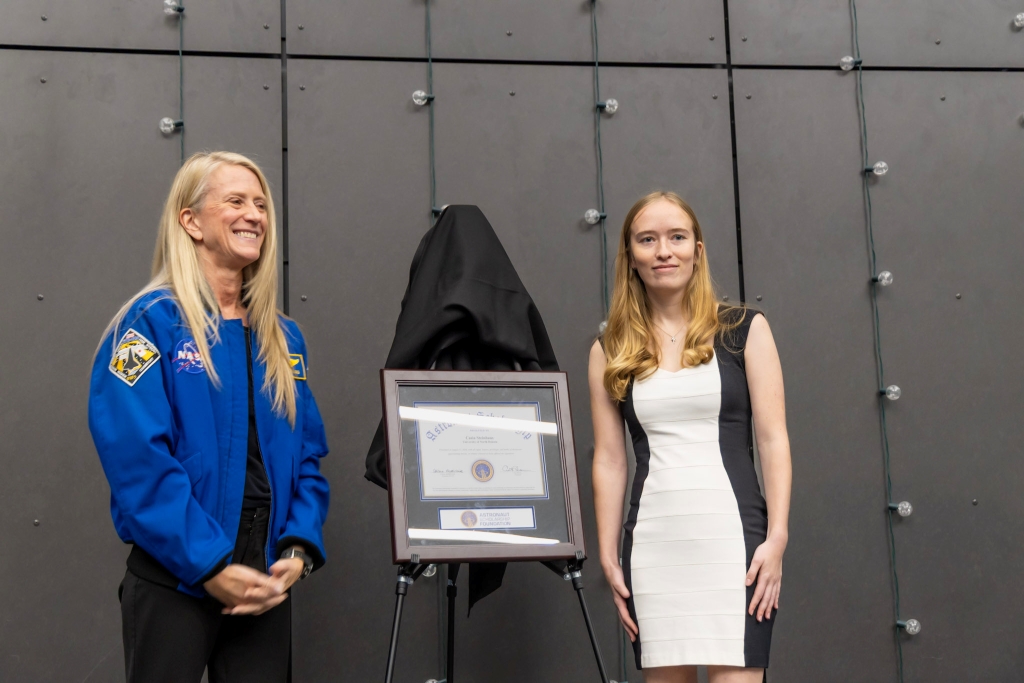
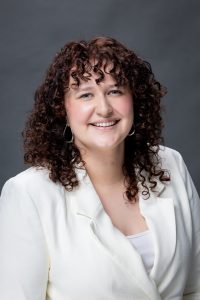
On Nov. 17, Karen Nyberg awarded Casia Steinhaus UND’s first Astronaut Scholarship. Nyberg, a retired astronaut and alumna, presented the award to Steinhaus who is a Physics and Mathematics senior from Devils Lake.
“I am so honored to be UND’s first Astronaut Scholar,” Steinhaus said.
For Nyberg, presenting the scholarship was a chance to see years of work with her alma mater pay off. This adds another milestone for UND as it continues to expand its work in space.
“It’s about supporting talented students who have potential to make important contributions to science and technology, whether in space or right here on Earth,” she said.
The Astronaut Scholarship Foundation recognizes undergraduate students for their research, academic achievement and leadership in STEM fields. The scholarship provides up to $15,000 and pairs recipients with a mentor. Scholars also attend the foundation’s Innovators Symposium and Gala, where Steinhaus first met Nyberg.
Early in her research, Steinhaus worked with satellite data and machine learning to help detect oil spills during an internship at NASA. During the summer of 2026, she went on to conduct research as a DAAD RISE scholar in Germany. Her interest in plasma physics and fusion energy also earned her a U.S. Department of Energy internship at Princeton Plasma Physics Laboratory.
She plans to pursue a Ph.D. in plasma physics and hopes to conduct fusion energy research at a national laboratory. Earlier this year, she was named UND’s fifth Goldwater Scholar.
“What I find particularly impressive about Casia is the breadth of her interests and her willingness to take on new challenges from the time she was in high school,” continued Nyberg.
Much like Nyberg, who grew up in a small town in Minnesota, Steinhaus grew up on a farm outside Devils Lake where her high school offered few advanced classes. Eager to get a head start, she began taking college courses early and earned her associate degree at 17.
Outside the classroom, Steinhaus’ precision has earned her national recognition in competitive shooting. She placed first overall at the Individual Smallbore Rifle Intercollegiate Club National Championships in 2024 and 2025 and won the air rifle national championship in 2026.
Now, as a founding member of UND’s Women in Physics Club, she not only reaches for new heights, but she helps fellow students build a community in physics and encourages young people in rural communities like hers to explore STEM related fields.
“That combination of curiosity, determination, leadership and a desire to make a difference is exactly what the Astronaut Scholarship Foundation was created to recognize,” Nyberg said.
As Steinhaus took the stage, she thanked Robin Turner and Yee Han Chu for their work on helping her achieve the Astronaut Scholarship. She also thanked her mentors, Chonglin Zhang and Bryce Christopherson, who have helped mentor her along the way. Lastly, she thanked Tim and Becky O’Keefe, Linda Pancratz, Karen Nyberg and Doug Hurley for their gracious donation to the scholarship.
“I’m so grateful for this opportunity, and I look forward to celebrating many more Astronaut Scholars from the University of North Dakota,” Steinhaus said.
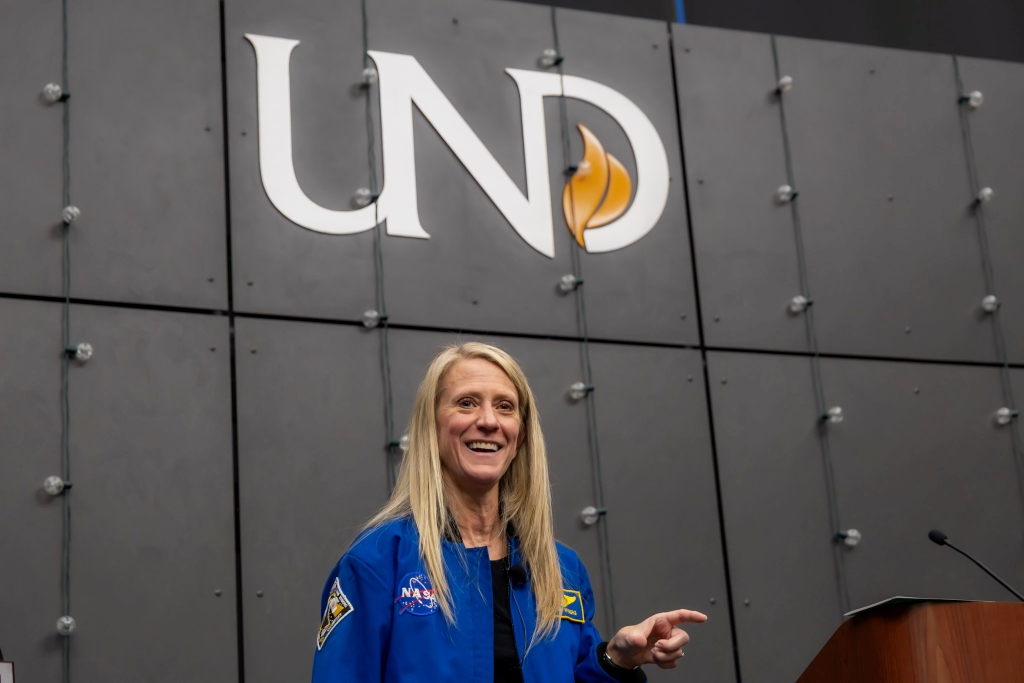
From UND to orbit and back
After presenting the scholarship to Steinhaus, Nyberg told the audience how she got to NASA. Her first leap was from Minnesota to Grand Forks to Houston. While studying Mechanical Engineering at UND, she landed a co-op at NASA’s Johnson Space Center in Houston. It was her first job with NASA, three years before she earned her degree in 1994.
“That was such a door opener for me, and especially because I came from a town of less than 100 people in southern Minnesota,” Nyberg said.
Zero to 17,000 miles per hour in about eight and a half minutes — that’s how Nyberg described her first launch aboard the Space Shuttle Discovery in 2008.
“What an incredible ride!” she said with a gleaming smile.
About an hour into that first flight, Nyberg helped open Discovery’s payload bay doors so the shuttle radiators could cool its equipment. Once the hatch was released, she could see the blue curve of the Earth through the rear windows.
Nyberg compared the experience to photographing a sunset. You can look at the picture the next day, she said, but it never will capture what it felt like to be there. From orbit, she mentioned that the blues from Earth looked almost otherworldly against the darkness of space.
“I’ve never seen a black that’s so deep and so dark; the contrast was overwhelming,” she said.
Discovery’s mission lasted about two weeks. Afterward, Nyberg said the experience felt so surreal that without photographs, she might have been convinced she’d never gone. Then, in 2013, she launched again, this time from Kazakhstan aboard a Soyuz spacecraft.
“When I went back on my second mission, it felt like I had never left,” she said. “It’s like my body remembered it.”
This time, Nyberg spent 166 days aboard the station and got to work in the lab she’d originally helped bring into orbit. The crew handled routine maintenance and repairs alongside research. As Nyberg pointed out, if something broke, they couldn’t call a plumber.
Nyberg and her crewmates from the United States, Russia and Italy took turns hosting dinner in the U.S. and Russian sections, bringing plenty of food to share. For those months in orbit, they really tried to make the station their home.
About 150 experiments were underway at any given time, Nyberg said. Some needed little from the crew like flipping a switch. Others included studies of how the human body responds to spaceflight where the astronauts were the subjects. For one experiment on how fluids behaved in orbit, Nyberg set up a camera and talked in real time with a researcher on Earth as she carried out the test.
With days that full, free time was harder to come by than she’d expected. One Sunday, an incoming cargo spacecraft’s rendezvous was called off. So, Nyberg pulled out the sewing supplies she’d brought from home and made a stuffed dinosaur for her 3-year-old son.
Nyberg, who had long loved to sew, also stitched a quilt block in orbit. It had inspired quilters around the world to send in blocks of their own. Volunteers assembled them into 28 quilts, which went on display at the 2014 International Quilt Festival in Houston. Now, they are proudly displayed at the Brisco Center for American History.
Back at UND, Nyberg said she felt honored to have seen the planet from orbit and grateful she could share what it was like to look upon the place we all call home.
“It’s our lifeboat,” she said. “It’s our home.”