The Rhoade to The Lecture
Jesse Rhoades, professor at UND, reflects on the unexpected turns that shaped his path to becoming an educator
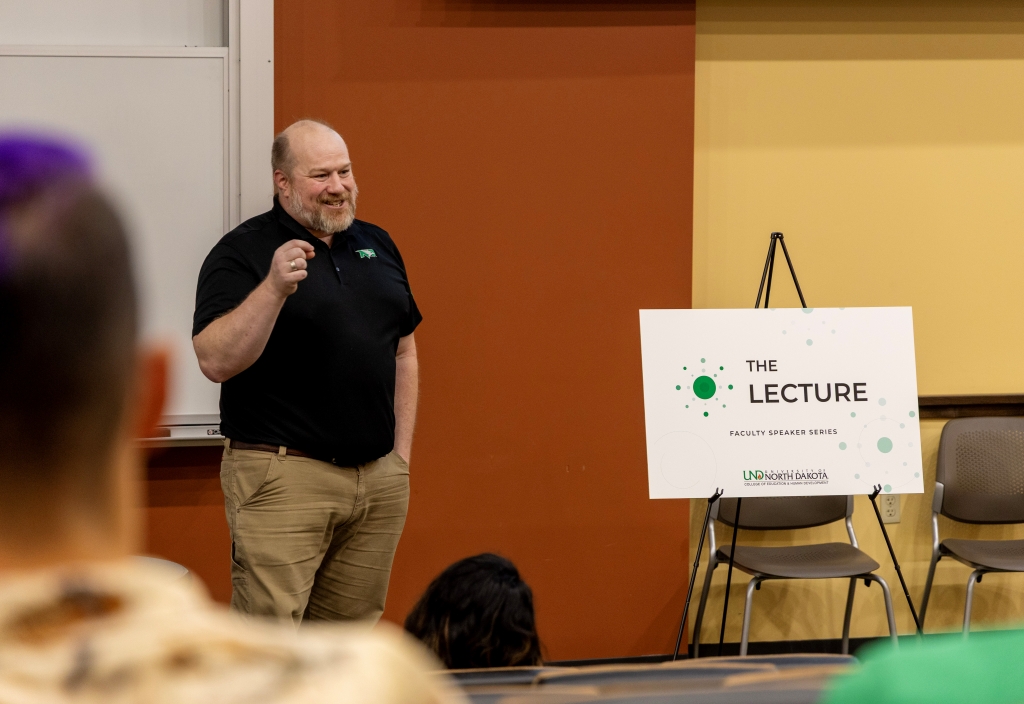
“I had two second grades, and I became a full professor.”
For Professor Jesse Rhoades, the distance between those two points included labels, a fascination with space and a path that eventually led to NASA.
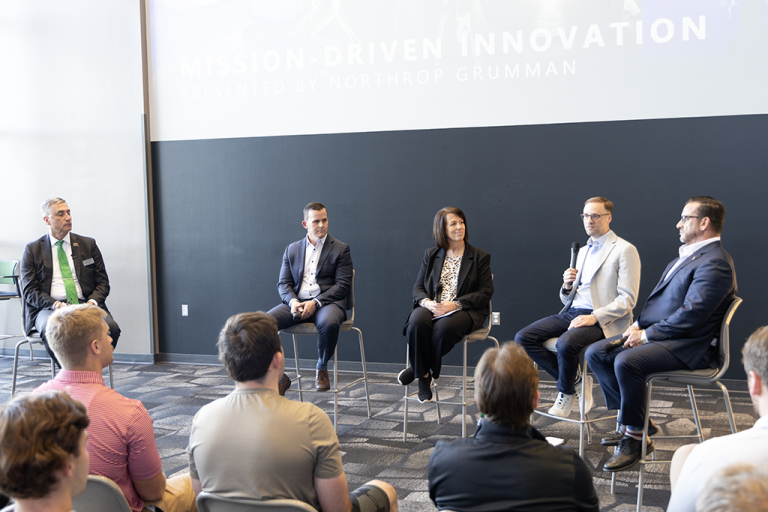
Journeys like Rhoades’ are what the College of Education and Human Development hopes to bring forward through The Lecture, a new series that looks beyond faculty members’ work to the people and paths that built it.
“It is a great opportunity for us to celebrate and make our faculty’s work more visible,” said Shelbie Witte, dean of the College of Education and Human Development. “More importantly, it’s a way to get to know them as individuals and learn about their journeys to academia.”
The long detour
Rhoades traced his way of learning back to his childhood on a farm, where his days were filled with experiments, exploration and, as he described it, “no lesson plans, just figuring things out.”
When he entered a traditional classroom, that curiosity didn’t translate as easily. Rhoades recalled struggling with the way he was taught and ultimately repeating second grade.
“I didn’t do well in elementary school or high school,” Rhoades said. “It was just a learning issue.”
Through the struggle, an interest in space began to take off. Rhoades recalled being captivated by the 1985 film SpaceCamp, devouring books about space at the library and imagining a future in the field. But when he later shared that interest with a teacher, he was told, “Those careers are limited.”
By high school, another label stuck: “non-college bound.” Years of struggling in the classroom were reflected in his grades and standardized test scores, and after being told college wasn’t in his future, Rhoades began to believe it.
But athletics opened another path. After high school, he attended Parkland College on a full athletic scholarship. While his peers experienced the traditional freshman year, Rhoades believed they had earned an experience he had not. Instead, he spent two years rebuilding academically while competing in track and field.
“I didn’t get the freshman year everyone else had,” Rhoades said. “But I got the one I needed.”
His success at Parkland earned him a full scholarship to Indiana State University, where he continued competing as a Division I track and field athlete. After earning his degree in physical education teaching, Rhoades taught middle school PE for two years. Learning that discovering what you don’t want can be just as valuable as finding what you do.
He returned to graduate school, studying exercise science at Indiana State and later earned his Ph.D. in kinesiology at the University of Illinois. That path brought together fields that might seem like worlds apart: the quantitative study of how bodies move and the study of how people learn.
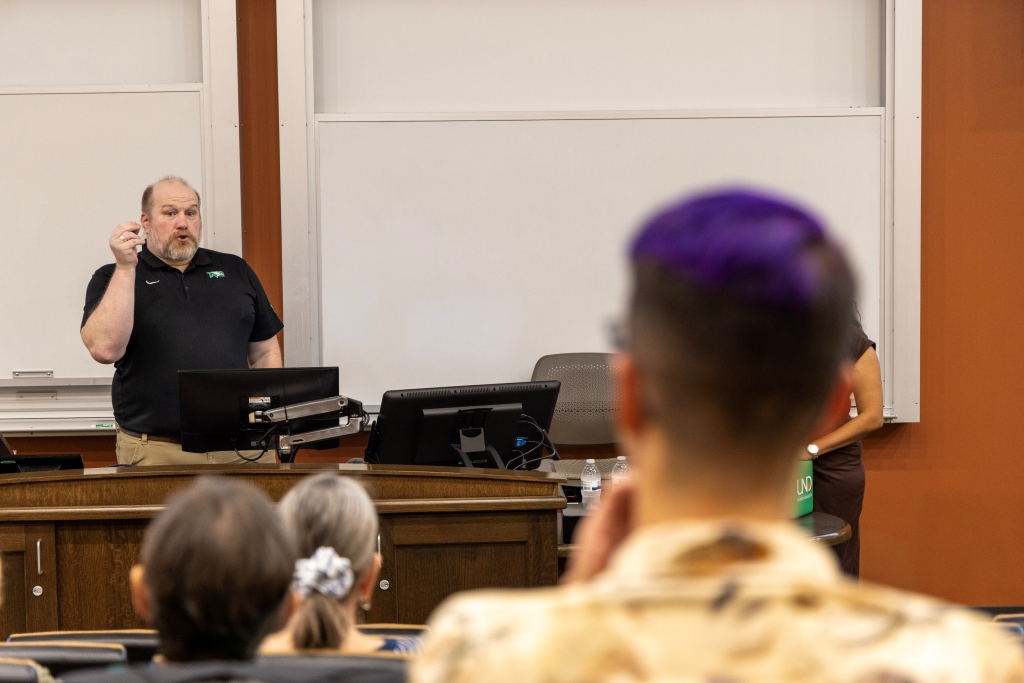
Off the marked trail
That willingness to question what comes next, which shaped Rhoades’ path, is part of what Witte hoped the series would reveal about faculty members.
“Even at this rank, we’re still asking questions and pondering what’s next,” Witte said.
For Rhoades, the path forward was rarely clear, but his willingness to keep moving has shaped not only his own journey but also the way others learn from him.
His connection with UND’s Space Studies program opened a new avenue for his biomechanics research and eventually helped lead to collaborations with NASA. Looking back, his advice was simple.
“Say yes and just kind of buckle in,” Rhoades said.
That has meant entering rooms where he was still learning, too. Rhoades recalled the anxiety of working with NASA researchers and realizing there was no one above him to check his work before NASA did. Rather than waiting until he knew everything, he learned along the way.
That approach has shaped more than his research. Before Rhoades took the stage for The Lecture, one of his doctoral students, Komal Mangle, described him as an educator grounded in patience, mutual respect, and someone who stayed beside her through moments of self-doubt.
Mangle focuses on kinesiology in the College of Education & Human Development’s Education, Health and Behavior Studies doctoral program. She also served as president of the CEHD Student Council during its inaugural year in 2025-26.
“Through the moments I doubted myself and moments I didn’t even know what I was building,” she said. “He did not just guide my research, but also helped shape the person I am.”
Rhoades brings that same willingness to figure things out together into his work with students.
“There’s nothing that we do that is too difficult,” Rhoades said. “We’re going to work through it and teach them how to do it.”
As his research has grown, students have grown alongside it, contributing to projects, collecting data and publishing research with him. Their work has reached NASA’s Johnson Space Center, where Rhoades and his students have studied human movement in reduced gravity and how spacesuits affect an astronaut’s range of motion.
Students also contributed to research examining how people with lower-limb amputations could safely enter and exit spacecraft as NASA explores the possibilities of para-astronaut spaceflight.
For Rhoades, their involvement goes beyond assisting with his work.
“My students that work there are partners,” Rhoades said. “They aren’t resources.”
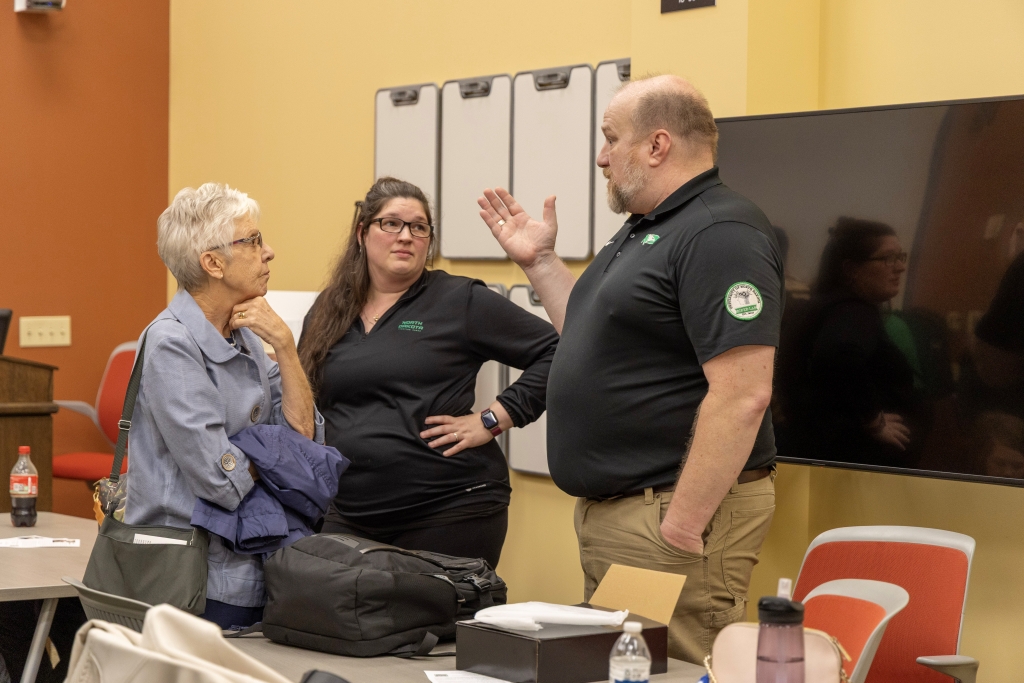
New terrain
Most recently, their work has turned toward the moon. Rhoades and his students began studying how the lunar surface’s extreme cold can change the rigidity of an astronaut’s boot and what that means for the way the foot moves inside it.
Understanding how a foot moves inside a lunar boot has drawn on expertise across UND, including kinesiology, physical therapy, occupational therapy, aerospace and space studies. Those partnerships have helped Rhoades’ research move from studying how the body responds to spaceflight toward designing solutions to the problems researchers uncover.
In the case of the lunar boot, Rhoades and his collaborators are examining how changes to its design could preserve natural foot movement while protecting astronauts from the extreme environment outside. The work also reflects the importance Rhoades places on learning from people with expertise different from his own.
For Witte, those connections are part of what can be missed when faculty members are known only by their titles, departments or individual accomplishments. Creating The Lecture offers a way to bring more of those discoveries beyond a dossier and into the community.
Witte said she hopes those who attend The Lecture leave having learned something new while also seeing something of themselves in the paths faculty members share.
“Either they see themselves reflected in the faculty we’re honoring or see a window to a world they didn’t know existed and didn’t know was possible for themselves,” Witte said.