Retired wind turbine blades find second life at UND
Great River Energy donation gives UND students hands-on opportunity to tackle a growing challenge in wind energy recycling
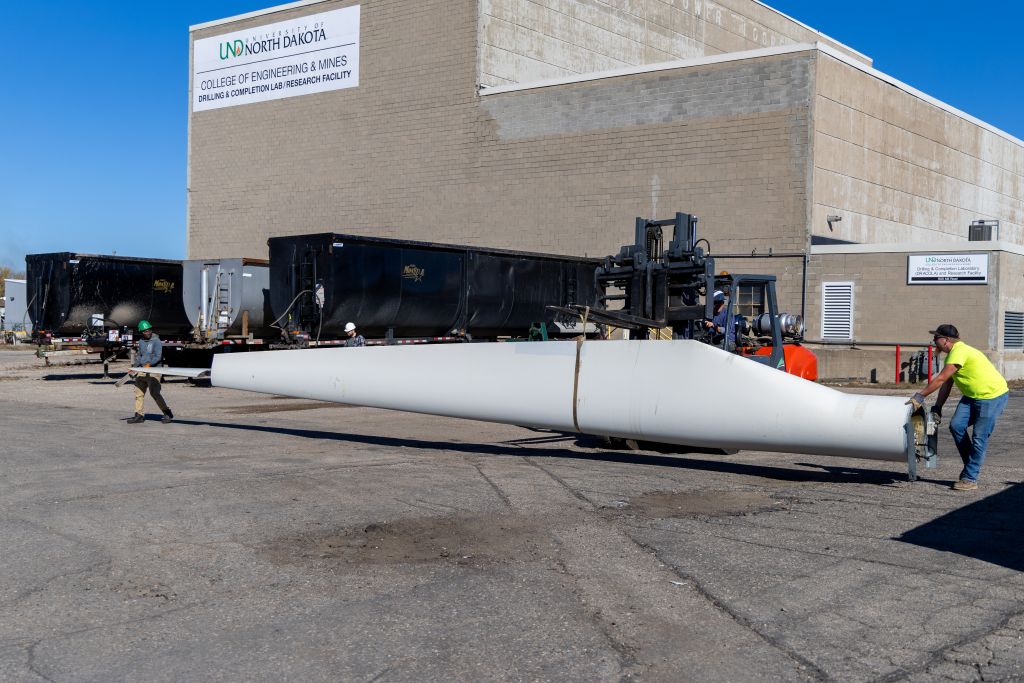
For nearly two decades, a wind turbine outside Great River Energy’s headquarters in Maple Grove, Minnesota, served as a local landmark and a symbol of renewable energy. Now, three of its blades have a new purpose at the University of North Dakota.
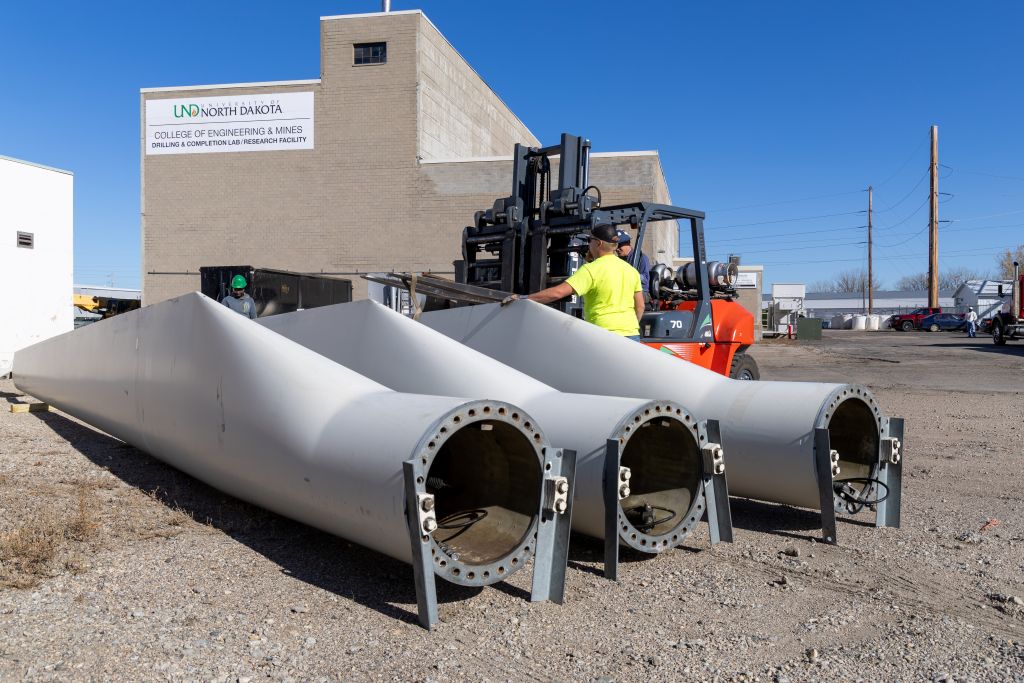
Rather than dispose of the blades after retiring the turbine, Great River Energy (GRE) donated them to UND’s College of Engineering & Mines, where students and researchers will use them to study how wind turbine blades deteriorate over time and explore methods for recycling their materials.
“Instead of it just being taken down and thrown away, it’ll go on to support the research of emerging engineers,” said Chris Campbell, manager of facilities services at GRE.
Hands-on research, close to home
For Surojit Gupta, professor of mechanical engineering, the donation provides an invaluable resource for research aimed at addressing a growing challenge for the wind energy industry: what to do with turbine blades once they reach the end of their useful lives.
Because the blades are made from durable composite materials that are difficult to separate and reuse, many retired blades end up in landfills.
Gupta is leading a $3.7 million research project announced in 2024 to investigate methods of recovering and repurposing those materials. With three full-size blades now on campus, researchers can examine the damage they’ve sustained over decades of operation.
Using techniques such as ultrasonic testing and infrared-based analysis, students will investigate defects in the blades and work to better understand how those defects develop. The findings could help inform improvements in blade design and recycling methods.
“We already have a group of senior design students who are all excited to start working on it,” Gupta said.
The research team also is exploring methods to recover the fibers and polymers that make up the blades, potentially allowing those materials to be reused in products such as automobiles and boats. Another avenue involves processing blade materials for use in 3D printing.
Before the donation, Gupta and his team had been planning visits to sites with retired wind turbine blades to conduct their research. Now, with three blades on campus, undergraduate and graduate students will have the opportunity to examine them firsthand without leaving UND.
Gupta said the donation will help train “a huge ecosystem of students” in diagnostic testing and recycling operations.
From local landmark to the lab
The donated blades came from a 200-kilowatt turbine with a history spanning more than three decades.
Originally put into service in the Netherlands in 1994, the turbine was refurbished and purchased by Great River Energy in 2007. It operated at the cooperative’s Maple Grove headquarters until the end of 2025, when it was retired to make way for a modern 100-kilowatt turbine.
As GRE considered what to do with the old equipment, its existing ties to UND helped connect the cooperative with Gupta’s research. The partnership offered an opportunity to keep the blades useful while supporting the next generation of engineers.
The donation builds on longstanding ties between GRE and UND. David Saggau, GRE’s president and CEO, earned both his undergraduate and law degrees from UND, and the cooperative has supported the University through engineering scholarships, contributions to campus facilities and partnerships in energy research.
For GRE, the research also addresses a question the cooperative frequently hears from the public.
“Turbine recycling is one of the things that we hear about the most from the public when it comes to wind energy,” Campbell said.
Gupta and his students will begin by examining the blades and documenting defects before eventually moving into recycling experiments. The research could help identify practical ways to recover valuable materials from retired blades, turning a difficult waste problem into a source of reusable resources.
For Campbell, the donation adds another chapter to the turbine’s story. He said GRE is proud to see equipment it no longer uses benefit “the next generation of young engineers” and find “a second life or a second purpose.”