UND law alum joins U.S. Court of Appeals in on-campus ceremony
Friends, family members and colleagues praise Judge Dan Traynor’s (’97) legal acumen and commitment to service
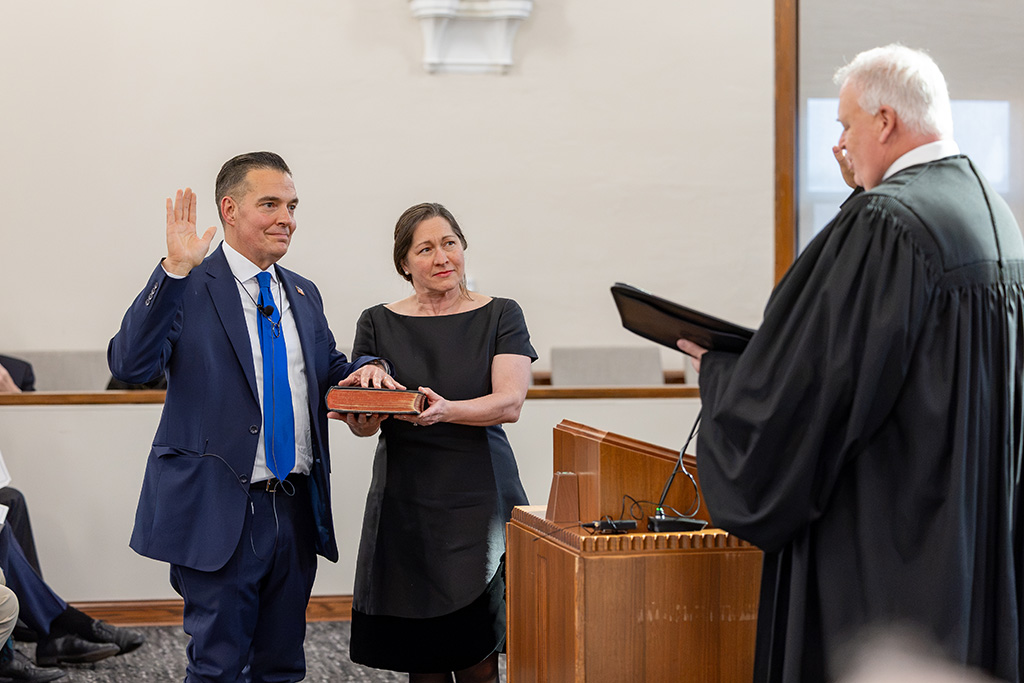
Last week, a prominent UND alumnus officially took his place as a United States appellate justice.
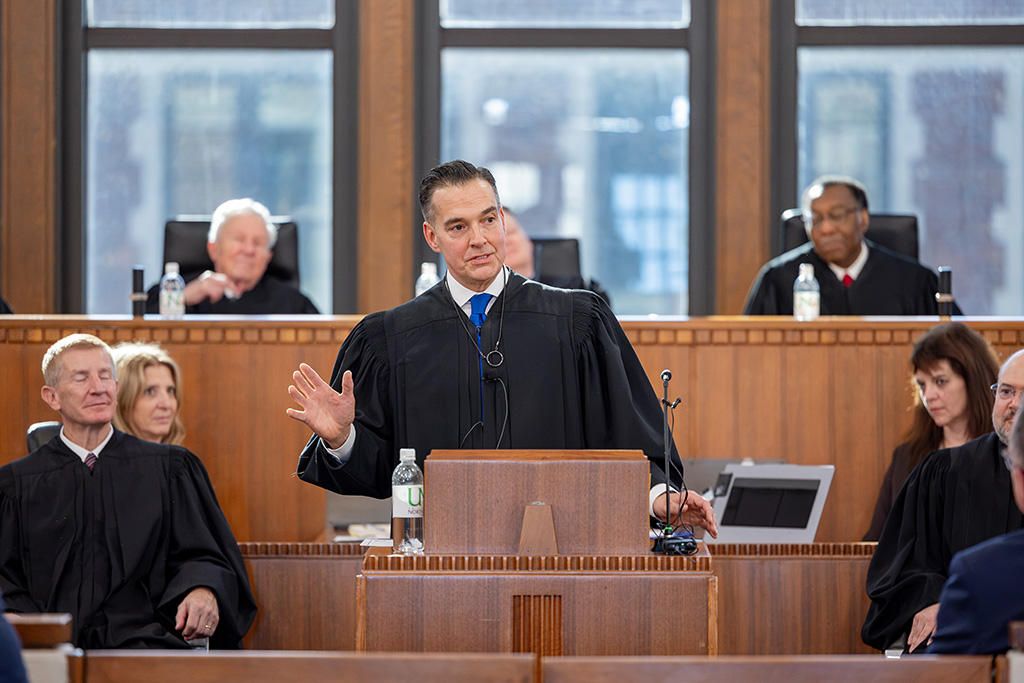
On Thursday, Oct. 29, Judge Daniel Traynor was sworn in as the newest member of the United States Court of Appeals for the Eighth Circuit – during a special session of the Court held at the University’s School of Law’s VandeWalle Courtroom. The Eighth Circuit is one of 12 federal circuit courts and has jurisdiction over cases in North Dakota, South Dakota, Minnesota, Iowa, Nebraska, Missouri and Arkansas.
Traynor is filling the seat of fellow UND Law alumnus Judge Ralph R. Erickson, who is retiring from the Court.
From 2020 to 2026, Traynor served as a justice of the United States District Court for the District of North Dakota. Before serving on the federal bench, he practiced insurance law and business litigation in his native Devils Lake.
“It’s a privilege to welcome you to the University of North Dakota, and to UND law, as we gather to recognize Judge Traynor and his entire family on this momentous occasion,” said Del Crandall, dean of the Law School, during his welcoming remarks.
Lisa McEvers, chief justice of the North Dakota Supreme Court, was among several of Traynor’s high-profile classmates in attendance – including Peter Welte, chief judge of the United States District Court of North Dakota and Tony Weiler, executive director of the State Bar Association of North Dakota. A former colleague of Traynor, McEvers spoke highly of his generosity, legal wit and work ethic, traits she said “epitomized our class of 1997.”
“Despite his youth, it was Judge Traynor showing me the ropes around the State Capitol,” McEvers said. “Teaching me about the Legislature, who the movers and shakers were and the political landscape of this state. Rather than keep this information to himself, he was generous with his knowledge to those around him.”
Weiler, who was Traynor’s fraternity brother at Phi Delta Theta, said Traynor’s leadership skills were already on display as the chapter’s president.
“He had the ability to listen to both sides of an issue, and his responses were also very measured,” Weiler said. “He always strived to do the right thing.”
After taking the oath of office, administered by Erickson, Traynor donned his new judge’s robes and reflected on his personal and legal journey. He began by recognizing his former boss, Judge Gerald VandeWalle, who served 36 years on the North Dakota Supreme Court, including 21 years as its chief justice.
“Thirty years ago, I was his law clerk, and today he’s watching me become a member of the Eighth Circuit,” Traynor said.
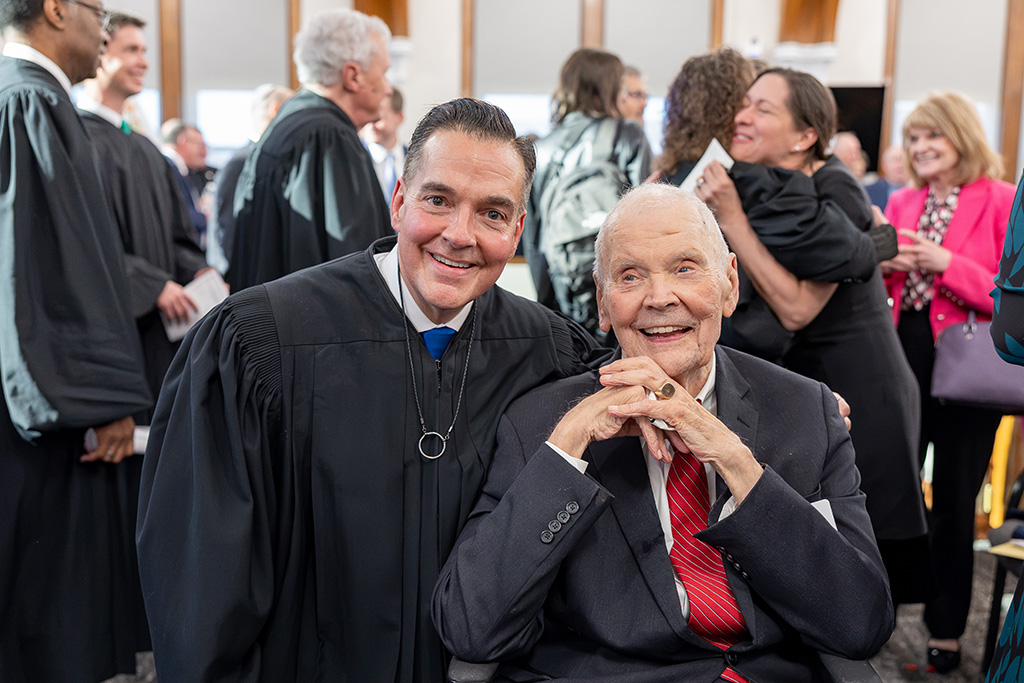
Traynor cited extensive family ties to UND’s Law School as his reason for hosting the investiture ceremony on campus, rather than at a federal courthouse as is customary for federal judges. He is the fifth member of his family to graduate from the school, joining his grandfather Mack, father Jack, and brothers Tom and Paul – the latter of whom is a current law professor – as alumni.
Traynor added that his investiture represents a make-up ceremony of sorts. The Red River Flood of 1997 and the COVID-19 pandemic cancelled his law school graduation and his investiture ceremony upon being appointed as a district court judge, respectively.
“Despite not having a graduation, the class of ’97 has done pretty well,” he joked.
Traynor also stated that he wanted to hold his investiture at UND to recognize the Law School’s role in serving the state – particularly in rural areas where residents often lack access to legal services.
“This law school, and the 15 law schools within the eighth circuit, are educating the next generation of prosecutors, defense attorneys and judges,” he said. “I’m grateful it has increased its enrollment – we need more lawyers. Throughout rural America and within our tribal nations, there are legal deserts.”
Traynor concluded his remarks by stressing the need for empathetic and nuanced attorneys in an era of rapidly innovating artificial intelligence.
“Machines cannot appreciate the sincerity of an allocution of a defendant at their sentencing hearing,” he said. “Or the body language of a witness during a trial. They also cannot replace, in my view, the most important lawyerly function of being a counsellor. To understand the human person who has been charged with a crime, has been injured or whose rights have been violated. Machines do not have empathy.”