Boozhoo (Hello)! UND students hone their Ojibwe skills
Weekly language table supplements University’s existing Ojibwe curriculum
Editor’s note: In the UND LEADS Strategic Plan, the Affinity core value calls on UND to “embrace environments where people from unique cultures and backgrounds can interact, be valued and know they belong.”
With that in mind, and in honor of November as Native American Heritage Month, this story calls attention to a weekly event that is meant to help “people from unique cultures and backgrounds” interact.
* * *
Thanks to the help of a UND professor, students studying Ojibwe now can practice their language skills in a conversational format.
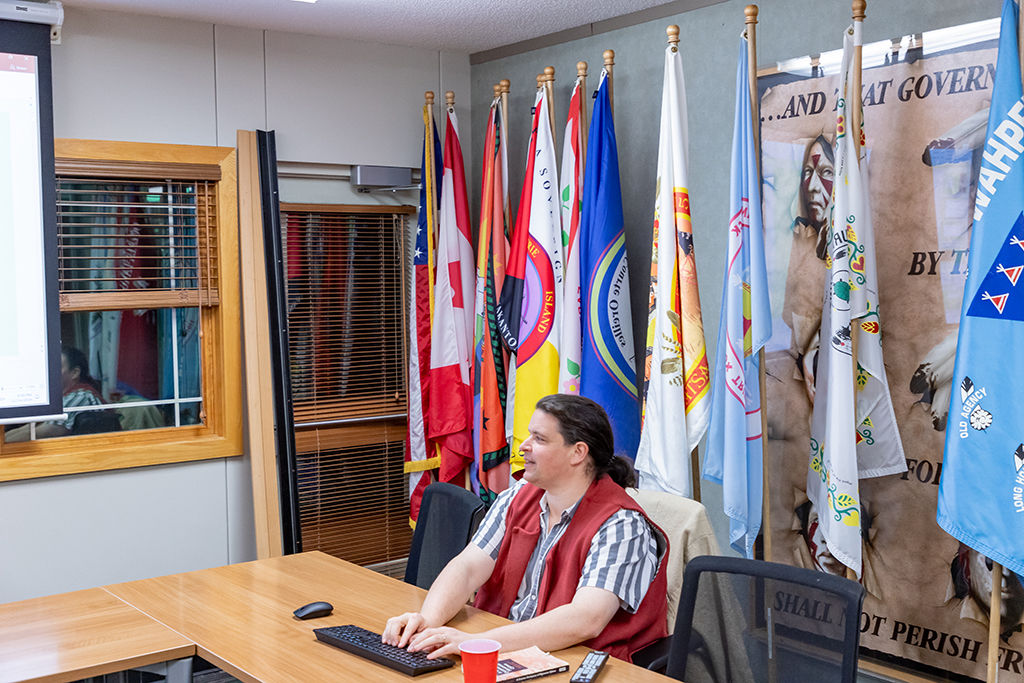
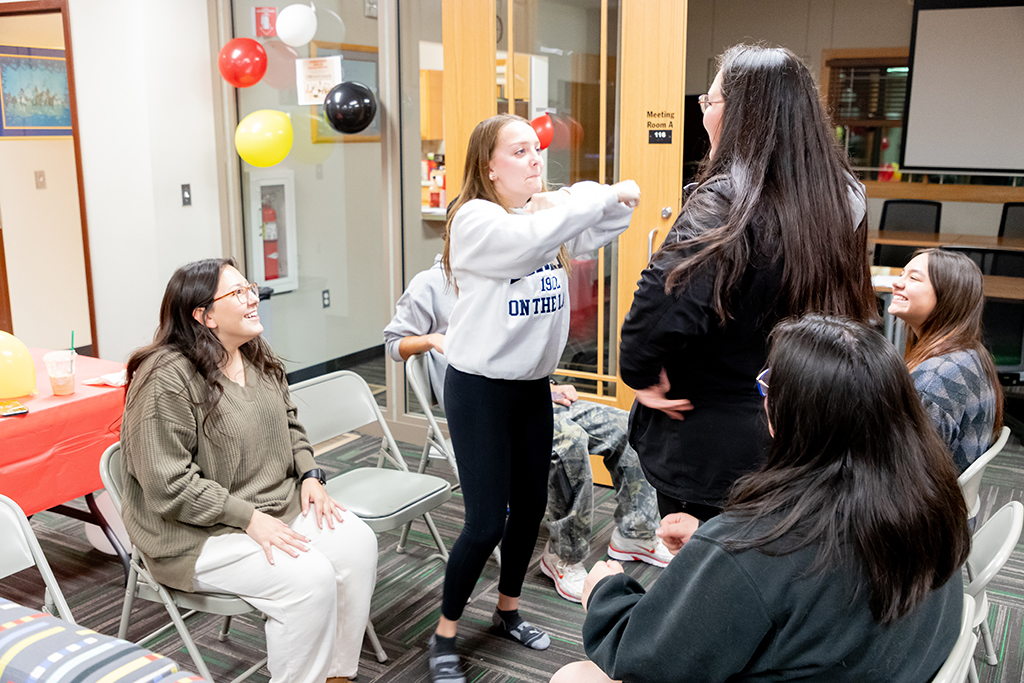
Every Thursday night during the academic year, Jeremy Kingsbury, teaching assistant professor of History & American Indian Studies, hosts an Ojibwe language table or discussion.
The language table is designed to supplement UND’s Ojibwe curriculum, which currently offers students two courses: Ojibwe language I and II, or IS 232 and IS 235, respectively. The former is offered in even years, while the latter is available upon student demand, and can be taken in any sequence.
Kingsbury — who is not affiliated with any tribal nations — is an adept scholar of both Ojibwe language and culture, earning a Bachelor of Arts in American Indian Studies and Ojibwe Language from Bemidji State University. He then went on to earn a doctorate in history from the University of Iowa in 2022.
A native of Milwaukee, Wis., Kingsbury first took Ojibwe courses at the urging of his friends, taught by “one of the big names in Ojibwe in the States” at the University of Wisconsin-Milwaukee.
“I was bad at Spanish, and I had some friends who had taken the Ojibwe night class,” he said. “I was more than a little bit brainwashed — they kept bringing in elders to influence me.”
Ojibwe is verb-based, with four different types of verbs used based on “who or what is doing the action, and if it is acting on anything or anyone else,” Kingsbury said. Although he conceded that this can overwhelm new students at first, Kingsbury added that “the way verb groups are conjugated with prefixes and suffixes is very consistent and predictable.”
“For beginners, learning verbs is the best way to gain meaningful understanding of the language,” he said.
Ojibwe’s dialect also varies by region. Recently, Kingsbury said, there has been an east-west divide in how the language is spoken. Speakers in Michigan and Ontario, for example, are prone to dropping syllables.
“It’s sort of weird, because it seems like it’s only the last 80 years or so that this has happened,” he said. “It seems to be a product of reservations and reserves.”
Ethan Johnson, a senior studying Biology and a member of the Turtle Mountain Band of Chippewa, said he chose to study the language to connect with family members.
“Up until Ojibwe was offered, I was kind of just learning on my own,” he said. “It’s been nice having people to speak it with. If I learn it here, I can bring it back to my family.”
Leon Kuchlein, majoring in Aviation Safety & Operations and minoring in Global Studies, decided to enroll in Ojibwe to fulfill an elective requirement. A linguist who is fluent in English and Japanese, Kuchlein enjoys the unique challenge of learning Ojibwe.
“I thought, ‘I have no idea what that’s going to be like; let’s take it,’” he said. “This is the hardest language I’ve ever studied, but it’s fun. I also feel like it’s good to learn a little bit about the language if you’re going to live here.”
Kingsbury concurred. “If you’re going to live in Ojibwe country, it’s pretty cool to understand the language,” he said.
The language table meets at the Indigenous Student Center at 6:30 p.m. most Thursday nights. Those interested in attending should email Kingsbury at jeremy.kingsbury@und.edu, or check the Student Center’s Facebook page to confirm that it is being held.
Back by demand, Kingsbury also will be offering Ojibwe II in the spring semester. The class will meet rom 11:15 a.m. to 12:05 p.m. Mondays, Wednesdays and Fridays.
>> Do you have questions or comments about the UND LEADS Strategic Plan? Your thoughts are welcome! Please contact Mike Wozniak, coordinator of Leadership & Programming, and/or Ryan Zerr, associate vice president for Strategy & Implementation, the co-chairs of the UND LEADS Implementation Committee. You also may offer your thoughts by visiting the UND LEADS Strategic Plan home page and clicking on the “Provide your feedback” link. Thank you for your support of the UND LEADS Strategic Plan!