Prisoner reentry: Why doing hard time can lead to harder times
Simulation exercise opens eyes to tough challenges people must navigate to dodge the downward spiral that could land them back in prison

For the nearly 450,000 people released from state and federal prisons each year, there’s no such thing as a Get Out of Jail Free card.
That was the message heard loud and clear by the few dozen community members taking part in December’s “Prisoner Reentry Simulation” inside the UND Memorial Union’s Henry Family Ballroom.
The three-part immersive experience that explored the many challenges formerly incarcerated people face when trying to reintegrate into society was just one of many presentations prepared by students in the College of Arts & Sciences’ Undergraduate Showcase.
In all, more than 60 projects were represented in the showcase meant to give students the chance to highlight and celebrate their research and creative activity without the pressure of competition.
So why is prisoner reentry important?
With an estimated 95% of the nation’s 1.2 million incarcerated population expected to be released at some time, Meghan Mitchell, assistant professor of Criminal Justice Studies, says understanding and mitigating the obstacles to successful prisoner reentry is more important than ever.
After four decades of booming mass incarceration — fueled by America’s tough-on-crime policies, violence and harsher drug laws — Mitchell says the nation now is experiencing what some scholars call a “de-carceration era” as more and more formerly incarcerated people are coming back to our communities.
“Thinking about it from a purely business model, the more successful they are in reentering society, the less money we as taxpayers are going to spend on apprehending them and locking them up,” Mitchell said. “But we also have to ask ourselves what kind of citizens do we want them to be. They’re going to become our neighbors and our colleagues, so what responsibility do we have in helping them successfully reintegrate?”
Law-abiding people may have strong philosophical differences on what purpose and to what extent our prisons should serve — to punish, to rehabilitate, or some degree of both — but the only thing that’s really certain, Mitchell stressed, is that the system and results are complex.

Smooth transition easier said than done
“Granted, it’s a small population of people, but some will say being in prison is kind of a cake walk. ‘It’s easy, right?’” she said. “Someone tells you what to do and where to be at all points in time. You don’t have to worry about where you’re going to get your food or who’s going to cook your meals. There’s very little autonomy in prison.
“But what people don’t always realize is just how scary and challenging it can be to get dropped back into our fast-paced and constantly changing society after you’ve spent some time separated from it. When a person goes to prison, they’re essentially plucked out of their community, their family, their job and everything they once had. After they’ve served their time and get released, they often don’t have the supports they need to succeed, yet they have some pretty stringent requirements placed on them.”

The barriers to prisoner reentry
That road to redemption is full of pitfalls and what can seem like impossible odds.
Almost immediately, they’re faced with high stakes and high stress. They need to meet with their parole officer. They may need to get a birth certificate to secure a proper ID. They need to find housing. They need to get a job. They need to buy groceries. And they need to stay clean.

The endless challenges are guaranteed, but the handy resources are not.
Further, their ability to right the ship is hindered by other personal circumstances, Mitchell added. National statistics, for example, show that the average education level of the prison population is eighth grade, and the reading level often is fifth grade or even lower. Plus, many have co-occurring mental health and substance use issues. Then, there’s the unpopular social stigma that exists on top of everything else.
“It all works to create a perfect storm of multifaceted events that can make their transition extremely difficult,” Mitchell said. “No matter how well they adapted in prison or how much they were rehabilitated, the fact is that the continuity of care just isn’t great in our justice system.
“We have to ask ourselves at what point is your punishment fulfilled, at what point have you served your debt to society and at what point should we stop punishing you and help you reintegrate so you can begin to live out a life free of all of these added barriers to success.”
The reality of high stakes and high stress
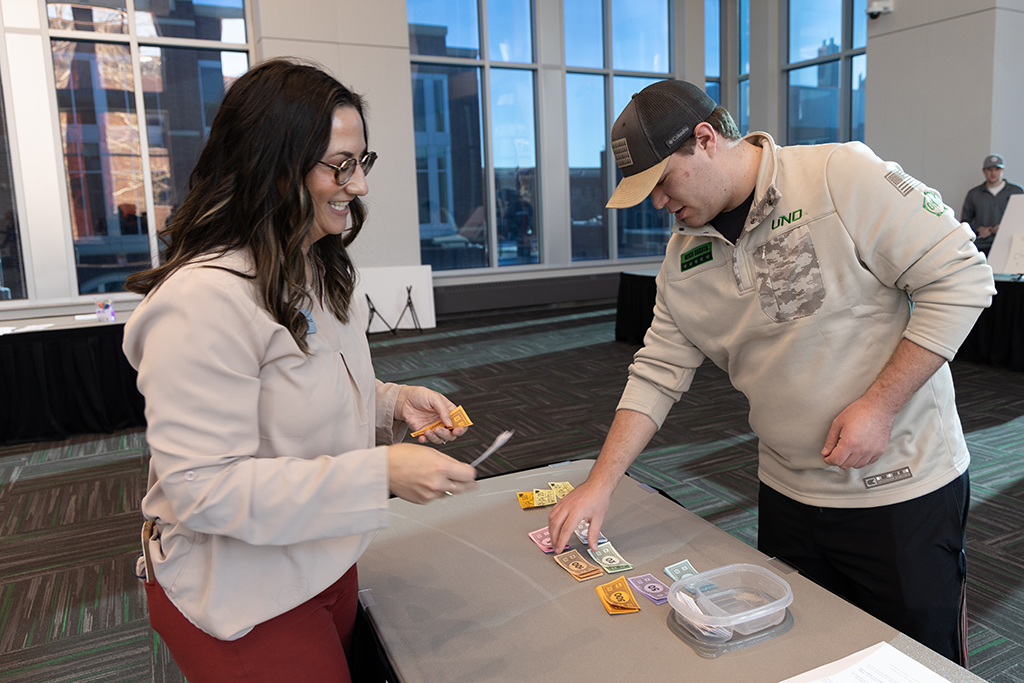
In three 20-minute rounds — each 10-minute interval representing one week of parole — the 36 students enrolled in Mitchell’s “Introduction to Corrections” course, set out to create reentry simulations that would feel as real as possible.
In fact, the blind participants who drew “life cards” to assume the personas of imaginary people who just had been released in a city with as many as 10 resource centers — all critical to their reentry success — said they felt real anxiety as they attempted to negotiate all the twists and turns of their individual parole requirements.
“I felt very clueless about what I was supposed to do and the order in which I was supposed to do it,” said Psychology major Jordan Nichols. “I didn’t know where to start. I tried to get a job but didn’t have my birth certificate or ID, so I really had to backtrack. That lack of guidance has to be one of the biggest obstacles for formerly incarcerated people. They just need help to get their feet under them.”
Consequences around every corner
Pick the wrong popsicle stick, and you test positive for drugs and get sent to the Treatment Center. Fail to meet a Job Service task — in one scenario, it’s an impossible Jenga feat — and you risk losing your job. Pay too many fines, and you might not be able to eat or make your Halfway House rent.
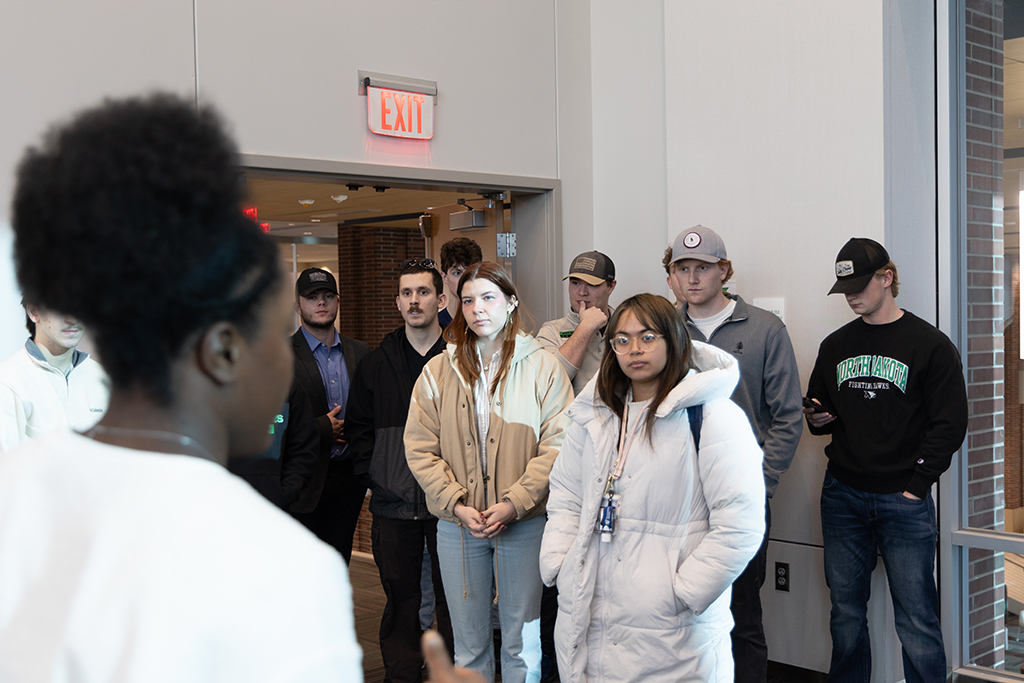
In her introductory instructions, Criminal Justice Studies sophomore Alimath Salou explained to the simulation participants that North Dakota is one of only two states that does not guarantee prisoners gate money to assist their reintegration. Salou would be more generous, but the $100 she put in the participants’ pockets would give them no comfort.
“The most difficult thing is just understanding what to do. Where do I start? Everybody is confused, and I think that’s how it must feel in the real world,” Salou said. “If you don’t have a good support system to show you the way, then everything is going to be more difficult. It feels like you’re being thrown into a pool of sharks.”
Madison Lyman, a sophomore and double-major in Criminal Justice Studies and Psychology, had a similar take.
“I think society kind of works against people who are trying to leave behind a criminal lifestyle,” she said. “They just don’t get a lot of breaks.”
Lyman, who also was the mastermind behind the Job Service’s impossible Jenga task, said she felt guilty about not hiring people.
“I wanted to give everyone a job, but in the real world, you have a 40% chance of not being hired just because of your felony record,” she said. “That was hard for me, but it’s just how it works. I was trying to reflect reality.”
Looking to the future of reentry programs
Duly noted. That’s exactly what Mitchell said she wanted her students to emulate with their reentry simulation exercise.
“We wanted to re-create some of those barriers so people could see how sometimes intentional and unintentional circumstances can drastically derail a person’s ability to succeed upon returning to society,” Mitchell said. “I also wanted the students and others to understand the impact of interagency collaboration. That’s something that often doesn’t exist, but agencies serving justice system populations have to work very collectively.
And, hopefully, this was also a good experience for learning the importance of empathy. Not everyone has equal opportunities for successful reentry. We have to critically examine the gaps as we try to move toward better continuity of care.”
>> Do you want to read more UND Today stories? Just hit the link or go to our home page to subscribe to our twice-weekly newsletter.