18:83 lecture: Everyday leadership from teachers
In pop-culture and real-world classrooms alike, life lessons from teachers go far beyond algebra, Dean Shelbie Witte says
What do Yoda, Minerva McGonagall from the “Harry Potter” series and Dewey Finn from “School of Rock” have in common?
First, they’re all teachers, although Yoda was not much for classrooms and Dewey Finn barely had a license for driving, let alone teaching.
Second and more important, they’re all exceptional teachers in their way – dedicated mentors (Yoda), fierce protectors of their students (McGonagall) and masters of helping students find their true talents (Finn).
Moreover, they showcase these traits in ways that students, readers and viewers alike can relate to. This is not Captain America-style heroism or superpower on display, in other words.
This is everyday leadership – and teachers can show the rest of us the way.
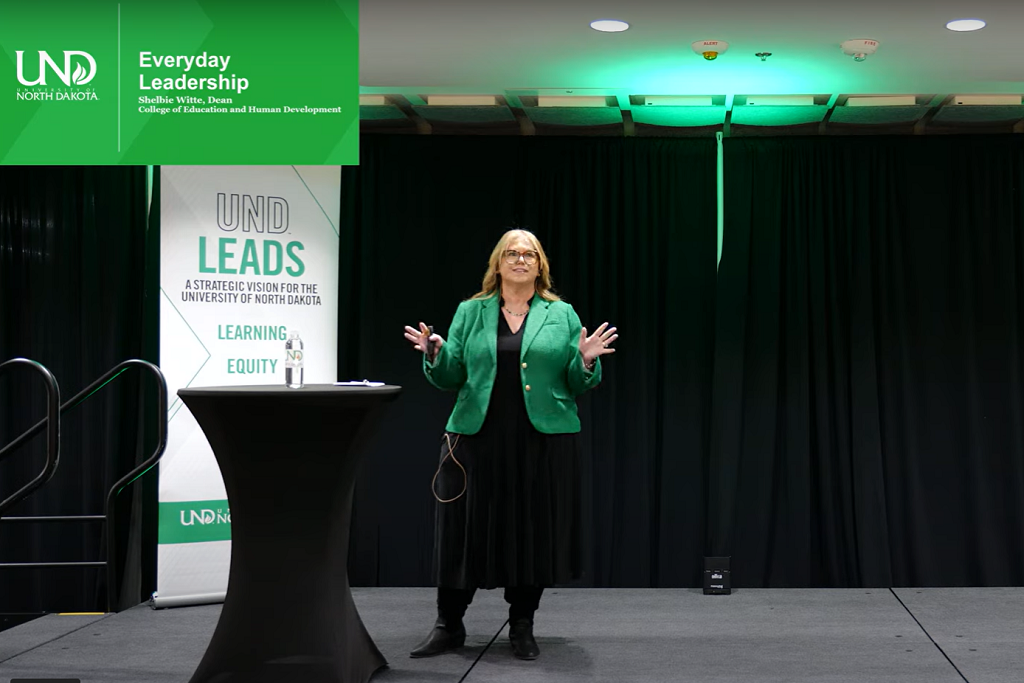
That was the theme of the recent talk by Shelbie Witte, dean of the UND College of Education & Human Development, as part of the 18:83 Speaker Series. The series invites campus and community leaders to the Memorial Union’s Social Stairs to outline their approach to leadership.
Speakers time their addresses to about 18 minutes and 83 seconds — a figure that corresponds to the University’s founding year.
“When I think about leadership, I think about CEOs, politicians, military officers, social activists and the like,” Witte said. “But today, I want to share with you what I know best, and that is the quiet, consistent, courageous leadership of teachers.”
Every day, “teachers model everyday leadership,” Witte noted. Witte herself became dean, she said, “because teachers believed in me, and they left the ladder down for me and others to find our way to the profession.”
In the same way, “everyone has a teacher memory,” she said – a glowing ember of gratitude for a key teacher or set of teachers along the way. And to highlight the traits of everyday leadership that bring about this effect, Witte turned to teachers from pop culture, to help listeners understand in an instant exactly the traits that she’s talking about.
‘I pledge allegiance … to the band!’
Which is where Dewey Finn comes in. The “School of Rock” lead character “was not prepared to be a teacher,” Witte said with a laugh. “Let’s just establish that right off the bat.
“But what he was a master of is discovering what made the hearts beat of his students – what made them click; what was their bliss.”
Everyday leadership, she said, “requires that we are able to leave something the way it used to be done, if the learners are disengaged or disinterested. We have to try new things; Finn made sure that the students in his classroom enjoyed the journey.
“And I think that’s something that’s often missing from everyday leadership: we forget about joy.”
In the “Harry Potter” series, Professor McGonagall is famously stern, but is also much respected by the students for always keeping their best interests at heart.
“She doesn’t raise her voice,” Witte said. “She’s super calm under pressure.” She leads with integrity, and “protects her students fiercely, and stands up for them even when it’s hard.
“This is the type of everyday leadership we often overlook,” she said.
‘Do, or do not. There is no try.’
As for Yoda, “his mentorship style is timeless,” Witte notes. “His many interactions with Jedi, especially Luke Skywalker, show that he gives them just enough guidance and just enough space to be in a thing we call ‘dissonance,’ where they’re trying to find their way and grapple with learning.”
You see, “everyday leadership isn’t always about giving orders,” Witte said. “It’s about investing in people and giving them just enough space to figure it out on their own. When Yoda says, ‘The greatest teacher, failure is,’ he is signaling one of everyday leadership’s greatest challenges: Often we must allow space for failure and the chance to try again.”
Then there is Mr. Miyagi from “The Karate Kid,” who “taught Daniel so much more than just karate,” Witte noted; Coach Boone from “Remember the Titans,” who “built unity among his players, and what started out as mandatory cooperation very quickly … became collaboration”; and even Ted Lasso from “Ted Lasso,” who “brought skeptical people together in a way that at the end, they were not just rooting for wins but rooting for each other.”
If you think back to these and other favorite teachers in your lives, you’ll realize that you, too, learned a lot more from them than whatever formulas or quotations they were presenting on the chalkboard.
“Today I’ve shared with you about integrity, professionalism, mentorship, support, advocacy, inclusion” and more, Witte noted in conclusion.
“Teachers are the very best example of everyday leadership. We don’t have to be world leaders to lead change in the world. … We need more teachers, but we absolutely need in the world more everyday leaders.
“And as Yoda would say, ‘Wait for permission, you must not; choose it, you must. Only when you believe, truly rise you will.’
“Thank you very much!”