UND conducts joint training event in collaboration with National Guard, Grand Forks AFB
Grand Forks’ UAS ecosystem ‘unlike any other in the world – where U.S. military drone dominance takes flight,’ says deputy commander of 119th Wing, North Dakota Air National Guard
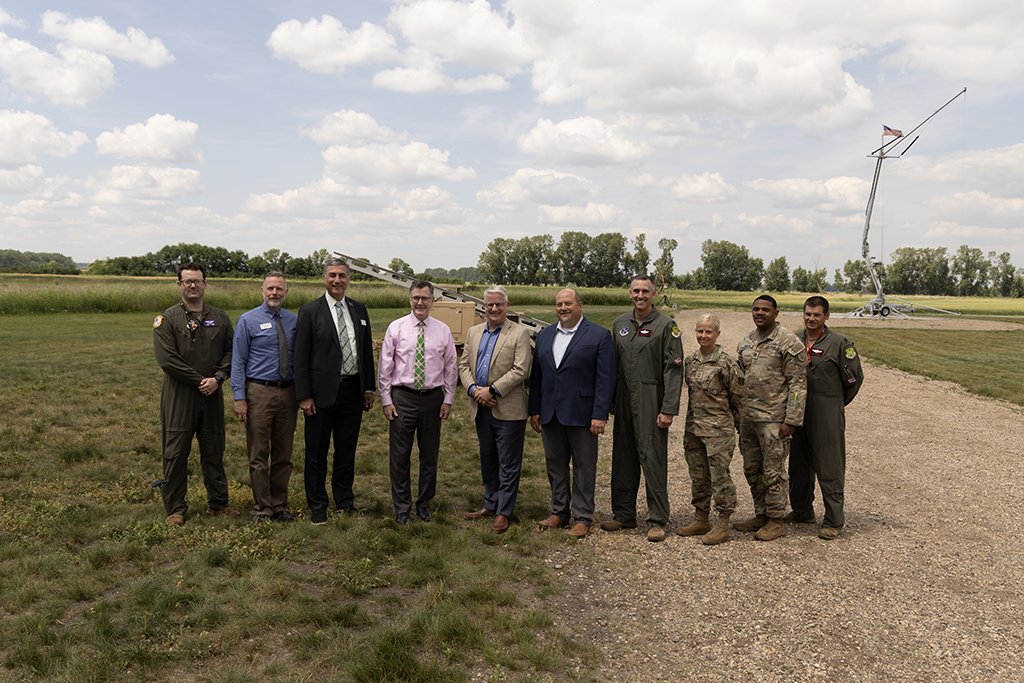
UND and local military leadership recently got a glimpse into training the University is conducting to accelerate the armed forces’ Counter Uncrewed Aerial Systems and Live, Virtual and Constructive (LVC) capabilities and readiness.
Partnering with the North Dakota Army and Air National Guard, and U.S. Air Force, UND hosted the experiment — the fifth in an ongoing series — in mid-July at Gorman Field UAS Test Range, a facility located just south of Grand Forks Air Force Base.
The series of experiments were established through a Memorandum of Understanding with the North Dakota Air and Army National Guard. Previous experiments were also held at Camp Grafton, an Army National Guard installation near Devils Lake, N.D.
The experiment involves simulating adversarial drone traffic, with UND operating multiple small UAS aircraft to encroach on Army Air Defense Artillery command posts. Simultaneously overseeing the operations from above are the UND-owned Boeing Insitu Scan Eagle aircraft operating beyond visual line of sight (BVLOS), 119th Wing operating General Atomics MQ-9 Reaper, and 319th Reconnaissance Wing and 410th Flight Squadron operating the Northrop Grumman RQ-4 Global Hawk flying overhead from Grand Forks Air Force Base. Operations were further supported by industry leaders onsite such as Detect Inc. and Vigilant Aerospace Systems.
Gorman Field is a venue well suited to host these experiments, said Paul Snyder, director of UND Aerospace’s UAS Operations program. Not only does Gorman UAS Airfield enable the experiment’s partners to conduct these joint training operations safely, but also has the integrated technology to create a common operating picture with multiple entities that can be ingested into an LVC environment for a more immersive training experience.
Col. Ryan Ayers, deputy commander of the Fargo-based 119th Wing of the North Dakota Air National Guard, praised the robustness of Grand Forks’ UAS ecosystem as an ideal proving ground. The level of collaboration between the private sector and defense communities, he noted, “contributes to continued innovation in the discipline.” “This is the type of collaboration, integration, and initiative Defense Secretary (Pete) Hegseth has directed us get after, and we are all-in on unleashing U.S. military drone dominance,” Ayers said.
“I can’t think of any other environment like this in the world,” he added. “We have the airspace, joint warfighter expertise, industry, and university partners all local and collaborating right here, learning from one another. Together, we’re all overcoming our individual organizational constraints, and creating opportunities where we can train like we fight, research, and experiment — simultaneously.”
Col. Alfred Rosales, commander of the 319th Reconnaissance Wing added, “harnessing the potential of unmanned systems is no longer a future aspiration, but a present-day necessity for maintaining our adaptability and dominance in the evolving landscape of modern warfare. This partnership with UND and our fellow North Dakota National Guard units is crucial to staying ahead of emerging threats and ensuring our continued readiness.”
Additionally, the ecosystem fosters education and workforce development– key aspects in an environment of rapidly evolving technology that UND is poised to meet.
“Watching these students and recent graduates collaborate with accomplished professionals is truly inspiring,” Snyder added. “They’re not just learning — they’re envisioning what’s possible. They are going to come up with the next big idea.”