Karen Nyberg lands on campus to launch Astronaut Scholarship Foundation partnership
UND graduate and retired NASA astronaut chronicles 20-year career in campus address
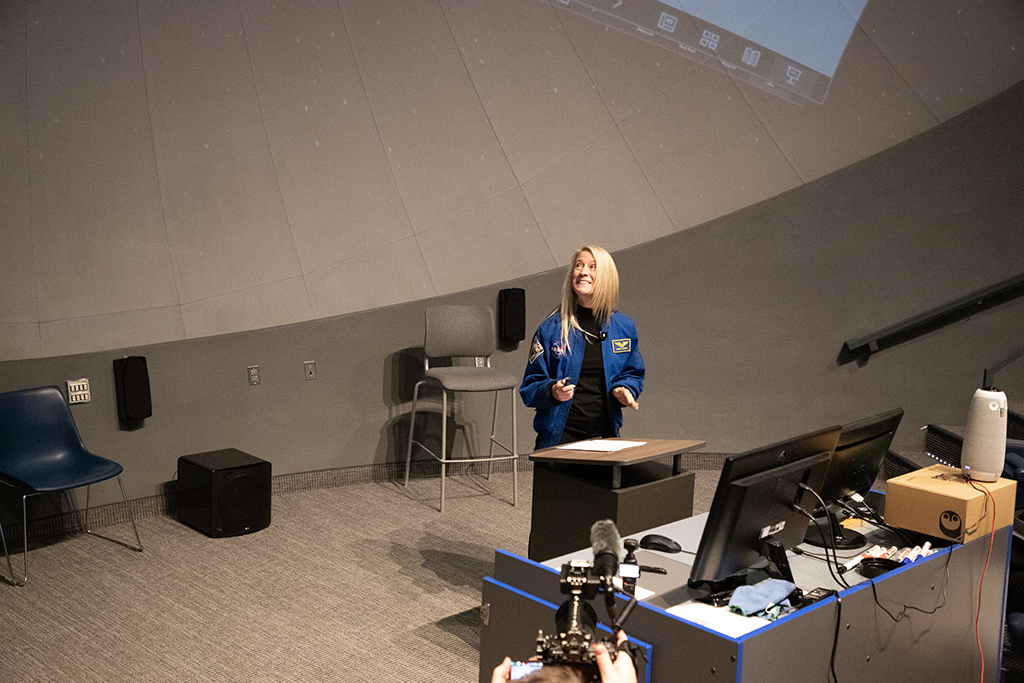
Earlier this week, UND welcomed back an alumna whom administrators called among the University’s most distinguished.
Karen Nyberg, a retired NASA astronaut who spent a total of 180 days in space conducting missions servicing the International Space Station (ISS), addressed students, faculty and staff at the Odegard Hall Atmospherium on Monday, Jan. 26. She chronicled her 20-year career with NASA, while also celebrating the launch of UND’s partnership with the Astronaut Scholarship Foundation (ASF).
The scholarship was established in 1984 by NASA’s Mercury Seven astronaut group – the first Americans to travel to space. It is awarded to approximately 70 rising juniors and seniors studying STEM subjects annually, representing 55 partner institutions nationwide. Additionally, the scholarship’s mentorship program provides awardees with invaluable networking opportunities to help launch their academic and professional careers.
Robin Turner, senior director of development for the College of Engineering & Mines at UND’s Alumni Association and Foundation, expressed excitement at the opportunities such a partnership affords UND students.
“This partnership marks an important milestone for UND,” she said. “This collaboration recognizes the excellence of our students and faculty and opens new doors for our talented undergraduates pursuing STEM degrees. It will directly empower the next generation of innovators, researchers and explorers right here at UND.”
“Essentially every student in the College of Engineering & Mines could benefit from this program,” added the college’s Dean Ryan Adams. “There are so many opportunities here. One thing I’ve learned over the past 25 years or so of my life, is that people in the space community love to share their knowledge.”
Provost Eric Link introduced Nyberg – who herself played a major role in establishing UND’s membership in the ASF.
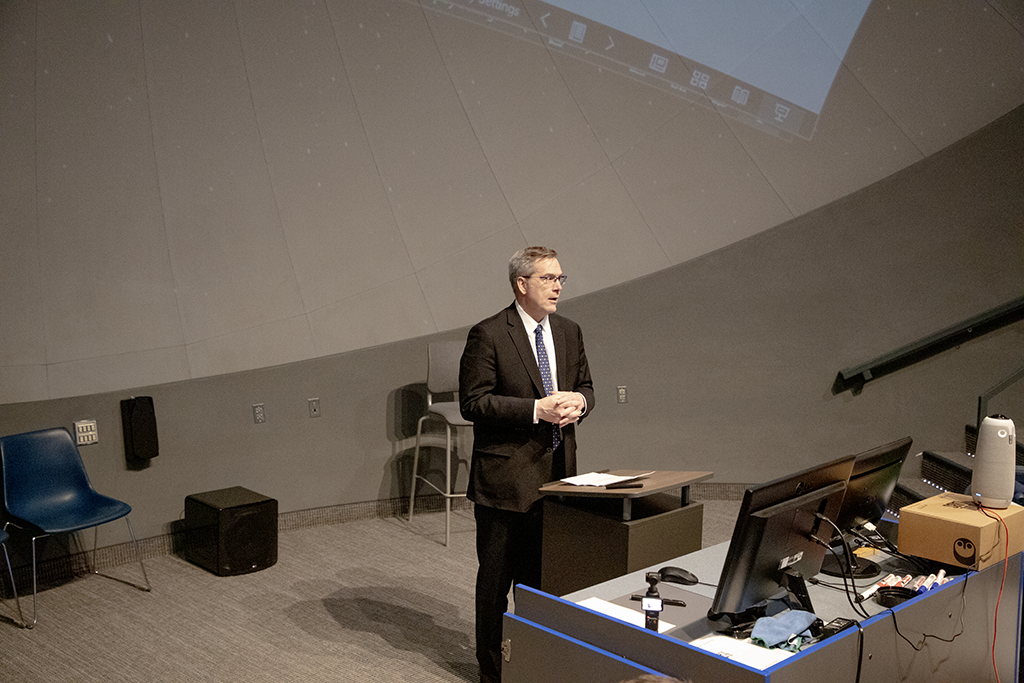
“We are incredibly grateful for Dr. Nyberg’s leadership and service within the Astronaut Scholarship Foundation,” he said. “Her commitment to supporting the next generation of leaders reflects both her remarkable career, and her enduring connection to our university.”
Nyberg earned a bachelor’s degree in mechanical engineering from UND in 1994, graduating with Summa Cum Laude honors. She then obtained master’s and doctorate degrees from the University of Texas at Austin in the same subject, before being selected as a NASA mission specialist in July 2000.
The period during which Nyberg joined NASA was one of strong momentum. According to Nyberg, the space shuttle program was routinely operating upwards of eight flights annually with a new mission – supporting the construction of the International Space Station.
“It was a very exciting time in the office,” she said. “We learned the Russian language and travelled to all the NASA sites around the U.S. As a new class, we were excited with the anticipation of ‘what our flights are going to be like? What are we going to be doing?’”
Then, on Saturday Feb. 1, 2003 – just a few months after Nyberg and her cohort graduated from candidate school and became fully-fledged astronauts – tragedy struck. The space shuttle Columbia disintegrated upon re-entering Earth’s atmosphere, killing all seven astronauts on board.
“This was a moment where you realize just how quickly things can change,” Nyberg said. “It was not only that we were grieving the loss of our good friends and colleagues, but this momentum and excitement came to a jolting halt.”
Nyberg praised NASA’s resolve, and by 2005, the space shuttle returned to flight – albeit with a timeline for decommissioning once the ISS was complete. Eight years after joining NASA, Nyberg finally got her opportunity to fly on the space shuttle Discovery — delivering the Japanese Experiment Module or Kibō — to the ISS.
Nyberg reminisced about the first time seeing Earth from space shortly after leaving orbit.
“When we opened the payload doors and I got my first look at the Earth — the broad limb of the Earth — I have never seen anything so vibrant in my entire life,” she said. “It was so overwhelming and beautiful.”
“It changes a person,” she added. “I gained so much more respect for the Earth. When you compare that to the vastness of space where there is nothing for millions of miles, everyone on Earth is your neighbor. It certainly increased my empathy for the people I don’t know on all corners of the Earth.
Nyberg returned to space in 2013 aboard a Russian Soyuz spacecraft, staying at the ISS for 166 days.
Nyberg, who also met her husband — former astronaut Doug Hurley — during her time at NASA, said her career exposed her to a truly international team.
“The International Space Station really is the example of working together,” she said. “No matter what the politics were on Earth, we collaborated and cooperated.”