From Newton to iPhones: How collaboration works
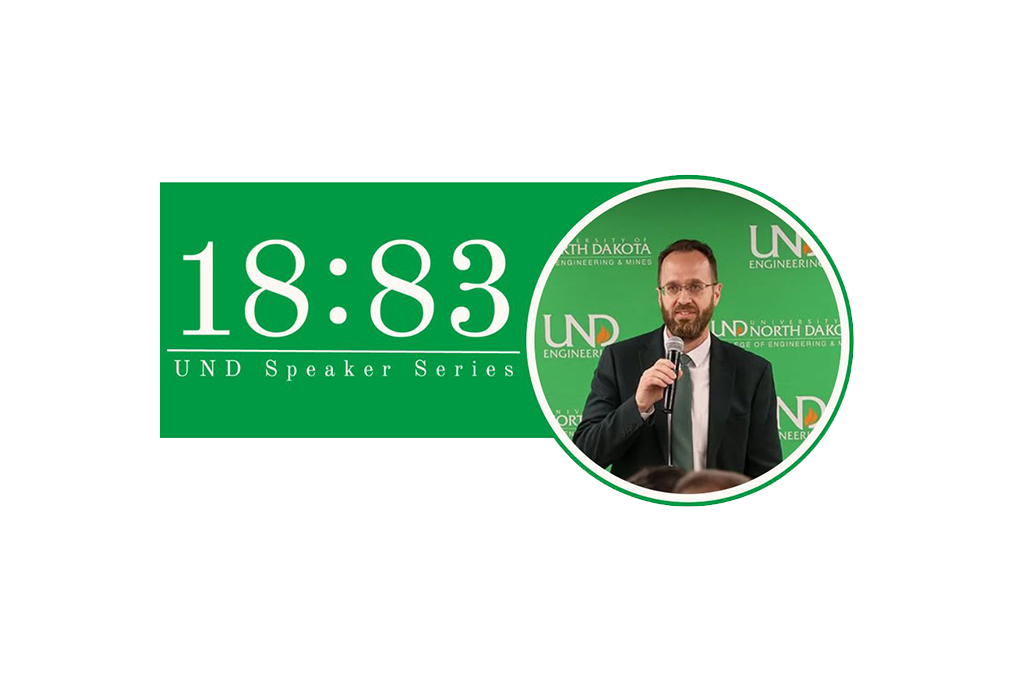
Ryan Adams, dean of the College of Engineering & Mines, shares the essence of collaboration and innovation in latest 18:83 talk
Editor’s note: A recording of Dean Adams’ speech will be linked to by this story as soon a link is publicly available.
####
Imagine a problem — something major and long term that affects the world — and think: can it be solved by a single discipline?
Ryan Adams, dean of the College of Engineering & Mines, opened with a simple answer: no.
For his time on stage at the 18:83 Speaker Series, Adams spoke about the necessity of multidisciplinary collaboration in not only enhancing educational outcomes at places such as UND, but in solving today’s and tomorrow’s problems.
Each semester, the University invites leaders and executives from both UND and the local community to speak at the Memorial Union for about 18 minutes and 83 seconds, a number coinciding with the University’s founding year.
To kick off the spring-semester lineup, Adams pulled real-world examples to define and characterize collaboration and its impact globally.
Adams first addressed a common form of mythmaking in popular culture: the lone genius.
Albert Einstein developed the tenets of the Theory of Relativity while working in a Swiss patent office. James Clerk Maxwell lived in the countryside writing the equations of electromagnetism that changed the course of technological development. And the work of Isaac Newton, perhaps most famous of all, is credited for the creation of calculus and fundamental theories of physics.
Though the romanticization of such figures continues to inspire bright minds and evoke pride in human progress, it often doesn’t reflect reality, Adams said.
“Albert Einstein famously worked with everyone he could throughout his life,” Adams remarked. “Even during his time in the Swiss patent office, he was a Ph.D. student working for a Ph.D. advisor with academic colleagues the entire time. Maxwell built those equations on the shoulders of scientists such as Faraday, Ampere, Gauss and others…
“Newton was a faculty member in England and had all kinds of students, colleagues and others that he bounced ideas off that eventually led to his discoveries. None of them acted in isolation; all of them contributed to the future through collaboration.”
Teamwork makes the iPhone dream work
Adams further focused on the nature of collaboration and innovation by talking about what are now ubiquitous products, such as microwaves and the Apple iPhone.
In the case of the microwave, though it was first introduced to the public in 1947, it took more than 30 years for it to be the household staple we know today. The first versions were functional, perhaps, but it was an expensive and unwieldy product — people didn’t know what it was good for.
“A team was necessary to make the microwave happen,” Adams said.
And by team, Adams referred to the engineers, scientists, marketers and economists that iterated the home microwave to be of higher quality, lower cost and purpose.
It’s at the fringes of disciplines that innovation happens, Adams explained.
The story for the Apple iPhone is similar. A multidisciplinary team took the basic and clunky cell phone to create a comprehensive, experiential product — all the way to the packaging.
“How did they do it? They took teams of people with great expertise in their field, got them together, and helped them work together to solve an interesting problem and exploit an interesting opportunity,” Adams remarked.
Success in four words: Get along with others
So, what does this mean for science, technology, engineering and math (STEM) education at UND?
Adams encouraged students to take courses or engage in activities that intersect with disciplines outside their own majors and colleges. An essential piece of collaboration is communication, he said throughout his talk.
It is critical that people of all disciplines have a depth of understanding in their field, Adams said, because people who are now students will go out into a world that operates through multidisciplinary teams.
To communicate effectively is to contribute effectively.
“If we don’t give our students the opportunity to learn how to communicate with people outside of their background, we’ve missed an incredible opportunity,” Adams said. “Faculty, consider introducing things for students that get them to think outside the box. Get closer to those boundaries.”
And for leaders: find time and opportunities for collaboration and protect those times, he said.
Just think of the problems that can be solved when the conditions of collaboration are met, Adams said in closing.
“Can you work together? If the answer is yes, the future belongs to you.”
The next installment of the 18:83 Speaker Series will take place at 2:30 p.m. on Wednesday, Feb. 11, featuring Patrick O’Neill, interim dean of the Nistler College of Business & Public Administration.