New Publication: Predicting Freeze-Thaw States in Alaska Permafrost Landscapes
Featured in the International Journal of Applied Earth Observation and Geoinformation (Impact Factor 8.6; Vol. 140, June 2025), a research paper by the UND ARCTIC Lab introduces a new technique for predicting the freeze-thaw states of Northern Alaska’s active layer of soil, that has consistently outperformed traditional methods.
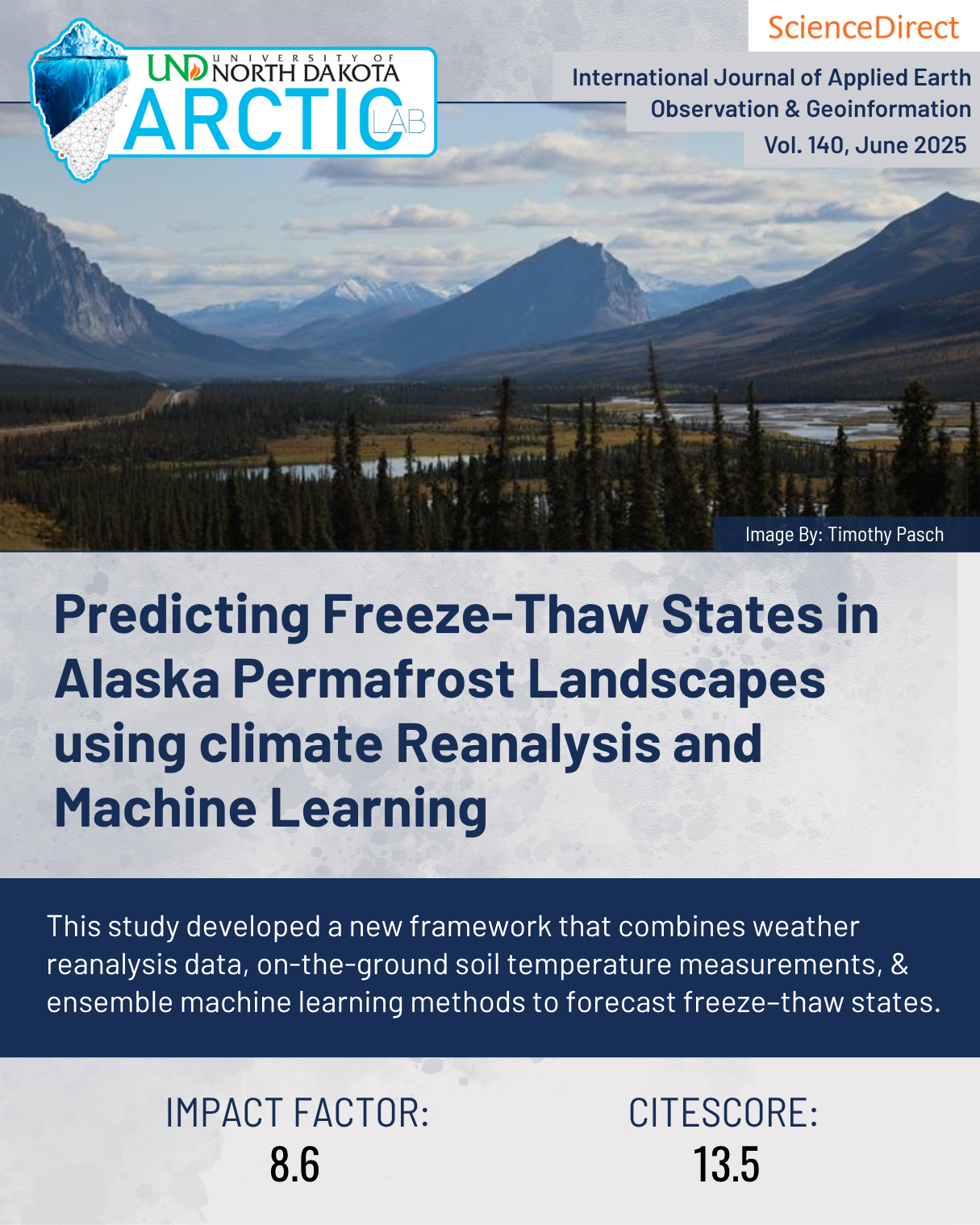 In “Predicting Freeze-Thaw States in Alaska Permafrost Landscapes using climate Reanalysis and Machine Learning,” (DOI: https://doi.org/10.1016/j.jag.2025.104576); UND ARCTIC Lab researchers Aymane Ahajjam, Mary Soaper, Robert (Rob) Chance, Jacqueline Aguigui Chandler, and Timothy J. Pasch, PhD utilize weather reanalysis data, on-the-ground soil temperature measurements, and ensemble machine learning methods to forecast freeze–thaw states.
This paper was made possible thanks to the strong collaboration between its amazing team of co-authors, each of whom bring incredible value and experience to our lab. At age 20, Undergraduate Research Assistant Mary Soaper has already conducted fieldwork and been published several times, and she will soon be pursuing her master’s degree; Jacqueline Chandler, a Ph.D. student in Communication at UND with Dr. Pasch, spent seven years working as the Director of Public Affairs and Communication for the USDA Forest Service’s Alaska Region; Aymane Ahajjam is a former post-doc who has now been promoted to Research Engineer II since joining the ARCTIC Lab; Robert Chance has recently completed his Ph.D. in Geology at UND, and was first author on another one of our major research papers in 2024 (DOI:https://doi.org/10.1007/s12145-024-01486-1).
An especially noteworthy aspect of this paper is the high Impact Factor of its publishing journal. A scientific journal’s Impact Factor (IF) measures the frequency that the articles within that publication are cited. With an IF of 8.6, the International Journal of Applied Earth Observation and Geoinformation is a highly cited and influential source, which is exactly where the work of the UND ARCTIC Lab belongs.
The papers cited are based upon work supported by the Broad Agency Announcement Program and the Cold Regions Research and Engineering Laboratory (ERDC-CRREL) under Contract No. W913E522C0001.