UND ARCTIC Lab Starts 2026 with Three High-Impact Papers
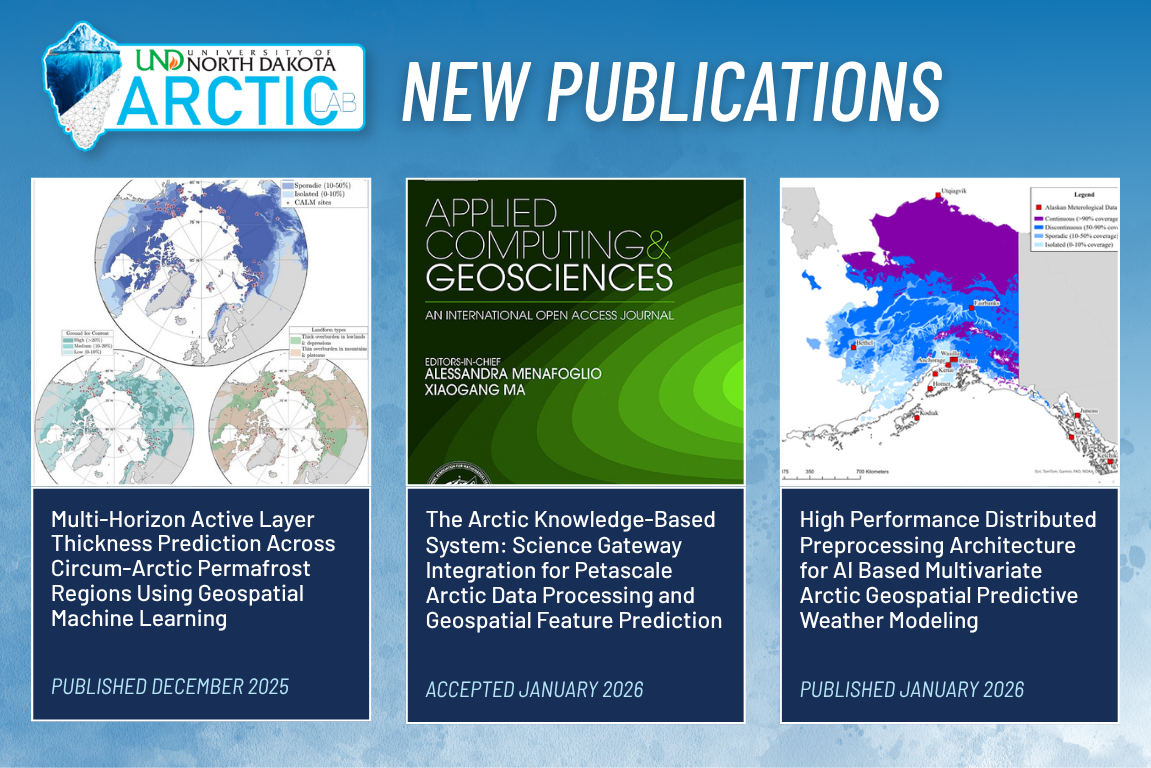
2026 is off to a strong start for the UND ARCTIC Lab, with three high impact papers from our team published or accepted for publication over the last two months.
“Multi-horizon active layer thickness prediction across circum-Arctic permafrost regions using geospatial machine learning” was published in the Journal of Geophysical Research: Machine Learning and Computation in December. The study introduces a data-driven framework for predicting the Arctic permafrost’s maximum active layer thickness up to five years in the future. This approach combines field measurements with geospatial features for the most accurate projections possible, offering a scalable and effective tool for understanding how permafrost landscapes are changing over time across the Arctic. https://doi.org/10.1029/2025JH000969
“The Arctic Knowledge-Based System: Science gateway integration for petascale Arctic data processing and geospatial feature prediction” was recently accepted for publication in the Journal of Applied Computing and Geosciences This introduces the Science Gateway component of the Arctic Knowledge-Based System (A-KBS), which is designed to advance AI-assisted modeling of permafrost dynamics and other Arctic geospatial processes, as well as providing researchers with a unified portal to configure and execute prediction tools for many different Arctic data sets (Paper Accepted). https://doi.org/10.1016/j.acags.2026.100322
“High performance distributed preprocessing architecture for AI-based multivariate Arctic geospatial predictive modeling” was also accepted for publication in the IEEE Journal of Selected Topics in Applied Earth Observations and Remote Sensing (J-STARS). The paper describes a high-performance, distributed artificial intelligence-based (AI) approach for Arctic-focused multivariate geospatial feature prediction to enhance model accuracy and computational efficiency through parallel processing and distributed dataset pre-processing. https://doi.org/10.1109/JSTARS.2026.3655410
Three high impact published papers in such a short window of time is a stellar achievement for UND ARCTIC. Over the coming weeks we will dive deeper into each paper and the talented researchers who authored them.