CARS ’24: Understanding cyberthreats to protect the future
Fourth annual Cyber Awareness and Research Symposium advances cutting-edge cybersecurity concepts

The exponential growth in cyberattacks, mitigation strategies for individuals and industry, and the current state and future of cybersecurity were all topics industry insiders and researchers delved into in the Memorial Union Ballroom on Oct. 28-29.
The occasion was the fourth annual Institute of Electrical and Electronics Engineers Cyber Awareness and Research Symposium (IEEE CARS), which covered all those topics and more.
CARS is a networking event for students, members of the community, academics and industry professionals to get together to advance emerging concepts in artificial intelligence-driven threats, and data science for cybersecurity, among other topics. The symposium is hosted jointly by UND’s Center for Cyber Security Research, and University IT, with the aim of raising awareness and promoting state-of-the-art cybersecurity activities.
Appearing virtually from his office in Bismarck, North Dakota University System Chancellor Mark Hagerott thanked participants for attending and congratulated the UND team that organized the symposium. He exhorted attendees to meet one another in a spirit of cooperation that can lead to beneficial results for industry and beyond.
“You create knowledge, you share many great ideas, you meet new people and maybe budding new companies will come together,” he said. “As a historian of technology, I can tell you that more than once, people just meeting at a conference had an idea, and they created something new.”
Speaking next, UND Provost Eric Link also welcomed the attendees, and offered them a message of gratitude, which, he mused, is probably not a message cyber researchers are used to hearing.
“This is a scary new world in many ways that we live in, but because of the work that you are doing it is less scary for us,” Link said. “We want to thank you for your continued push on the boundaries of knowledge, helping us get smarter, better, faster and stronger in our awareness of what cyber can do for us.”
Prakash Ranganathan, director of C2SR and associate professor of Electrical Engineering, said conducting research and teaching courses is one thing, but putting on an event like CARS is quite another. He thanked the 15 graduate students and C2SR staff members for their support in organizing the event (“Without you, I could not do this,” he said), and he expressed his gratitude for CARS’ sponsors.
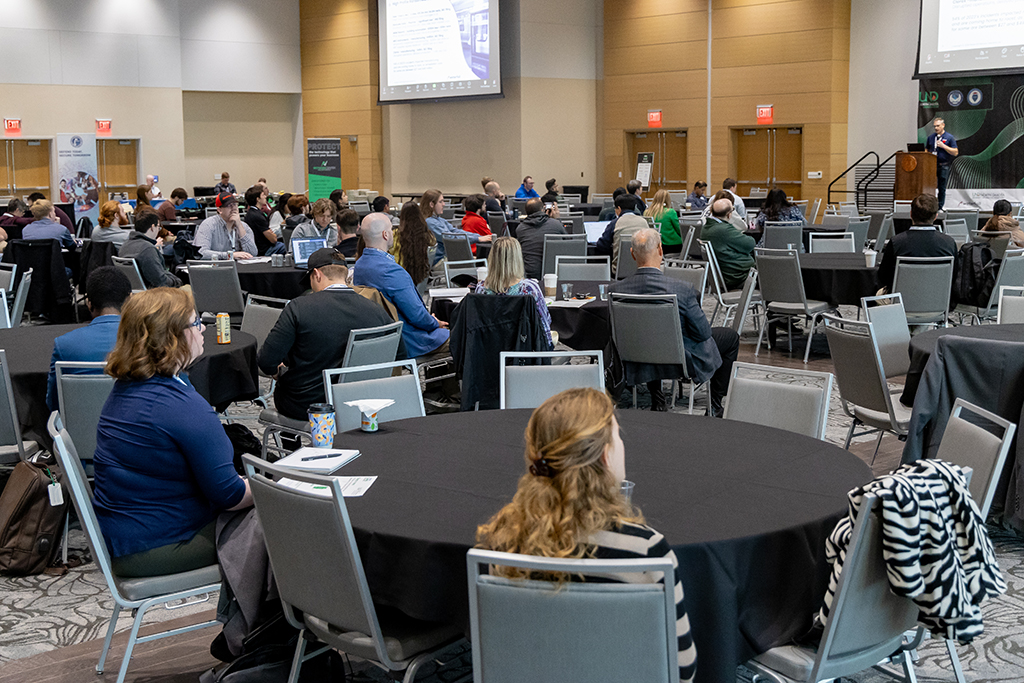
Up next that first day was Rees Machtemes, of Waterfall Security, who spoke about trends in cyberattacks on critical infrastructure — think entities such as railroads and water treatment plants. Those attacks, he said, are dramatically on the rise.
Machtemes and Waterfall Security publish an annual threat report of cyberattacks. About 80% of those attacks are ransomware attacks (an attack that locks out a business from their own files until they pay a “ransom” to get that access back), but attacks from nation-states and hacktivists — people who hack computers to achieve political aims — also are increasing, he said.
These trends have serious implications for business and critical infrastructure security. In one instance, a tooling company for a microchip manufacturer was hit by cyberattack and had to shut down for a time. The cost of that event? Two hundred million dollars in lost revenue.
In another instance, hotel and casino chain MGM Resorts was hit by a ransomware attack that disrupted operations to a significant degree: All hotel doors suddenly unlocked; the online reservation system was shut down. The attack occurred for 10 days and showcased the need for entities around the globe to invest in cybersecurity measures to protect themselves.
Machtemes, who predicted that about 100 major attacks will occur by the end of the year, said the objective is clear:
“Ultimately, the goal here is to try to understand what kind of attacks we are seeing in order to better defend against them,” he said.
Capturing the Flag

Over the course of the two-day symposium, other speakers addressed topics including the future landscape of cybersecurity, and how to protect physical systems from attack (there are those water treatment plants again). Workshops were held on topics ranging from fraud detection to machine learning to a general discussion of cybersecurity for individual people. In addition, 58 academic papers — presented and discussed at 15 paper sessions — were accepted for publication by IEEE Xplore, a digital repository “of scientific and technical content.”
But the CARS Symposium was home to another challenging area, as well: one that pitted middle school, high school and university students against one another in a cybersecurity challenge.
The challenge was called the UND CyberHawks National Capture the Flag Competition. Students visiting UND formed mixed teams to demonstrate their skills in a six-hour event.
As much a recruitment effort and career path demonstration, the event got students to show off their skills in areas such as forensics, cryptography and web exploitation, among others. Nearly 30 high school and university teams competed in the CTF event.
The CTF event winners were:
- CTF College Level 1: Team SegfaultRPI, Adam Todd, Bulmaro Nava-Camal, Devin Ross and
Jason Ng (all from Rensselaer Polytechnic Institute). - CTF College Level 2: Team Delogrander, Carson Titus, Jaden Liu and Neil Kumar (all from the U.S. Air Force Academy).
- CTF College Level 3: Team Cyberlions, Asa Reynolds, Cy Fisher, Liam Geyer and Robbie R (all from Pennsylvania State University).
- CTF High School Level 1: Team Bull Moose Party, Fatemeh Saeedi, Jake Kalenze, Micah Kauffman and Sonakshi Singhal (all from Red River High School).
- CTF High School Level 2: Team Roughriders, Briley Zhang, Gayatri Gautham, Lauryn Brynjulson and Olivia Whitney (all from Red River High School).
- CTF High School Level 3: Team Youngest Presidents, Micah Jorgenson, Quentin Albaugh and Seetaram Mugu (all from Byron High School).
Written by Adam Kurtz // UND Today