Turning up the heat (recovery)
UND students partner with RJ Energy Solutions to repurpose restaurant waste energy
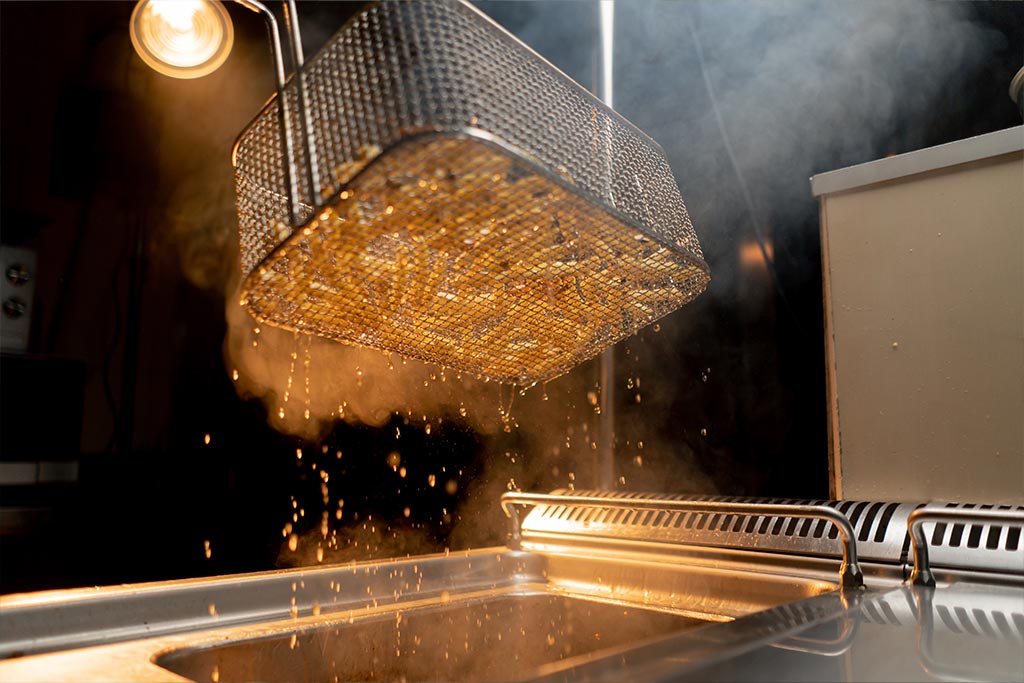
Every time a commercial fryer fires up in a restaurant kitchen, a significant portion of its energy — up to 75% — is lost as waste heat, vented into the air and driving up cooling costs.
But thanks to a collaboration between RJ Energy Solutions and a multidisciplinary team of engineering students at the UND College of Engineering & Mines, that waste might soon be working smarter, not harder.
Their senior design project titled “Monitoring and Visualizing the Performance of a Waste Heat Capture and Repurpose Proof-of-Concept System,” aims to change how commercial kitchens handle this inefficiency. Sponsored by RJ Energy Solutions, the team developed and tested a system designed to recover at least 30% of this wasted energy through a closed-loop fluid transfer process that monitors and transmits data in real-time.
Engineering a smarter kitchen
The scale of the issue is massive; in the U.S. alone, nearly 1.4 million commercial fryers are in use. Floor-standing models — the type most often used in institutional and restaurant settings — account for roughly 826,000 units. These appliances consume approximately 100,000 BTUs per hour, yet only a quarter of that energy goes directly into cooking. The rest escapes as heat, forcing kitchen HVAC systems to work overtime.
“We wanted to solve a problem rooted in wasted energy,” explained Bailey Turner, an electrical engineering student. “Whenever you cook something, a lot of the energy used to power whatever you’re cooking with is wasted as heat. You can already feel this in a standard kitchen at home, and the issue is even worse in commercial kitchens. Were this project to become a widely accepted and full-scale product, restaurants would have to pay significantly less in order to keep their kitchens cool and their staff safe.”
Their solution involves sensors that measure temperature, pressure, and flow rates in a heat transfer fluid system. This data is logged and wirelessly transmitted to RJ Energy Solutions for real-time monitoring and long-term performance analysis. If scaled, the system could inform energy-saving strategies, improve worker comfort, and reduce environmental impact.
Wired for collaboration
The project brought together students from the Department of Mechanical Engineering and the School of Electrical Engineering & Computer Science.
“The biggest challenge I faced was learning how to work with an interdisciplinary team on the fly,” Turner said. “The worlds of mechanical engineering and electrical engineering are so different that the separate teams of the project had entirely different goals for getting this off the ground.”
Computer science student Wyatt Hanson echoed the importance of cross-disciplinary collaboration. “We had ten student team members… and this project incorporated so many real-world aspects from different disciplines that we relied heavily on each other. This project could not have happened without our ability to communicate and work with each other effectively.”
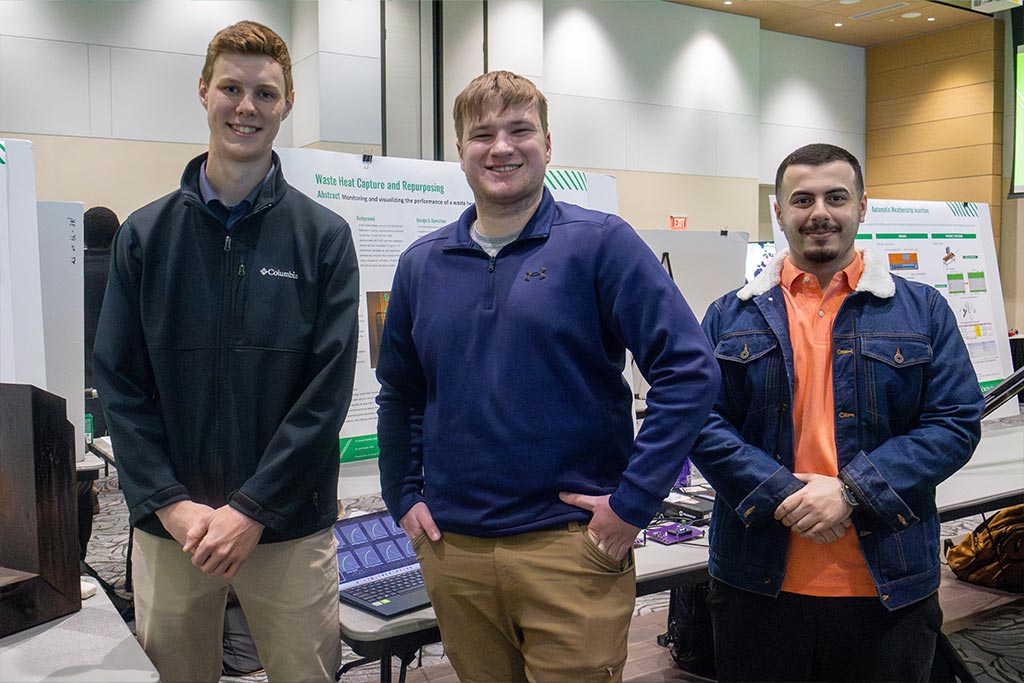
Hanson also appreciated the hands-on nature of the experience: “This project allowed me to gain full stack development experience. I was able to work on the back end of the system with data ingestion along with the front end of creating a user interface for the customer experience.”
Electrical engineering student James Sprague praised the team’s organizational strategy. “UND School of Electrical Engineering and Computer Science students divided the project into distinct work packages (WP)… Despite this individual ownership, frequent collaboration was encouraged. This approach not only enhanced the quality of each WP but also significantly increased the chances of overall project success.”
Their efforts produced a system that, as Sprague described, “captures waste heat and repurposes it to generate cooling, featuring integrated instrumentation, real-time data display, comprehensive data management, and precise unit control for enhanced energy efficiency and sustainability.”
Impact beyond the classroom
The project offered not only technical achievement but also meaningful context.
“In restaurant kitchens, there is an incredible amount of heat energy that gets wasted,” said mechanical engineering student Eli Jensen. “This project works to capture and reuse some of that energy in other parts of the business, which reduces the overall energy footprint. This not only reduces the business’s energy costs, but also…helps the planet too.”
With so many moving parts, delegation and communication were key. “There were many subsystems that went into making this project,” Jensen added. “Without dividing them up amongst the team, it would have been very difficult to focus on the details while looking at the project as a whole.”
That interdisciplinary collaboration left a lasting impression on Turner as well. “Even if every team member individually had all of the skills to do this project, it wouldn’t get anywhere without proper communication between members.”
For Hanson, the project’s significance extends far beyond UND. “This project is able to be scaled to help many commercial kitchens capture the wasted heat that occurs. Further improvements could…convert it back into usable energy. This project has the real possibility to help our environment in many ways.”
What’s next on the burner?
The completed system is just a proof of concept — but it’s one with tangible promise.
With RJ Energy Solutions receiving regular performance data and exploring further optimization, this UND senior design project could inspire broader energy-efficient practices across commercial kitchens nationwide.
By harnessing waste, these student engineers are helping redefine what it means to cook smarter.
Written by Paige Prekker // UND College of Engineering & Mines
RJ Energy Solutions
200 45th Street South Fargo, ND
701-212-4835 // Rjenergysolutions.com