UND energy engineering student wins global AspenTech competition
Representing UND on the world stage, Chinaecherem Okwuonu takes global title in AspenTech Innovators Challenge after first being named North American winner
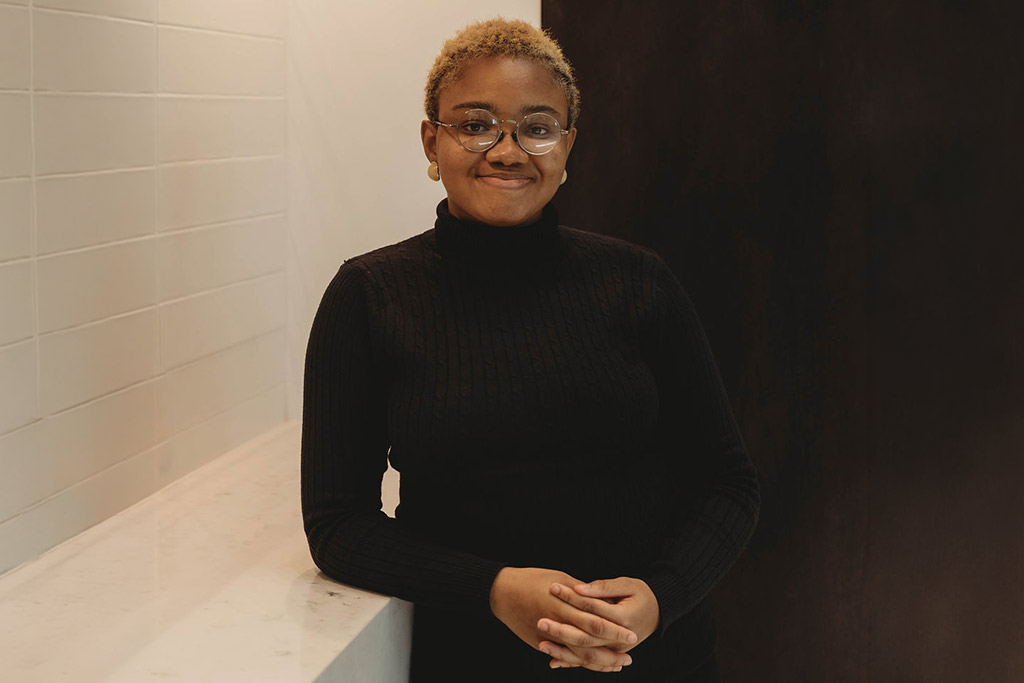
When Chinaecherem Okwuonu entered the Global Academic Innovators Challenge hosted by AspenTech — the developer of the ASPEN Plus® simulation software that is used by chemical engineers to design all types of plants (chemical, power, food, refining or pharmaceutical) — she found herself in a competition that rewarded not only technical knowledge, but creativity.
The UND Energy Engineering graduate student first earned recognition as the North American regional winner before advancing to the Global Showdown, where she competed against regional winners from around the world. She ultimately won the global competition, marking an achievement that reflects both her technical skill and UND’s growing strength in energy research, process engineering and industrial decarbonization.
“Winning the North America regional round was already a huge honor because of the caliber of students participating in the competition,” Okwuonu said. “Advancing to the global showdown and ultimately winning at the international level was both exciting and humbling.”
For Junior Nasah, director of the CEM Research Institute, Okwuonu’s win speaks to both her abilities and the strength of UND’s engineering programs.
“Our engineering programs can compete on the global stage,” Nasah said. “This highlights our commitment to train students to address both regional and global challenges.”
The Global Academic Innovators Challenge invites students to use AspenTech tools to address pressing global challenges across five themes: resource efficiency, energy transition, circular economy, carbon capture, utilization and storage, and bio-based feedstock.
For the first phase of the competition, Okwuonu developed a project focused on lowering emissions from grain drying, an energy-intensive agricultural process. Her project explored how a modular fuel pyrolysis unit could be integrated into a fossil fuel-fired grain dryer as a decarbonization tool.
She evaluated the concept from multiple angles, including whether the modified system could match the performance of a conventional grain dryer, how much it could reduce direct carbon dioxide emissions at different fuel conversion rates, and whether the project could be economically feasible under changing carbon prices and fuel conversion rates.
“The challenge was very exciting in that it not just allowed but encouraged creativity,” Okwuonu said.
After being selected as one of five regional winners, Okwuonu advanced to the Global Showdown, a live, two-hour virtual challenge. In that round, competitors were asked to separate a chemical mixture into three high-purity products — acetone, methanol and toluene — while keeping heat duty and carbon dioxide emissions low.
Because acetone and methanol form a mixture that is difficult to separate through conventional distillation, Okwuonu used extractive distillation, a specialized separation method, to reach the required purity levels.
The time-bound format tested not only her technical training, but also her ability to make decisions quickly and clearly.
“The most challenging aspect was balancing technical accuracy with time constraints,” Okwuonu said. “The competition required making engineering decisions quickly while still ensuring that the solution remained technically rigorous and realistic.”
Throughout the competition, Okwuonu relied on process simulation, process optimization, thermodynamics, energy systems analysis and Aspen Plus modeling. She also drew on her background in process engineering and research experience in energy systems and decarbonization.
But technical knowledge alone was not enough.
“On the nontechnical side, critical thinking, time management, communication, adaptability, and the ability to make engineering decisions under pressure were extremely important,” she said. “Being able to clearly explain technical reasoning in a concise and organized way was a major part of the competition.”
Nasah said Okwuonu’s careful approach to her work stood out.
“She is very meticulous with any task she is given,” he said.
From Grand Forks to the global stage
Okwuonu said her UND experience played a major role in preparing her for the challenge. Her research at the Center for Process Engineering Research (CPER) has included work in process modeling, optimization and industrial decarbonization — areas closely aligned with the demands of the AspenTech competition.
One project she pointed to as especially impactful was a U.S. Department of Energy-supported collaboration between UND and HQuest focused on non-catalytic pyrolysis of associated gas to produce zero-carbon dioxide hydrogen and high-value carbon black. She also has been involved in a project focused on lowering carbon emissions in agriculture through new methods, supported by the UND Early Career Scholars Program.
Those experiences helped her connect engineering analysis to real-world sustainability challenges across industrial and agricultural systems.
“My research experience at UND, particularly my work at the Center for Process Engineering Research, played a major role in preparing me for this competition,” Okwuonu said. “Working on these projects strengthened my understanding of sustainable energy systems, process integration, and advanced engineering analysis.”
Her graduate coursework in energy engineering — including energy systems engineering, applied engineering business analysis, energy systems optimization and system dynamics — also helped her approach complex engineering problems with practical, data-driven solutions.
Nasah said the CEM Research Institute helps create the kind of research environment where students can build those skills through applied, industry-relevant work.
“CEMRI has created a research ecosystem where students are supported by faculty, staff and fellow students,” Nasah said. “This is the work experience trifecta; students get to be trained by experienced staff, be advised by faculty, and also be mentored by their peers.”
For Okwuonu, the global win is more than a competition result. It connects directly to her long-term goals in sustainable process engineering, energy systems engineering and industrial decarbonization.
“This achievement strongly aligns with my long-term goals in sustainable process engineering, energy systems engineering, and industrial decarbonization,” she said. “My research interests focus on cleaner energy technologies, process optimization, and reducing industrial emissions. Winning this competition has further motivated me to continue pursuing impactful research and engineering solutions that contribute to sustainable energy and industrial systems.”
Nasah said the achievement also aligns with one of CEMRI’s central goals: preparing students for the workforce and the challenges they will be asked to solve.
“This achievement aligns with one of our key goals, which is to educate and train the workforce of tomorrow,” Nasah said.
Okwuonu said representing UND on a global stage made the achievement especially meaningful.
“UND has played a major role in my growth as an engineer and researcher, and I am proud to contribute to the university’s reputation in engineering and energy research,” she said. “Winning the competition while representing UND was especially meaningful because it reflects the quality of education, mentorship, and research opportunities available at the university.”
She credited several UND mentors and collaborators for supporting her academic and professional growth, including Nasah, Johannes Van der Watt, Abdelmalek Bellal and Olusegun Tomomewo.
“Their support has played an important role in my academic and professional development,” Okwuonu said. “I would also like to thank the College of Engineering & Mines and the UND Early Career Scholars Program for fostering an environment that encourages innovation, research, and professional growth.”
Written by Paige Prekker // UND College of Engineering & Mines