Cybersecurity’s changing landscape takes center stage at UND
International experts, researchers and students gather at UND to explore emerging threats and the future of cybersecurity research
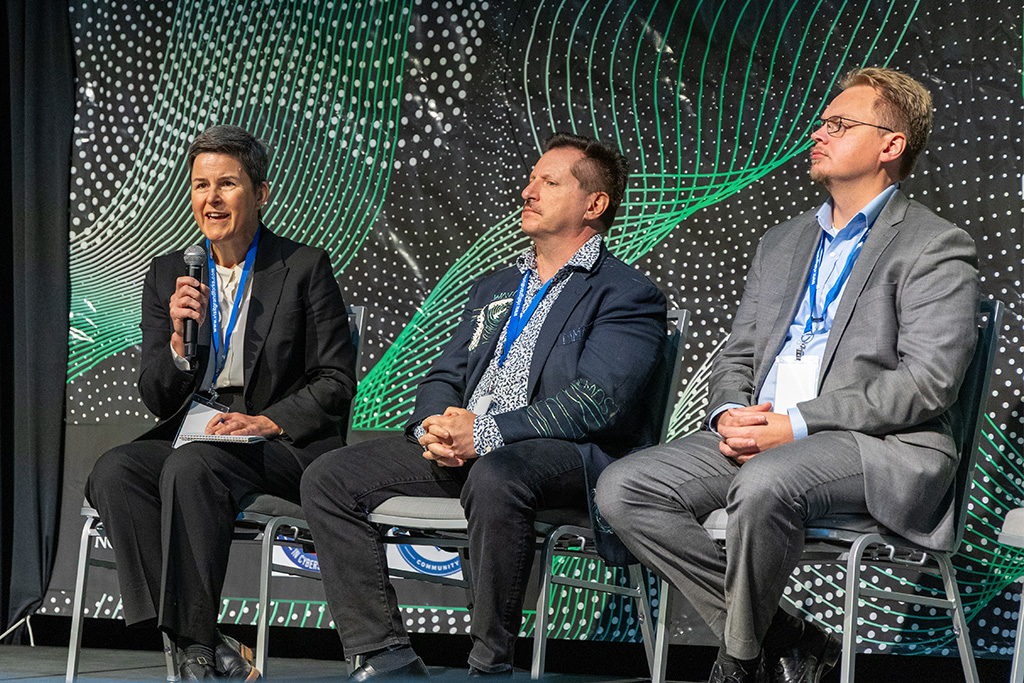
When Zoe Fowler, academic outreach director at the Department of War, addressed cybersecurity researchers gathered at the University of North Dakota, she drew an unexpected comparison between the challenges of the digital world and North Dakota’s pioneer history.
The resourcefulness that helped early settlers navigate unfamiliar land, she said, had the same qualities needed to confront the rapidly evolving technologies of the current world.
“Cyberspace is our new contested frontier,” said Fowler, cyber academic and outreach lead for the U.S. Department of War’s Cyber Academic Engagement Office.
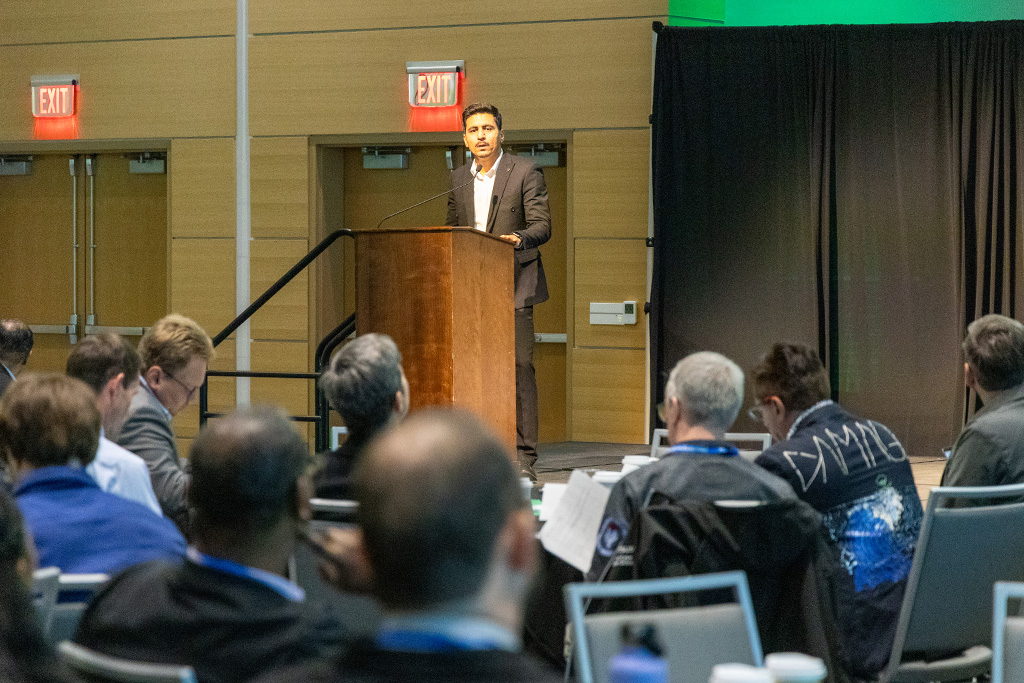
Her remarks helped set the stage for the sixth annual IEEE Cyber Awareness and Research Symposium (CARS), held Oct. 26-28, which brought researchers, government representatives, industry leaders and students together to examine emerging cybersecurity threats and explore ways to address them.
Preparing for an uncertain future
Hosted at UND’s Memorial Union, the three-day conference featured 186 accepted research papers and representatives from 57 institutions designated as National Centers of Academic Excellence in Cybersecurity.
Jointly hosted by UND’s College of Engineering & Mines, Center for Cyber Security Research and Artificial Intelligence Research Center, CARS gave students and faculty the chance to connect with representatives from federal agencies, national laboratories and technology companies.
During Monday’s opening remarks, UND President Andrew Armacost encouraged attendees to take advantage of those opportunities.
“That’s the purpose of being here: to make the connections so that you can advance your research, you can share your ideas,” he said.
The importance of those connections was evident during Monday’s federal leadership panel, which brought together representatives from the Department of War, Department of Energy, National Science Foundation and Argonne and Oak Ridge national laboratories.
Much of the discussion centered on a question facing researchers and universities: As artificial intelligence, quantum computing and other technologies advance, where should the next generation of cybersecurity researchers focus their efforts?
Fowler, who also participated in the panel, described how the rapid pace of technological development is changing the way research is conducted.
Rather than relying exclusively on multiyear projects, she pointed to the department’s AI Forwards initiative, which includes 90-day research efforts intended to explore promising ideas quickly, even when their outcomes are uncertain.
Such an approach, she explained, allows researchers to investigate possibilities that might otherwise be overlooked and identify emerging technologies worthy of further investment.
Benjamin Blakely, a cybersecurity and AI researcher at Argonne National Laboratory, raised questions about the reliability of artificial intelligence as it takes on increasingly complex responsibilities.
“How are we as humans going to interact with LLMs? Where are the boundaries?” he asked, referring to the large language models underlying many contemporary AI systems.
Blakely argued that understanding when AI systems can be trusted, and how humans should oversee their work, will become an increasingly important research area, particularly as the technology is applied to critical infrastructure.
Cole Smith, a program manager with the Department of Energy’s Office of Electricity, emphasized a related challenge: helping organizations make informed decisions about cybersecurity risks.
Electric utilities, for example, must continually decide how to spend limited resources protecting their systems. Research that helps quantify those risks and guide investments, Smith said, will remain valuable regardless of how technology changes.
Panelists also considered whether growing attention to AI and quantum technologies might diminish the importance of cybersecurity research. They generally agreed that emerging technologies would instead create new security challenges and opportunities.
Smith encouraged researchers to take advantage of technological advances without losing sight of the principles underlying existing systems.
“Embrace these new tools, but don’t skip the fundamentals,” he said.
The discussion also touched on career opportunities for doctoral students, with panelists encouraging them to pursue internships, collaborate across disciplines and build relationships with researchers at national laboratories and government agencies.
The intersection of emerging technologies and cybersecurity was also a focus of Tuesday’s quantum computing panel, which featured UND faculty members Ayush Asthana, assistant professor of Chemistry. and Markus Allgaier, assistant professor of Physics, alongside Scott Aaronson, a computer science professor at the University of Texas at Austin.
Aaronson discussed quantum computing’s potential to accelerate scientific discoveries while warning that sufficiently powerful quantum computers could undermine widely used encryption methods. Although the timeline remains uncertain, he urged organizations to begin adopting security methods resistant to quantum computing.
Students put research into action
Amidst experts discussing challenges facing cybersecurity researchers, students attending CARS demonstrated how their own work could help.
“IEEE CARS is all about students,” said Prakash Ranganathan, director of Cyber Security Research at UND and one of the conference’s organizers, during an awards presentation help on the first night of symposium.
That emphasis was reflected in the conference’s student competitions, including the national Capture the Flag competition, which drew 213 teams from around the world in its first virtual round, with 47 advancing to the finals at CARS.
During the Three Minute Thesis (3MT) competition, doctoral students were challenged to explain the significance of their research in just three minutes.
Among them was UND student Karim Muhammad, who presented research on protecting electrical grids from cyberattacks.
His work uses a form of artificial intelligence known as federated learning to identify threats across interconnected devices without requiring them to share all their information with a central system. The research addresses the growing cybersecurity challenges facing power grids as they incorporate technologies such as solar panels, batteries and electric vehicle chargers.
Muhammad earned third place in the competition.
Students also put their skills to the test during the UND CyberHawks National Capture the Flag competition and technical paper and poster presentations gave students additional chances to share their research.
Award winners included:
Three Minute Thesis: First, Tashi Stirewalt, Washington State University; second, Aayushi Verma, University of Connecticut; third, Karim Muhammad, UND.
Capture the Flag, university division: First, Delogrand, U.S. Air Force Academy; second, k3rn4lp4n1c-DSU, Dakota State University; third, idktheflag, an independent cybersecurity team.
Capture the Flag, high school division: First, TJCSC, Thomas Jefferson High School for Science and Technology, Virginia; second, Hack-CAA, Shawnee Mission School District, Kansas; third, Roughriders, Red River High School, Grand Forks.
Best research paper: First, James Hugglestone, Samuel Jacob Chacko and Xiuwen Liu, for “STRIATUM-CTF: A Protocol-Driven Agentic Framework for Autonomous CTF Solving”; second, Shashwot Shrestha and co-authors, for “Kernel-Level Electrical Characterization of Edge AI Workloads using Continuous Point-on-Wave Measurement”; third, Samuel Heuchert and John D. Hastings, for “Assessor Experiences in CMMC Level 2 Certification Assessments: An Interpretative Phenomenological Analysis of Role Expectations.”
Best research poster: First, Leslie Viviani, UND, for “Hiding in Plain Metrics: The K8s Blind Spot”; second, Md Mahedi Habib Chowdhury, University of St. Thomas, for “Secondary PCC Control for AI Data-Center Load Variations in a Grid-Connected Microgrid”; third, Yuhao Liu, Florida Atlantic University, for “Gröbner Bases and Relinearization.”
Written by Walter Criswell // UND Today