UND holds inaugural Dissertation Fellows Cohort
Event honors three exceptional doctoral students, highlights their research
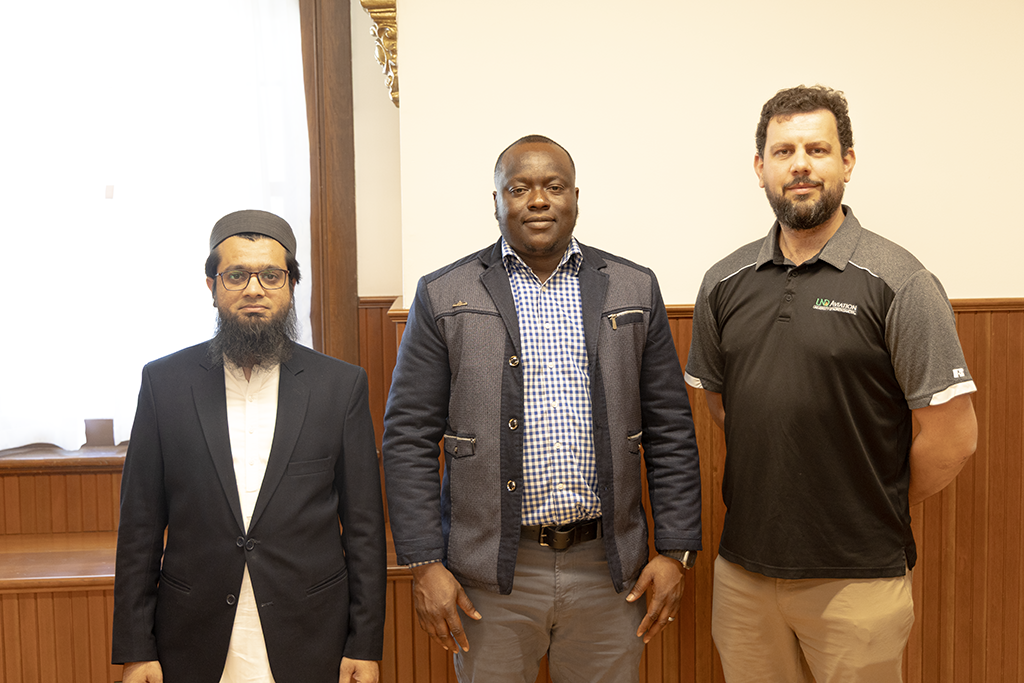
Last week, three UND doctoral students were honored for their dissertations’ research, a final step in an arduous academic journey.
On Wednesday, Oct. 21, the University’s School of Graduate Studies hosted its inaugural Dissertation Fellowship cohort at the Gershman Graduate Center.
The event recognizes three exceptional doctoral students each academic year and is the highest honor conferred to Ph.D. students at UND. This year’s dissertation fellows and advisors are as follows.
- Percy Kpodo, Ph.D. candidate in Educational Foundations and Research. Advisor: Robert Stupnisky, associate dean and professor of Education, Health & Behavior Studies.
- Jurie Visagie, Ph.D. candidate in Human Space Flight. Advisor: Pablo de Leon, professor of Space Studies.
- Fnu Tabish, Ph.D. in Civil Engineering. Advisor: Iraj Mamaghani, professor of Civil Engineering.
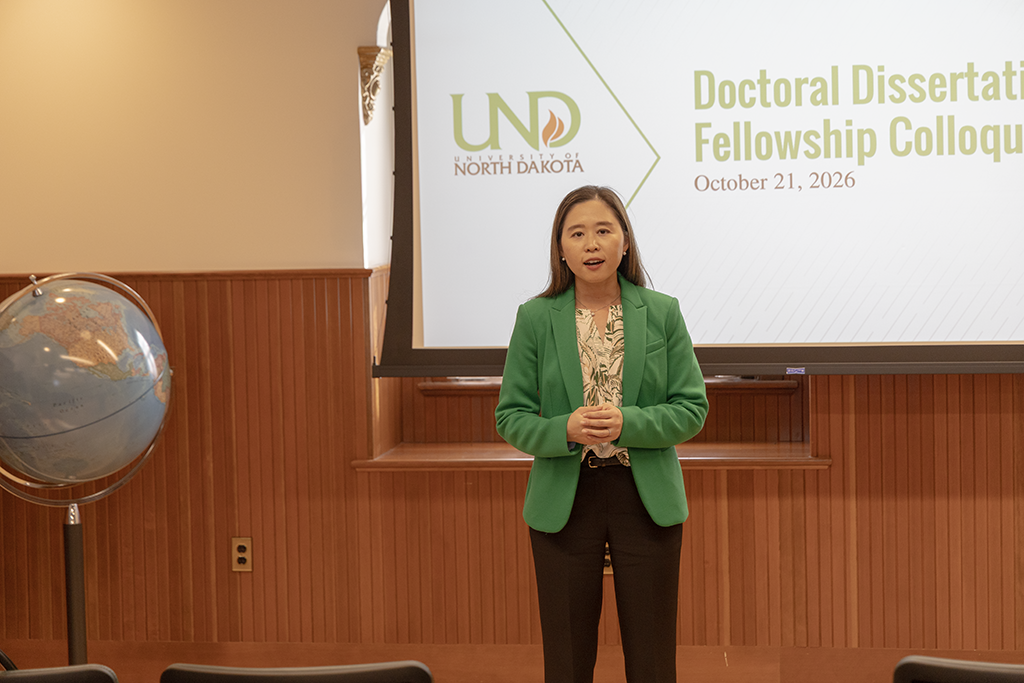
Soojung Kim, dean of the Graduate School, praised the fellows’ commitment to furthering scholarship in their disciplines.
“We, as a School of Graduate Studies – and as an institution – want to ensure that they cross the finish line successfully,” Kim said. “So, they can make a significant impact in their fields, change people’s lives and make UND proud. This is a celebration of what these innovative ideas are about.”
Kpodo’s research examines how universities can strengthen faculty research support by addressing factors such as workload and professional balance. It draws on studies worldwide, including the U.S. and Kpodo’s home country, Ghana.
Kpodo said he hopes his research will further the conversation on balancing faculty members’ dual workload of teaching and researching – the latter of which is seen as essential for obtaining tenure.
Tabish’s research addresses the structural engineering challenges facing cylindrical storage tanks, particularly their susceptibility to buckling and collapse during external loads and seismic events. By integrating finite element analysis with artificial intelligence and machine learning techniques, he aims to improve the prediction of structural stability and seismic damage in these critical infrastructure systems.
As these structures often contain environmentally sensitive materials, ensuring their structural integrity is paramount.
“These cylindrical storage structures are like a lifeline,” he said. “I’m very happy that I am working on the stability side of such important structures.
Visagie’s research explores the feasibility of constructing lunar and Martian habitats – a goal reiterated by NASA as part of its Artemis program. One such potential building material is regolith – a topsoil of sorts consisting of sand, rock and dust.
However, a major challenge of building structures in the vacuum of space habitats, is finding adequate binding materials. A major component of Visagie’s research is exploring alternatives such as biological waste.
“We can’t exactly bring cement or concrete with us, so what else do we have?” Visagie said. “I always like to say, ‘one man’s trash is another man’s treasure.’”
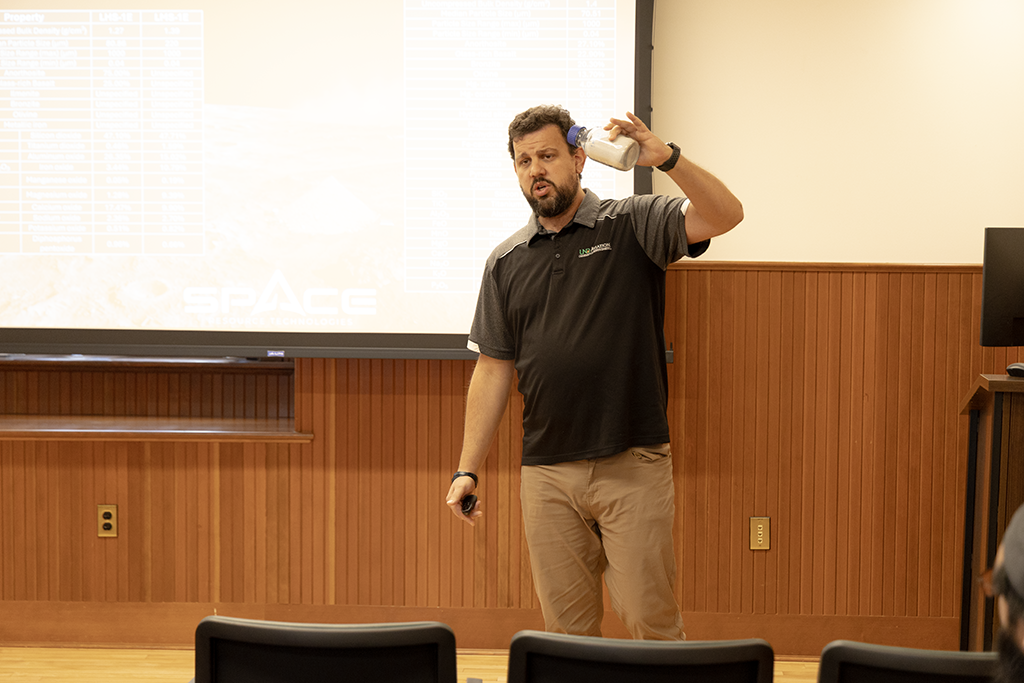
Despite the aforementioned challenges, Visagie remains bullish about mankind’s future in space.
“I believe that the future of mankind is not only here on Earth, but also in the stars,” he said. “Space is a conduit. We have evolved as a species, and technology is attached to our space travel. If you look back to the 1970s, suddenly, we had transistors and could communicate not only across continents but to the moon. I believe this technology will allow us to push that again. It might not be the final answer, but it’ll be that first step.”
The fellows’ dissertation advisors were laudatory in their praise.
“Percy’s selection as a Doctoral Dissertation Fellow is a well-deserved recognition of his dedication, scholarly growth, and unique professional experience,” Stupnisky said. “As his advisor, I have been particularly impressed by his ability to connect practical leadership experience with rigorous research methods and theory. His work has important implications for understanding how universities can better support faculty and foster research success across different institutional and national contexts.”
“Tabish’s selection as a Doctoral Dissertation Fellow is a well-deserved recognition of the dedication, scholarly potential, and commitment to research demonstrated throughout the doctoral journey,” Mamaghani said. “As chair of Tabish’s dissertation committee, I am pleased to see this achievement recognized and look forward to the contributions this research will make to structural engineering and the broader academic community.”
Written by Joe Banish // UND Today