‘Obesity has its hands in everything’
Fact: Americans are getting larger.
According to one Centers for Disease Control and Prevention (CDC) report, the percentage of Americans considered obese tripled between 1962 and 2012. Likewise, one 2021 report from the National Institutes of Health noted that obesity among children has quintupled since the 1960s.
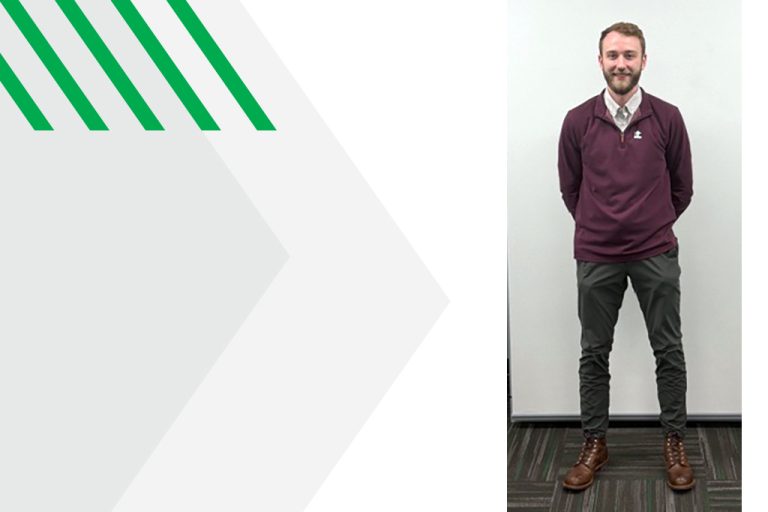
Reflecting on these figures, Hawley, Minn., native Cody Baxter, PA-C, explained that the problem goes beyond the proliferation of fast food and sedentary lifestyles.
In its own way, he said, the healthcare system itself has contributed to the obesity problem.
“A lot of times, the medical system defaults to thinking that obesity is a behavioral or moral failing and not a chronic disease,” said the co-owner of Fargo-based Progress Weight Management and 2018 graduate of the UND School of Medicine & Health Sciences (SMHS) physician assistant (PA) program. “In 2013, the American Medical Association defined obesity as a chronic disease, but there’s a big difference between making a position statement and then having the entire medical community actually adapt and get on board with that fact.”
In other words, added Baxter’s co-owner Stephanie Severson, PA-C, a 2019 grad of UND’s PA program, even if the majority of healthcare providers recognize obesity as a chronic condition, many health systems have been slow to prioritize obesity medicine in the same way they prioritized diabetes, mental illness, and other chronic conditions.
But obesity is often deeply embedded in each of these other conditions she said.
“Guess what?” Severson asked rhetorically. “If you treat obesity, high blood pressure gets better, diabetes gets better, autoimmune conditions get better, joint problems get better. So really, obesity affects everything.”
Describing how she was seeing an alarming amount of fatty liver disease in her former practice, Severson noted too how her previous employer didn’t seem able to address the root causes of and treatment for fatty liver in a comprehensive way.
“My training was basically to tell patients to lose seven to ten percent of their body weight and send them on their way,” she said. “I just felt like I was doing a disservice to my patients. I’d tell them, ‘Okay, you have fatty liver disease. Go lose some weight and see you in six months,’ which wasn’t really helpful.”
Independent obesity clinic
Then Severson met Baxter.
Working in the same system as her fellow UND alum at the time, Severson noticed that Baxter seemed to be managing a lot of her and other providers’ weight management referrals.
So she reached out to Baxter to ask about his approach to obesity care.
After commiserating, the pair settled on the idea of an independent, PA-run obesity medicine clinic outside the typical health system structure.
“We both found roadblocks in our own attempts to build out something bigger within a health system,” said Baxter, “so we decided we needed to try to do something on our own.”
And the pair never looked back.
The reason such a move was possible is that unlike many states, North Dakota allows physician assistants to practice independent of physician oversight. Taking advantage of this freedom, the pair established one of the state’s first PA-owned clinics.
“Because there’s not a lot of PA-owned practices in North Dakota, we had to do quite a bit of our own figuring out how to structure this in a way that met North Dakota Board of Medicine criteria,” Baxter said.
Obesity’s root causes
After figuring this legal structure out, the providers’ practice has taken off since it first opened in 2023, seeing hundreds of patients with the assistance of two nurse practitioners, a dietitian, and a third PA. That’s six total providers between the group’s Fargo and Valley City locations.
The team also performs telehealth consults across the state. What has made the clinic a success so far, Baxter and Severson said, is the fact that obesity medicine – or what they call cardio-metabolic medicine – remains an underserved need in North Dakota.
After all, the state ranks among the top third in the U.S. for obesity prevalence.
“We live in an obesogenic society,” continued Severson. “Everything is readily available at our fingertips, so we just don’t move as much as we used to. And we’re surrounded by highly palatable and very processed foods – and a lot of them don’t require a lot of work to acquire. If your genetics predispose you to gaining weight, that’s the perfect recipe.”
Even more, the UND alumni said, the rural and underserved character of North Dakota’s health system can present challenges to accessing regular healthcare, which can contribute to unmanaged conditions like obesity.
Growing old together
So Baxter and Severson took action, establishing a clinic that addresses obesity directly – in a comprehensive way.
Referencing the recent explosion of glucagon-like peptide-1 (GLP-1) medication use for weight management, Baxter said that his clinic’s non-surgical approach to weight loss is not an “either/or” when the discussion turns to lifestyle and behavioral change versus weight loss medication. It’s a “both/ and” scenario for most patients.
“We certainly support surgery in the right situations,” he said. “But in terms of what we are actually providing first-hand, it is mostly addressing behavior and lifestyle: diet, exercise, sleep, stress, mental health. We talk about all of those things at every visit.”
And while he frequently prescribes GLP-1 medications for weight loss, he emphasizes the need for oversight of patients on medication.
“We were early adopters of GLP-1, so we really were on the front line of that popularity curve and are true experts in terms of maximizing the benefit of these very potent medications and minimizing the side-effect potential,” he said, referencing the maxim that with great power comes great responsibility. “You really can see dramatic, awesome benefits with the medications, but they do need to be monitored well and optimized.”
Nodding in agreement, Severson emphasized that nutrition and exercise remain the core of any weight loss program.
Calling herself “anti-diet,” Severson said that language matters tremendously when it comes to coaching patients through some very difficult and major changes in how they live their lives.
“I want something that people can sustain long term, knowing this is going to be a lifestyle change, not a six week crash course,” she said. “So we talk about nutrition and we talk about exercise – which I try not to call ‘exercise’ because that term also has a negative connotation for some people.”
Instead, she simply encourages clients to move more.
“Are you walking more? Doing more gardening? Are you biking? Then, on the other hand, I’ll tell patients that I want them to lift weights, because that’s going to help muscle mass. That’s going to help them be mobile as long as they can and age well – and not be dependent on other people.”
Because while weight training and weight loss often conflict with each other, the weight training can help with mental health, stress reduction, mood, and sleep, said Severson. And when those factors are better addressed, weight loss can be easier.
“So I try to remove the ‘I have to exercise because I want to lose weight’ attitude [in patients], because that just sounds miserable. Nobody wants to have to do that. But if you say, ‘I want you to exercise because it’s going to make your mood or sleep better,’ that doesn’t sound so daunting, and you’re more likely to get there.”
So the providers work hard to meet patients where they are – which has been effective so far.
“I’m stealing words out of Cody’s mouth, but we’ll tell patients ‘I want to grow old with you,’” Severson said. “This is not a quick fix – we are in this for years together with patients. And because this is a chronic disease, they’re going to have peaks and valleys throughout their life where things change, and we’re going to ride that roller coaster with them.”
“In terms of our patients’ diet or weight loss journey, they’re often years into it by the time they get to us,” echoed Baxter. “How did we get here and what are the barriers [to weight loss]? Not everybody says ‘I’m just super hungry, and I ate way too many calories.’ It’s more like, ‘I have trauma in my childhood. I have long COVID. I went through a divorce. I had an injury, then I got depressed.’
“There’s a million different factors. So, really, there’s an endless array of where we can start with weight loss, and it doesn’t always have to be about needing to go on a diet.”