3D Printing Space Suits: The Future of Human Space Flight
Since the beginning of human space flight, space suits have been manufactured on Earth. But what if this equipment could be made in the depths of space?
A project developed by the University of North Dakota’s Department of Space Studies aims to do just that by creating 3D printed space suits. About 3 years ago, the Department of Space Studies received a grant from NASA to develop a non-traditional space suit that was almost entirely 3D printed.
The Mission

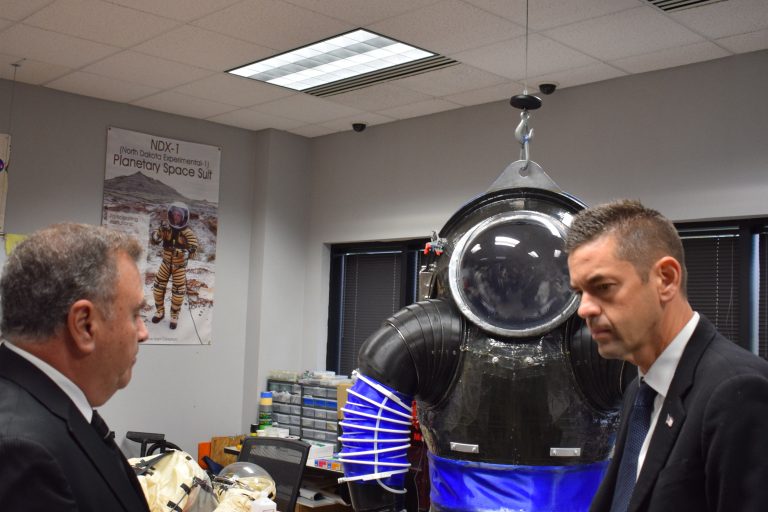
Department of Space Studies for the Artemis program at NASA’s
Marshall Space Flight Center. Photo credit: The Department
of Space Studies.
“Space suits are very labor intensive,” said Department Chair Pablo de León. “They require a lot of hours for manufacturing. As we move farther into exploration of the moon and Mars, it gets harder to transport materials. For that, you need to be able to manufacture and repair the suits at your destination.”
3D printing makes space exploration more sustainable, independent, and safer. The goal is to help future astronauts repair, maintain, and print their space suits wherever they go.
Background
“It started with an idea we pitched to NASA,” said de León. “We had a track record of performance, but this project was pretty far out there. It was interesting but risky because we weren’t sure if it would work, but NASA took the bet. Now, we are seeing results, and they seem happy with the progress we have made.”
The first prototype, NDX3, included joints that were 3D printed using flexible plastic. When these joints were tested, they worked so the project continued.
“Someone told me years ago that science is what you do when you don’t know what you are doing,” said de León. “When we went into this project three years ago, we didn’t have a clear idea of how to go about it and what process to use. So, we started with a first prototype to see if our idea would even work.”
Future Milestones
Now, the team is working on the second prototype, NDX4. This suit is almost entirely 3D printed, with minimal metal parts. Recently, the team received a patent for their 3D-printed space suits.
Testing the space suit includes pressurizing joints, comparing movement abilities to that of traditional suits, and then moving outside and completing tasks in the space suit. The team hopes to travel to the Badlands to test the suit later this summer as its environment mimics Mars.
“When we design the space suits,” said de León. “We have to think about walking in different gravities. We work in a BiPed lab with a gravity offload device that allows us to simulate how gravity would respond on the moon or Mars. In these environments, you walk differently and use different groups of muscles than you do on Earth.”
The team hopes to complete their testing and present the suit to NASA by October 2025. They hope that future suits can be customized to individual astronauts, making them more size-inclusive and personal.

“It’s magic really that something you design can be entered into a machine and be printed out the next day,” said de León. “It’s amazing that we can be doing this here at UND and be considered one of the few universities that can design these complex space systems. That’s no small accomplishment, and we are really putting UND at the forefront of this research. This will allow astronauts of tomorrow to have abilities that years ago were only in science fiction movies.”
Written by: Averie Eixenberger, Commercial Aviation and English major at UND.