Connecting disciplines, advancing discovery: Julia Zhao and Diane Darland’s interdisciplinary research at UND
By Mason Clobes
At the University of North Dakota, some of the most meaningful research begins at the intersection of disciplines.
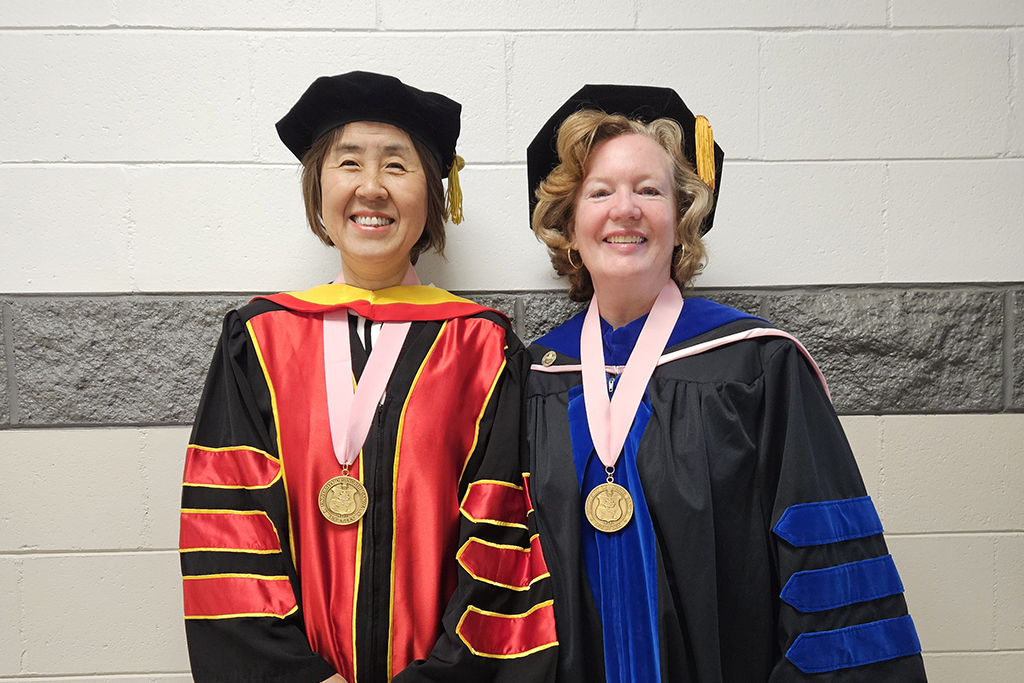
For Julia Zhao, Chester Fritz Distinguished Professor of Chemistry, and Diane Darland, Chester Fritz Distinguished Professor of Biology, that intersection has grown into a long-standing collaboration connecting chemistry, biology and nanomaterials. While pushing the boundaries of science, both Zhao and Darland emphasize the importance of creating opportunities for students to become confident, independent, and successful scientists along the way.
Zhao joined UND in 2004, and Darland arrived a year later. The two did not immediately begin working together, but their complementary expertise eventually created a natural partnership.
Zhao brings expertise in nanomaterials, including their synthesis and characterization, while Darland applies those materials to biological questions. Their work has included applications in bioimaging and drug delivery as well as newer projects involving nanozymes and persistent luminescent nanoparticles.
The pairing allows each researcher to approach a question from a different direction. Zhao can develop and characterize new material, while Darland can help determine how that material can be used to investigate biological systems.
“We have a perfect match for developing new materials and how to use it effectively,” Zhao said.
One example is their work with persistent luminescent nanoparticles. Unlike conventional fluorescent labels that diminish quickly, these nanoparticles can remain within cells and continue responding to a stimulating signal over extended periods (days or weeks). That creates possibilities for tracking different populations of cells and studying interactions that occur in developing or diseased tissue.
For Darland, that biological application is what makes the chemistry especially exciting.
“It really does provide tools that let me look at heterotypic interactions in cells,” she said, referring to interactions between different cell populations.
The nanoparticles can offer researchers a way to distinguish and follow those populations over time, creating new opportunities to study complex biological systems.
Their nanozyme research similarly seeks to connect materials science with biological questions. The project explores whether nanomaterials can help identify metabolic products in cells and provide insight into changes associated with cellular metabolism.
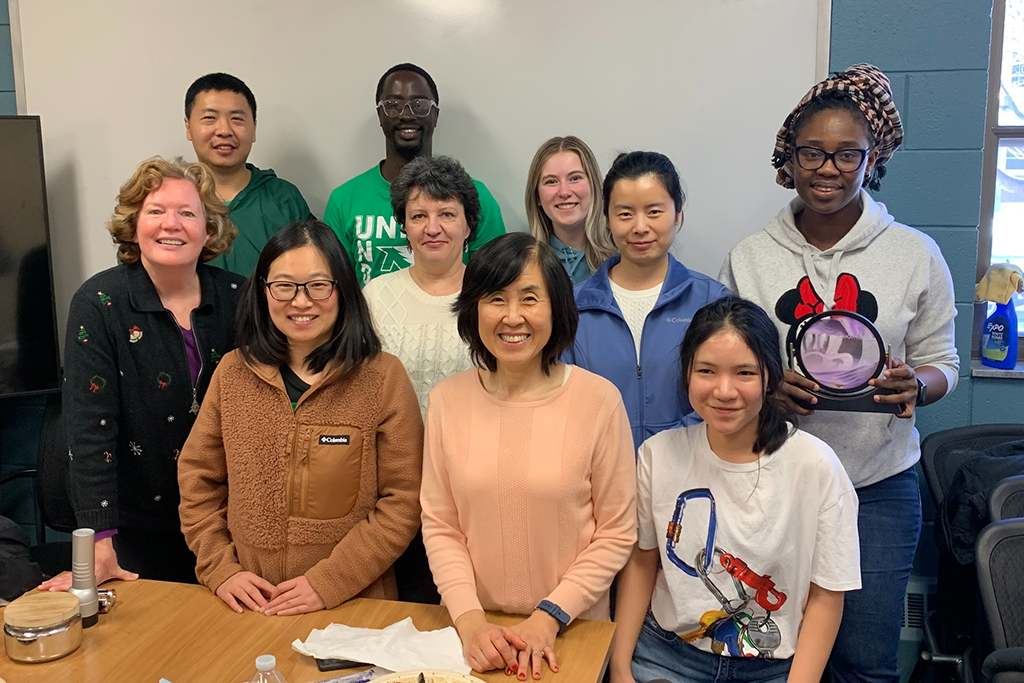
The collaboration has also become a training environment for graduate students. Zhao and Darland have formally co-advised three students and two postdoctoral researchers, while many more students have participated informally through research projects, group meetings, committees and training opportunities.
Additional training comes from collaboration with Colin Combs in the School of Medicine & Health Sciences. “I really like working with Colin [Combs] over in the medical school,” Darland said, describing the broader research community at UND. “You can identify people who not only have common research interests, but with whom you enjoy working.”
Students have been given crucial training and access to cancer cell lines from Combs’s lab for developing targeted techniques with their novel nanoparticles.
Students learn more than one side of a scientific problem. Zhao’s students gain experience with biological techniques while Darland’s students, working primarily in biology, can develop a deeper understanding of chemistry and nanomaterials.
That interdisciplinary training has translated into career opportunities.
One former student, Yingfen Wu, went on to a position at Mayo Clinic where her combined background in biology and nanomaterials was an important part of her preparation. Another student, Di Sun, received a postdoctoral offer from Harvard Medical School. Both students were co-advised by Zhao and Darland.
Zhao pointed to those outcomes as evidence of what students can gain when they are encouraged to work across traditional disciplinary boundaries.
“If you only have one side, nanoparticle synthesis, they won’t hire you,” Zhao said. “They need both chemistry and biology sides.”
Students are also encouraged to present their work as frequently as possible. Students have participated in meetings hosted by organizations including the North Dakota Academy of Science, EPSCoR and the American Chemical Society, along with UND’s Graduate School Achievement Day and national and international conferences.
Those experiences are an essential part of becoming a scientist. Students learn how to communicate their research, answer questions, interact with researchers outside their own labs and see the broader scientific community beyond UND.
The results can be dramatic. Zhao recalls students arriving at UND with limited confidence in English or public speaking and leaving as capable scientific communicators. Many of their students have also received awards for presentations and research.
Mentorship is not separate from research for Zhao and Darland; it is part of the research.
Zhao described students as people with significant potential who sometimes need encouragement when experiments fail or when a new concept feels overwhelming. Graduate research inevitably involves mistakes, setbacks and uncertainty, and both professors emphasized giving students room to learn from those experiences.
“When students struggle, you need to encourage them,” Zhao said. “You need to let them grow.”
Darland has taken that philosophy beyond her own research group. After receiving training through the Center for the Improvement of Mentored Experiences in Research, she helped develop UND’s Mentors Helping Mentors, designed to improve graduate-student mentoring across campus. Working with now-retired colleague Anne Kelsch and graduate student Blessing Okosun, Darland built the program from the ground up with summer fellowship support from the UND School of Graduate Studies.
Nearly four years later, more than 120 graduate students have completed the program’s in-person or online offerings, with additional facilitators now being trained.
Darland’s goal is straightforward: make effective mentoring a normal part of scientific training.
“If you’re training someone to be a good scientist, at the same time, you want to train them to be a good scientific mentor,” she said.
The goal is not simply to help students complete a degree but it is to help them become scientists who can eventually carry the work forward themselves.
Collaborations like Zhao and Darland’s also require institutional support. Building a new research direction takes time, equipment, personnel and, often, preliminary data. These resources can be difficult to find when researchers are already committed to existing projects.
The College of Arts & Sciences has supported that early-stage work through seed funding and interdisciplinary initiatives. In Zhao and Darland’s case, a college seed grant helped generate preliminary research that ultimately contributed to an NSF proposal.
“That helped us get the NSF grant that has been supporting our labs for the last three years,” Darland said.
Seed funding can be especially important for interdisciplinary research because collaborators often build something neither researcher could accomplish alone. A small initial investment can provide the data needed to demonstrate that a new idea works and make a bigger external grant proposal more competitive.
Ultimately, the work is about more than nanomaterials or biological imaging; it is about creating an environment where researchers can learn from one another, students can discover their potential and new ideas have the support needed to become something bigger.