The stories history left behind: UND researchers examine sexual violence in early North Dakota
By Mason Clobes
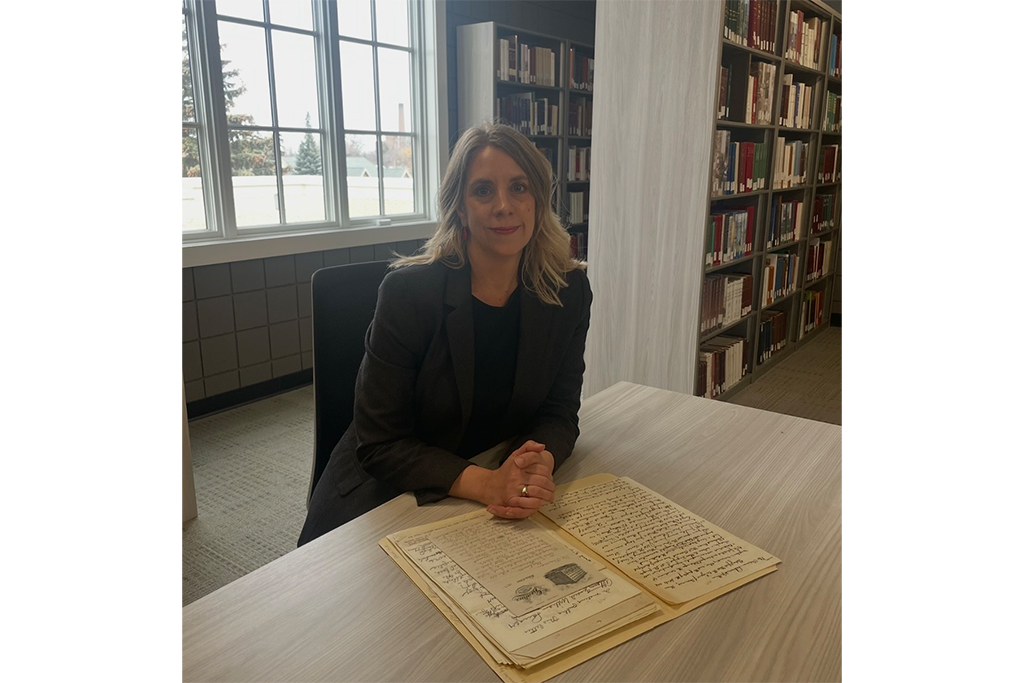
Through archival research, historical newspaper records and undergraduate collaboration, Nikki Berg Burin, assistant professor of History & American Indian Studies, is bringing attention to a difficult but often overlooked part of North Dakota’s history.
History is often remembered through the people, events and accomplishments that communities celebrate. But understanding the past also means examining the stories that are harder to tell. For Berg Burin, a historian, that means looking closely at the history of sexual violence in early North Dakota and the ways communities responded to it.
A Grand Forks native, Berg Burin has spent much of her career studying North Dakota history. Her interest in the history of sexual violence grew during the state’s oil boom in the 2010s, when conversations surrounding sex trafficking and commercial sex work became increasingly prominent in the region. At the time, she was teaching both history and women’s studies courses, and the overlap between her academic interests and issues unfolding in the surrounding communities led her to begin exploring the state’s history of prostitution, sex trafficking and sexual violence. Today, that research has developed into a book project examining sexual violence in Dakota Territory and early North Dakota statehood, roughly between 1861 and 1920.
The project began with a question: How prevalent was sexual violence in early North Dakota, and how did communities respond?
While researching an unrelated topic in the Chester Fritz Library’s Elwyn B. Robinson Department of Special Collections, Berg Burin came across records of a WWI-era statutory rape case involving a teenage girl. The discovery led her down a new research path where she uncovered references to women’s reform organizations advocating for changes to the age of sexual consent decades earlier, which was just 10 years old in Dakota Territory.
She became particularly interested in statements from the Dakota Woman’s Christian Temperance Union, whose members described sexual violence as a growing problem in the territory.
“I wondered, is there a way to quantify it? Is there a way to see the problem more clearly, to actually get a sense of how common sexual violence was in this time period, in this place?” Berg Burin said.
Without standardized crime reports or comprehensive law enforcement records from the period, newspapers became one of her most valuable research tools. Using historical newspaper databases, she and two undergraduate research assistants began documenting reported incidents of rape, statutory rape, sexual assault and other forms of exploitation. What started as an exploratory research project grew into a dataset containing more than 1,200 reported historical incidents.
History majors Katlyn Olson (’24) and Siri Ullery (’24) were the first two undergraduate research assistants to help build the original dataset, “North Dakota Sexual Violence Record: Newspaper Reports, 1861-1930.” Using Chronicling America, the Library of Congress’s digital newspaper archive, they helped develop search terms, combed through newspaper records and documented more than 800 reported incidents of sexual violence and exploitation. Each distinct incident was placed into the data set with up to 37 variables capturing information about the incident itself — including the charge, location and circumstances — as well as details about the victim and perpetrator, such as their age, race, ethnicity, occupation, marital status and relationship to each other. The variables also include information on legal outcomes, such as convictions, sentencing and pardons, and a descriptive summary of each incident.
The project continued to grow with the help of additional students. History major Carson Grave (’25), another undergraduate research assistant, expanded the dataset using Readex’s America’s Historical Newspapers database, adding another decade of newspaper records and helping bring the collection to approximately 1,000 cases. Subsequent research using additional newspaper databases pushed the total beyond 1,200.
Most recently, junior history major Aubrey Griedl organized and refined the growing collection. Her work involved fact-checking records, developing consistent abbreviations for different charges and case outcomes and creating additional spreadsheets to make the information easier to analyze. What had started as years of accumulated research was becoming a more organized and useful resource for Berg Burin’s book.
Berg Burin emphasized that students are active collaborators throughout the process. Regular meetings give them an opportunity to discuss what they are finding, raise questions and share their own interpretations of the material.
“They’re not just given a task that I later evaluate,” Berg Burin said. “They are collaborating with me at every step.”
That collaboration has benefited both the project and the students. Berg Burin noted that students often bring technical skills and perspectives that she does not necessarily have herself, particularly when it comes to organizing and navigating large datasets. Griedl, for example, introduced her to the usefulness of pivot tables and helped develop a system that made the information considerably easier to navigate.
For Griedl, working alongside Berg Burin also helped build confidence and problem-solving skills.
“Working with Dr. Berg Burin allowed me to gain historical research skills, the confidence to creatively problem-solve, and be a part of something important,” she said.
While the dataset offers a valuable look at how sexual violence was reported in early North Dakota, Berg Burin is careful to distinguish newspaper coverage from the actual prevalence of these incidents. Newspapers did not report every case equally. More sensational stories often received greater attention, and the records reflect the biases and priorities of the communities and publications that produced them.
For example, the dataset contains significantly more reports involving white women and girls, particularly teenagers, while Indigenous victims are almost entirely absent. For Berg Burin, that absence is meaningful in itself. It raises questions about whose experiences were considered newsworthy and whose stories were overlooked.
There is also the responsibility of working with deeply personal and sensitive historical records. Many of the individuals documented in the newspapers had their names and experiences publicly exposed, sometimes in considerable detail. Although those accounts are now part of the historical record, Berg Burin believes that does not mean they should be shared without careful consideration.
“I think when we’re talking about sexual violence, victims’ needs and interests have to come first,” she said.
She makes sure her students are introduced to these ethical considerations involved in handling sensitive information, including the importance of protecting individual identities and approaching historical accounts with care.
Berg Burin also recognizes the emotional weight that can come with this kind of research. Reading accounts of violence day after day can become routine, until a particular story brings the gravity of the material back into focus. Whether they are feeling desensitized or distressed, she encourages students to step away, take breaks and communicate when the work becomes difficult.
She hopes they leave the project with an understanding of how to care for themselves as researchers, something that can carry into any field of study.
Griedl found that working with the subject matter strengthened her empathy and changed the way she viewed local history.
“Working with Dr. Berg Burin and working with the subject matter at hand has deepened my empathy and opened my eyes to the history of our locality that, despite the horrific nature of it, should be made known,” Griedl said.
Although Berg Burin’s research focuses on events more than a century ago, she sees its relevance extending well beyond historical scholarship. During the period she studies, North Dakota was still defining its identity. Communities were developing, political movements were taking shape and residents were debating what kind of state they wanted to build. Yet, despite examples of significant social and political change, the ways communities addressed sexual violence often followed patterns seen elsewhere in the country.
Berg Burin hopes her work will contribute to a more complete understanding of North Dakota’s history, particularly women’s experiences during the state’s formative years. But she also wants readers to consider the broader role communities play in responding to sexual violence.
“Being opposed to it and saying this is wrong isn’t enough,” she said. “It’s not just an individual problem between a victim who suffered a trauma and a perpetrator who inflicted harm, but it is a larger community problem, so the community has to contribute to its solution.”
Her research is also beginning to reach beyond the written page. Berg Burin is collaborating with historians and documentary filmmakers from other institutions on an early-stage film project examining sexual violence across the Northern Great Plains during the early 20th century. The collaboration brings together researchers with different academic backgrounds and approaches, offering another way to share these histories with broader audiences.
“These stories matter just as much as the ones that make us proud,” she said.
Through her research and the contributions of UND undergraduate students, Berg Burin is helping bring those stories into greater focus. Along the way, students are gaining more than experience working with historical records. They are learning how to ask difficult questions, collaborate on meaningful research, think critically about evidence and approach their work with empathy and responsibility.
It is an opportunity to contribute to something larger than a classroom assignment: a deeper understanding of the history of the place they call home.