UND undergraduates explore how local businesses are navigating AI
By Mason Clobes
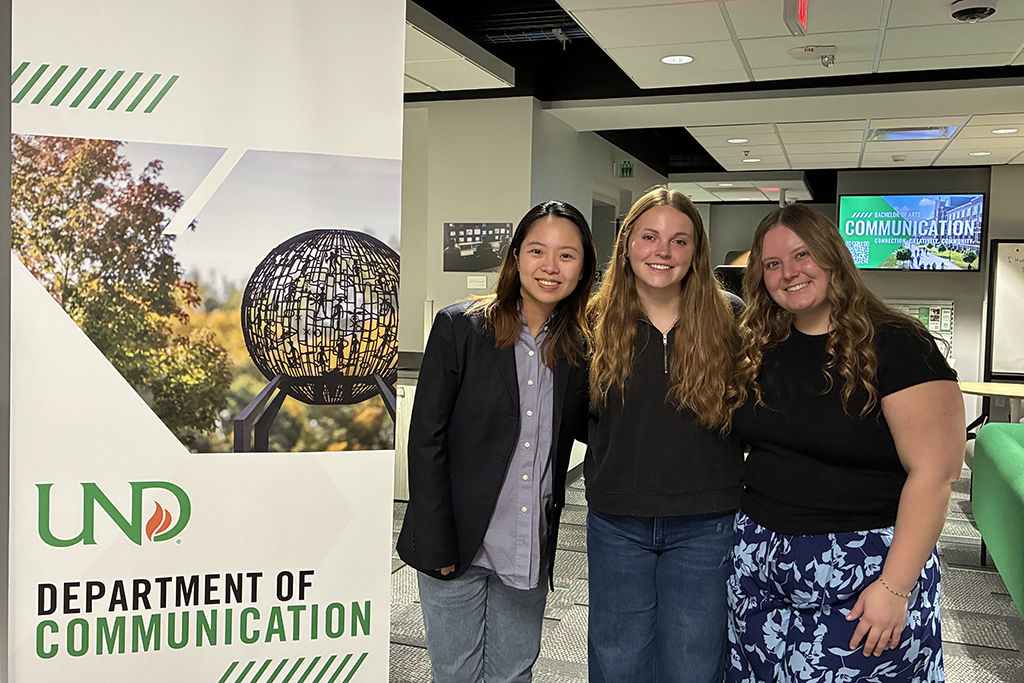
For University of North Dakota sophomore Makenzie Oltmans, a psychology and Spanish double major with a minor in communication, and Kasey Guttormson, a sophomore studying biochemistry, research offered an opportunity to step outside their academic comfort zones. Neither came to the project with extensive experience in research methods, but both were eager to learn.
Their work with Linqi Lu, an assistant professor in UND’s Department of Communication, connects research with community impact: interviewing Grand Forks business owners about their views on artificial intelligence and using those insights to inform an AI toolkit that helps local businesses strengthen their visibility and communication.
The project has given the students a firsthand look at how emerging technology is changing the way people work, communicate and interact with customers. Just as importantly, it has allowed them to experience research beyond the classroom, from conducting interviews and analyzing responses to preparing to present their findings to the local business community.
“It was kind of a step outside of my comfort zone,” Kasey said, describing the process of reaching out to business owners, finding the right contacts and arranging interviews. “Definitely just getting my face out there, making those connections, and obviously stepping outside the comfort zone of talking to people in that way.”
Lu’s research bridges communication, computer science and psychology to examine how information and emerging technologies shape human perceptions, decisions and well-being. Her work advances both the understanding of technology’s social influence and the development of AI tools for communication and research.
In this project, Lu and her collaborators sought to understand how local businesses view AI and whether they would consider incorporating tools such as AI avatars or persona prompting into their operations. The team interviewed business owners about their experiences, concerns and expectations to incorporate their opinions into agentic AI experimental design.
The students helped bring those perspectives into the research by conducting interviews with businesses throughout the Grand Forks area. Getting those conversations started was not always easy. Some business owners declined to participate as soon as they heard the topic was AI, believing their businesses had little connection to the technology.
The students persisted, following up with potential participants and finding ways to explain why their perspectives mattered.
Mackenzie, who had previously interned at her hometown newspaper, brought some interviewing experience to the project. Still, she found that research interviews required more than simply asking a prepared list of questions.
“You had to email them three or more times until they answered, and then you’d be calling them,” she said. “Eventually you would get an interview, and they would be great and extremely beneficial.”
The experience taught her to be persistent, adjust her approach and ask questions in ways that encouraged people to share their opinions openly.
The interviews also revealed that attitudes toward AI were rarely as simple as being for or against it. Some businesses were uncomfortable with the technology, while others were already using it in their daily operations. Even within a single business, owners could see value in some applications while rejecting other more customer-facing tools.
These distinctions help explain how people respond to AI. Understanding those responses means looking beyond whether someone likes the technology to ask why they feel that way and how their attitudes vary across situations.
Once the interviews were complete, the team faced another challenge: making sense of the information they had collected.
Interviews produce detailed accounts of people’s experiences and perspectives. To identify patterns in those accounts, researchers must examine and organize the responses systematically. This process introduced the students to qualitative research.
Lu and her collaborators, including sociology professor Katherine Furl, guided the students through a systematic approach to analyzing the interviews. The team used a codebook to identify recurring themes, including skepticism toward AI and the ways people attribute human characteristics to AI systems.
“The project has also benefited from support within UND’s Department of Communication, including help from Dr. Lee in connecting the work to the local community.” Lu said.
Kasey spent time reading interview transcripts line by line, identifying relevant passages and examining how frequently particular themes appeared. The team could then compare responses across different types of businesses to see where perspectives aligned and where they diverged.
For Kasey, who had little previous exposure to qualitative methods, the project offered a new perspective on how social science research works.
“I had no experience with quantitative versus qualitative data,” Kasey said. “All the big words and learning how that coding process works was a learning curve.”
Lu designed the project to introduce students to methods beyond their prior experience. With her own background more heavily focused on quantitative analysis, she brought in UND collaborators with expertise in qualitative methods to provide rigorous training.
The project also gave Lu and the students an opportunity to another emerging possibility: using AI itself as a research tool.
After the human researchers coded the interviews, Lu explored how large language models could analyze the same material using the team’s codebook and carefully written instructions. Comparing the results allows researchers to examine where AI agrees with human analysis, where it misses important details and how its performance might be improved.
For the undergraduates, this created an opportunity to see AI used in a context beyond generating answers or helping with schoolwork. By comparing their interpretations with a model’s output, they could see how researchers evaluate the technology’s performance.
Lu emphasizes that AI-assisted analysis requires human oversight. Researchers must define clear criteria, check the consistency of results and validate AI-generated classifications against human judgments. AI can help process large volumes of information, but the reliability of its analysis depends on how it is instructed and evaluated.
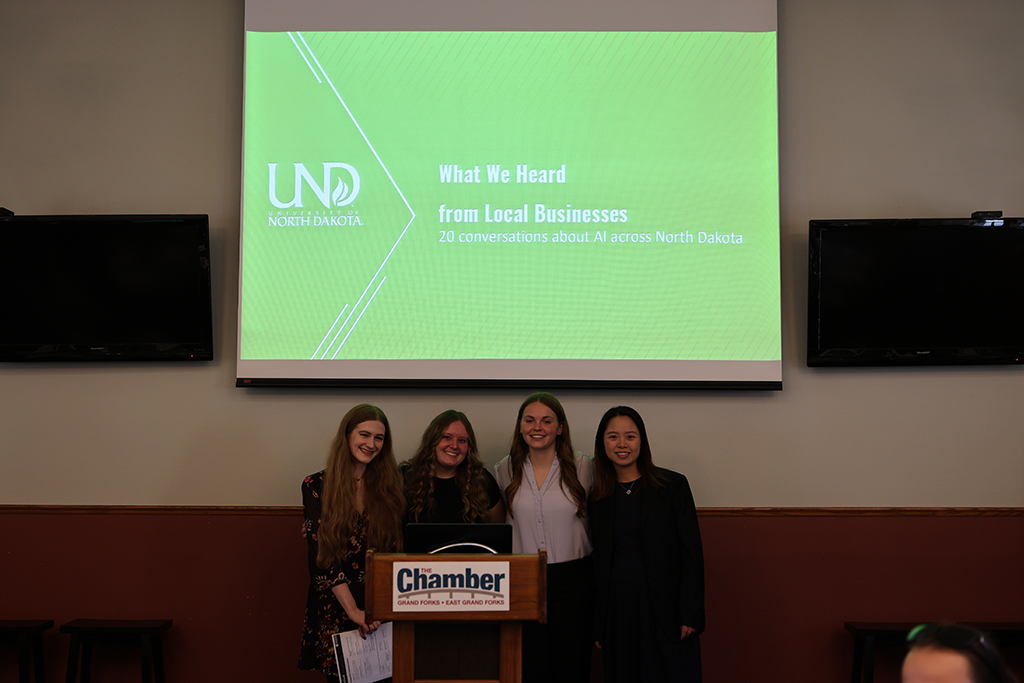
The team partnered with the Grand Forks Chamber of Commerce to bring its initial findings back to local business owners. At an Oct. 23 workshop, the students presented what they learned from the interviews, highlighting common themes as well as differences among business sectors.
The event gives the students a chance to share their work with an audience outside the university and allows participating businesses to hear how their experiences fit into the broader picture.
Mackenzie admitted she was a little nervous about presenting to community leaders, but she was also excited by the opportunity.
“It’s so exciting to be part of something like this, and it’s so unlike anything I’ve been a part of,” she said.
For Kasey, the presentation offers a different kind of challenge. She has experience speaking in front of groups through her tutoring work, but this research requires her to communicate findings without a single right or wrong answer. Instead, she must explain what the team heard and what patterns emerged from those conversations.
The Chamber collaboration reflects Lu’s broader effort to connect research with practical applications. She plans to extend the project through UND Connect, including a workshop to help businesses explore how to create AI agents suited to their needs.
A second phase of the research will use experiments to examine how people respond to AI personas. Drawing on the interviews with business owners, the team plans to investigate how different AI identities and designs shape those responses. For example, a persona modeled on an animal or an object associated with a business might affect how customers engage with it. The researchers will explore questions of trust and interest, including whether an AI character feels engaging or intrusive.
Although the project centers on AI, its impact on the undergraduates reaches well beyond the technology itself.
For Mackenzie, the interviews offered a chance to explore the human side of business, an area that connects with her interest in psychology and workplace relationships. Speaking directly with business owners helped her understand how people make decisions about technology in real-world settings.
Kasey gained experience navigating unfamiliar research methods and communicating with people outside her immediate academic environment. Both students learned that research requires flexibility: questions may change as new information emerges, participants may be difficult to reach, and the most interesting findings are not always the ones researchers initially expect.
Neither student needed to arrive as an expert to contribute. The project gave them a way to develop skills they can carry into future research, professional opportunities, and other areas of their education.
As AI becomes part of more workplaces and everyday interactions, Lu’s research examines how people respond to it and what shapes their attitudes. The project gives UND students a firsthand role in that work, connecting research experience with questions facing local businesses.