UND hosts pair of literacy-focused events
Teachers, families from around region attend CEHD’s StoryWalk and Pages & Pathways Literacy Conference
The College of Education & Human Development kicked off summer with literacy-based programming, welcoming nearly 150 North Dakota educators and community members. On June 18, the College introduced StoryWalk at the GRO.UND Learning Garden, the first of its kind on a university campus according to Joshua Hunter, associate professor of Education, Health & Behavior.
The Learning Garden’s self-guided StoryWalk invites visitors to read Julie Flett’s book “We All Play” while walking the perimeter of the garden. Flett’s children’s book draws parallels between the play of different species of animals and human children. Each panel includes QR codes that direct attendees to Cree translations of words on each page.
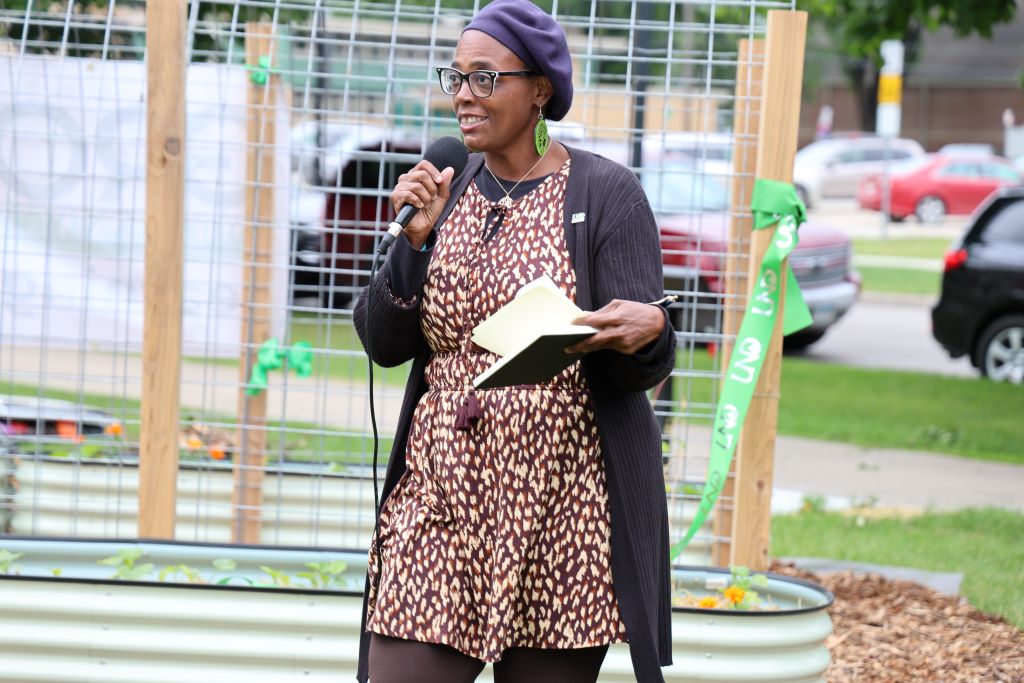
Salaam Green — author, educator, first poet laureate of Birmingham, Ala. and UND alumna in the Early Childhood Education master’s program — was present for the opening ceremony and read a freshly composed poem about UND’s Learning Garden to an audience of families as well as UND faculty, staff and students.
“Come, come, come to this garden,” Green read. “Come to this garden and feel full again. Come to this garden and dream again.”
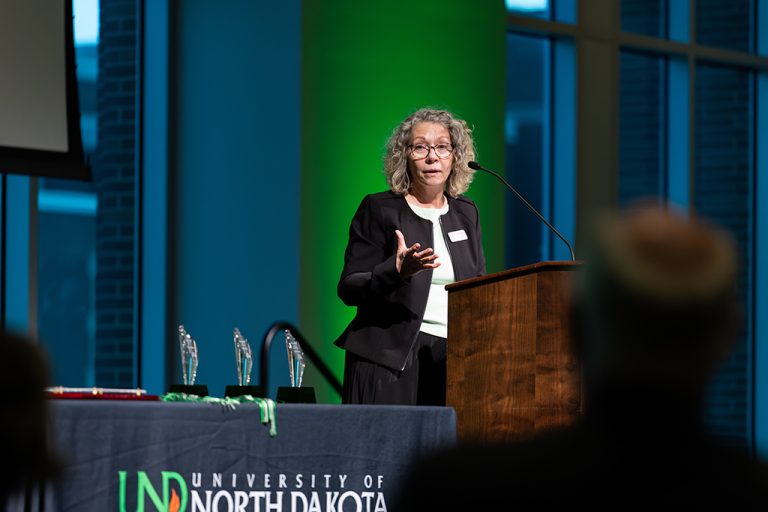
Green, the founder and executive director of Alabama-based program Literary Healing Arts, encouraged audience members to immerse themselves in literature and nature as they explored the Learning Garden’s sights and activities. She also provided a keynote speech at the College’s Pages and Pathways: PreK-12 Literacy Conference the following day.
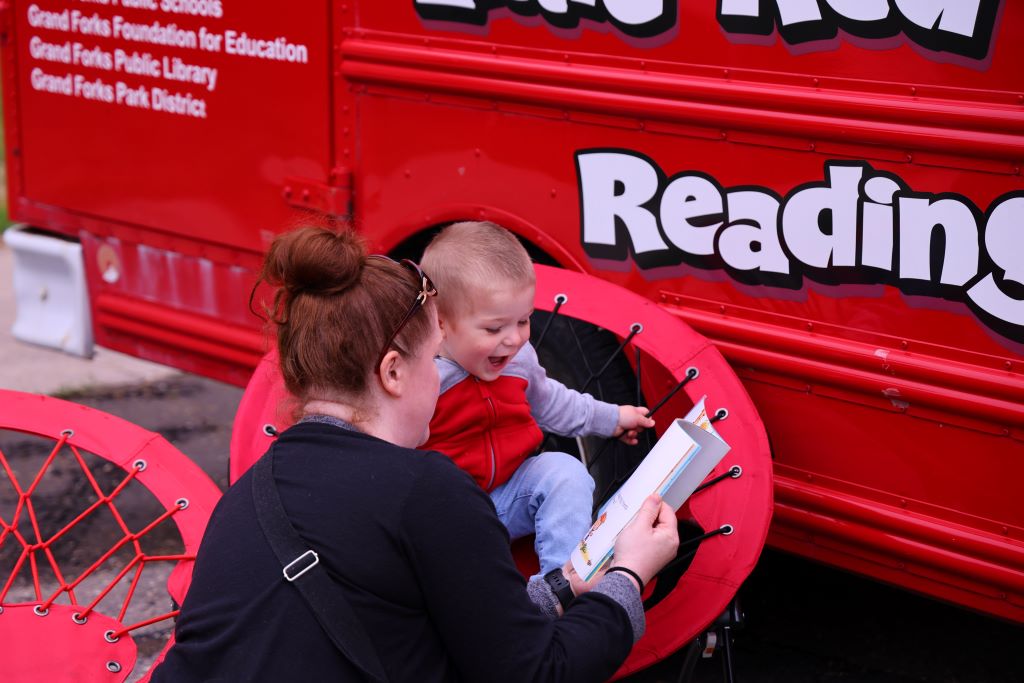
The StoryWalk event included Learning Garden staples such as the Smell and Touch Garden and pollinator gardens, as well as community attractions such as the Little Red Reading Bus. The bus, a mobile library, is supported by the Greater Grand Forks School District, the Grand Forks Public Library and the Grand Parks District Foundation.
Cheryl Hunter, professor of Education, Behavior & Health, said that the StoryWalk and Learning Garden were designed to bridge the gap between the University and surrounding community.
“You don’t often see learning gardens on university campuses, so it was really important to us that the community feel welcome to experience the StoryWalk and garden,” she said. “It’s totally accessible to the community, and it’s an experiential environment. You can teach things like science, art and nutrition, all in this area that’s open to the community.”
Surrounded by families exploring the Learning Garden’s sights and activities, Hunter said that the goal of the StoryWalk was to provide an on-campus, community-centric space for people of all ages to grow and learn about a variety of disciplines.
“We’ll be doing things in every season,” Hunter said. “The mission of the Learning Garden is to embody everything that the University has to offer; service, equitable access and the discovery — all in nature.”
Along with the pollinator garden and the Smell and Touch Garden, the event featured a community weaving project and live music from local musical act, the Ferguson Five. Cheryl Hunter noted that the StoryWalk’s activities and featured stories will rotate periodically through the seasons.
The next event, to be held later this fall, will be a harvest of all the edible produce that grows in the Learning Garden. Last year, GRO.UND donated 1200 pounds of food to students and community members who were food insecure.
Pages & Pathways Literacy Conference

The following day, CEHD held the second conference in its Pages and Pathways series, this time with a focus on reading and literacy.
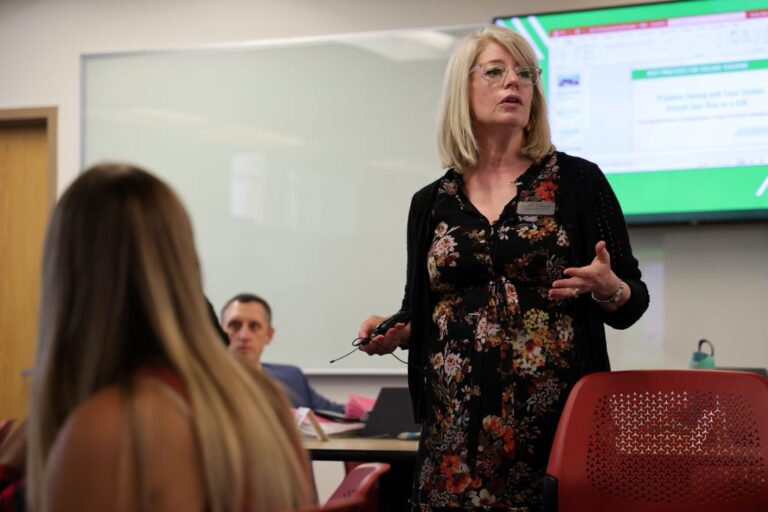
Linda Diamond, executive vice president of the Consortium on Reaching Excellence in Education (CORE) and co-author of the organization’s teaching reading sourcebook, was a keynote speaker at the event. A prominent figure in the rise of CORE learning and the “science of reading,” Diamond spoke to the importance of adopting evidence-based practices in literacy instruction.
“There’s been a longstanding debate — the so-called Reading Wars — that led to phonics being neglected,” Diamond said. “There are decades of research that shows that phonics is necessary for most children, along with vocabulary and background knowledge.”
In 2021, the state of North Dakota passed legislation requiring all K-3 students to learn reading under research-backed methods such as CORE’s Science of Reading (SoR), an evidence-based approach to teaching reading. Diamond noted in her keynote speech that the science of reading is not a curriculum or program but the culmination of years of research from fields including neuroscience and linguistics.
Sonja Brandt, assistant professor of elementary education methods, helped the Office of Teacher Recruitment and Retention program the event. The recent adoption of the science of reading by North Dakota public schools meant that offering the conference was an easy decision, she said.
“This SoR movement has been a big shift for educators. It’s a good change, but it’s a little scary because it’s very different,” Brandt said. “But the data is consistently showing that we have a huge percentage of kids in elementary school who don’t know how to read at their grade level, and we as a state needed to do something about that.”
At the conference, she provided a presentation on teacher and classroom resources with fellow CEHD faculty member McKenzie Rabenn. Brandt, who taught in fourth and fifth-grade classrooms in Minnesota, said her experience showed her how valuable conferences like the Science of Learning can be.
“Resources can be limited, especially when we’re talking about making those big shifts like we are with the science of reading,” she said. “One of the first questions that always comes up is where the money will come from. Looking for resources and ideas can be exhausting, so McKenzie and I wanted to offer a broad variety of resources that teachers could see bringing back to use in their classrooms.”
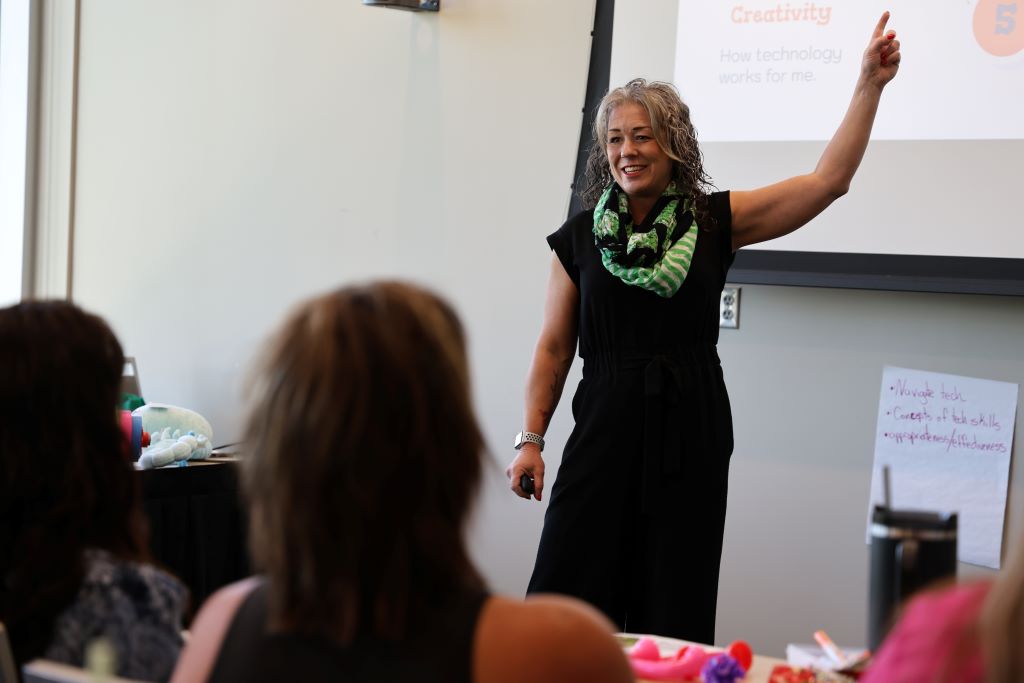
The conference featured 34 sessions presented by UND faculty and other educators from around the state. More than 130 K-12 teachers from North Dakota and Minnesota attended, earning a continuing education credit for just $20.
Bryce Nordine, who teaches sixth grade at Elroy H. Schroeder Middle School in Grand Forks, said he appreciated both the affordability of conference and the variety of sessions offered. He picked up some tips from the session on using AI as a teaching assistant.
“We’re trying to integrate literacy into all aspects of the classroom; things like science, math and English,” Nordine said. “I registered to get some new ideas of how to do that, and a lot of the sessions were great.”
Monte Gaukler, outreach specialist for OTRR, and Katie Stermer, who will take the reins from Gaukler when she retires in the fall, said they were happy to hear from teachers who found many of the sessions helpful. Further, they hope that hosting teachers from both North Dakota and Minnesota will continue the flourishing relationship between UND and the region’s educators.
“The more we reach back to the community, the more likely we are to make connections with teachers who weren’t aware of UND’s resources,” Gaukler said. “It’s all about making those connections and removing barriers, so that educators across North Dakota and Minnesota can share their knowledge with us and we can share our knowledge with them.”
The next Pages and Pathways conference, this time with an emphasis on STEM education, will be held in August.