A history of adaptive esports
Accessible gaming traces its origins to 1980s arcade games, writes UND scholar in The Conversation
Editor’s note: On Aug. 5, The Conversation published an article by Matt Knutson, assistant professor and director of UND’s academic program in Esports, outlining the history of participation in the discipline by people with disabilities.
The article is below and can be read in its original form on The Conversation’s website. As of Aug. 13, the article has been read more than 4,000 times by readers in the United States, Canada, Australia, United Kingdom and France, among other countries.
The Conversation is a nonprofit media resource that publishes “explanatory journalism” columns by university scholars, and makes those columns available for free and immediate republication. A complete list of all articles authored by UND scholars can be found on The Conversation’s website.
UND faculty members and graduate students who’d like more information on writing for The Conversation are invited to read Introducing The Conversation, a story that appeared in UND Today in 2022. An additional story from 2023, More than 340,000 readers worldwide, noted that UND faculty members who’ve written for The Conversation report “outstanding” experiences and say they’d recommend without hesitation that their colleagues become Conversation authors.
Questions? Please contact Tom Dennis, UND associate director of communications, at tom.dennis@und.edu, or Adam Kurtz, UND strategic communication editor, at adam.kurtz.1@UND.edu. Thank you!
By Matt Knutson
If you’ve seen an esports competition, chances are that there was a big stage with about 10 gaming PCs, each with a young person behind it wearing a look of intense concentration. They may have been competing for upward of a million dollars, and at the moment of victory, the winning team suddenly started screaming in joy.
Some of those esports players are people with disabilities. Today, esports organizations such as Permastunned and Para Esports shine a spotlight on the accomplishments of competitors with disabilities. They also attract industry support from big-name sponsors.
You might assume that these competitions started on flashy advanced technologies that arrived only in recent years. In fact, video games have enabled people with disabilities to experience new kinds of sporting activities for more than 40 years.
In one notable case, players with physical disabilities competed at pinball and other arcade games in tournaments held in Pittsburgh during the early 1980s. Disability advocates at the time praised how the games gave these players new sources of accomplishment, recognition and community-building. One player, Rob Marince, is central to this long-overlooked story, which I describe in my recent article in ROMchip, a journal of games history.
Empowering a pinball wizard
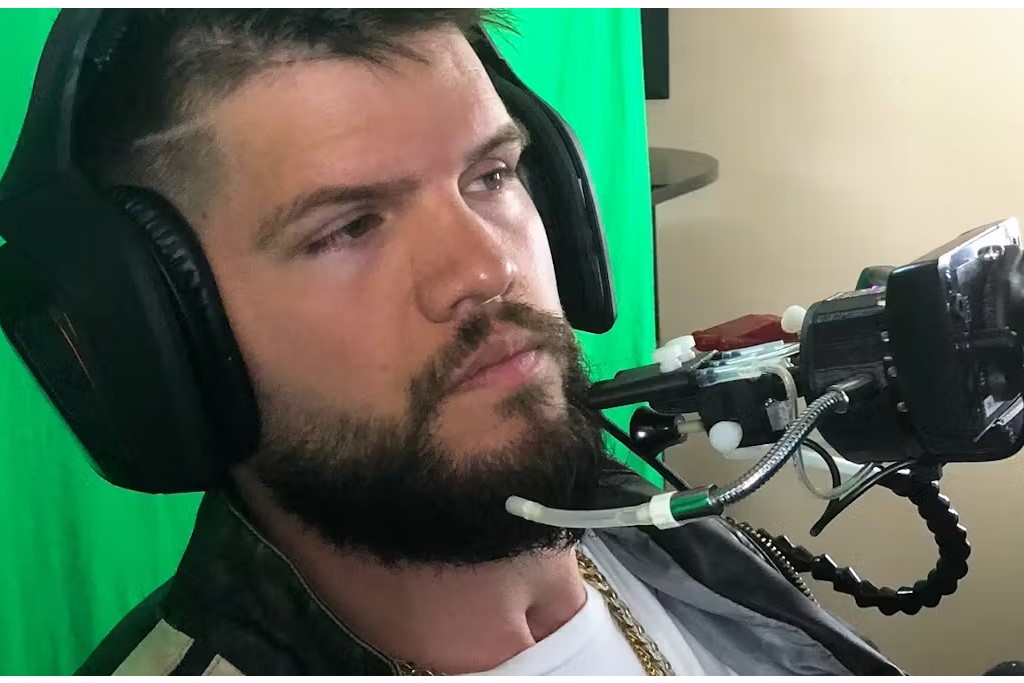
When an auto accident in 1977 paralyzed Rob from the neck down at the age of 17, his brother Gary took six weeks off from college to design a sip-and-puff controller that would enable Rob to play pinball and arcade games with his breath. Gary had collected parts from amusement manufacturers to assemble this device in order to give Rob some leisure activity and improve his quality of life.

with his mouth, thanks to his brother
Gary’s engineering prowess, landed
him on the cover of gaming
magazine RePlay in 1981.
Gary was self-taught, acquiring engineering skills through tinkering. He designed many other accommodations for Rob in the Marince home beyond the gaming interface. Eventually, Gary started organizing public competitions so that others in the Pittsburgh area could use the same kinds of controllers to access games and play together in friendly competition.
These tournaments were not small, private events. Pittsburgh sports figures, including Penn State football head coach Joe Paterno and members of the Pittsburgh Steelers, attended these events and tried out the same mouth interface as the other competitors. Additionally, local radio DJs announced the matches and gave away prizes, such as an $800 stereo system.
The extensive press coverage of these events highlighted disability technologies more generally. One story described the technological accommodations around the Marince household, including an Apple II Plus computer outfitted with a voice-command system that allowed Rob to perform tasks such as dimming or brightening the lights, adjusting his bed, playing video games and tape-recording TV shows.
A long road of progress
In the 1980s, arcade manufacturers such as Atari, Midway Manufacturing and Williams Electronics donated equipment to the tournaments for players with disabilities. They also supplied Gary with spare parts to build the custom mouth interface that his brother needed.
The path from 1980s arcade and pinball to today’s multimillion-dollar mainstream video games is neither a straight line nor a story of constant improvement for people with disabilities. Some game genres came and went, as did some game companies. Players with disabilities were gaming all along, but it wasn’t until the 2010s that advocacy for these players started getting wide recognition.
Over the years, the games industry had been slow to include players with disabilities in the game design processes where they could address systemic issues of accessibility. Advocacy organizations have worked in this space for more than a decade, with one landmark being the Includification project published in 2012 by AbleGamers.
Additionally, websites such as Can I Play That? have driven the conversation about which game developers are doing their part. With more than 60 accessibility options, a game like 2020’s The Last of Us Part II illustrates how seriously studios like Naughty Dog have taken the challenge of accessibility in gaming.
The gaming industry has improved its recognition and accommodation of disabilities in recent years. More games feature more enhancements for players with disabilities. Some have color-blind modes that prevent key information from being ambiguously colored. Some have subtitles of environmental sounds to ensure deaf players don’t miss off-screen threats. And some have customizable control schemes that can meet the physical needs of players with disabilities.
There has also been notable progress in recent years for accessible physical interfaces. The 2018 Xbox Adaptive Controller and the recently released Sony Access controller both feature modular design. Players with disabilities can swap components in or out as desired instead of trying to wrangle the one-layout-fits-all style of traditional controllers
Accessible gaming today
Today’s digital competitions open up new forms of sport to players with a broad range of abilities. Rob Marince’s story highlights how efforts to boost accessibility in gaming go all the way back to the era of arcade games. These pioneering projects laid the groundwork for the benefits of community-building, excitement, public recognition and the chance for achievement now enjoyed by so many players with disabilities.
And despite the massive popularity of video games and esports today, pinball machines continue to attract new generations of players – and, with them, ongoing efforts to make the electromechanical games accessible to players with disabilities.