PHOTOS and VIDEO: UND’s Summer Commencement 2024
University awards degrees to more than 500 students at ceremony, which features veteran journalist Chuck Haga as keynote speaker
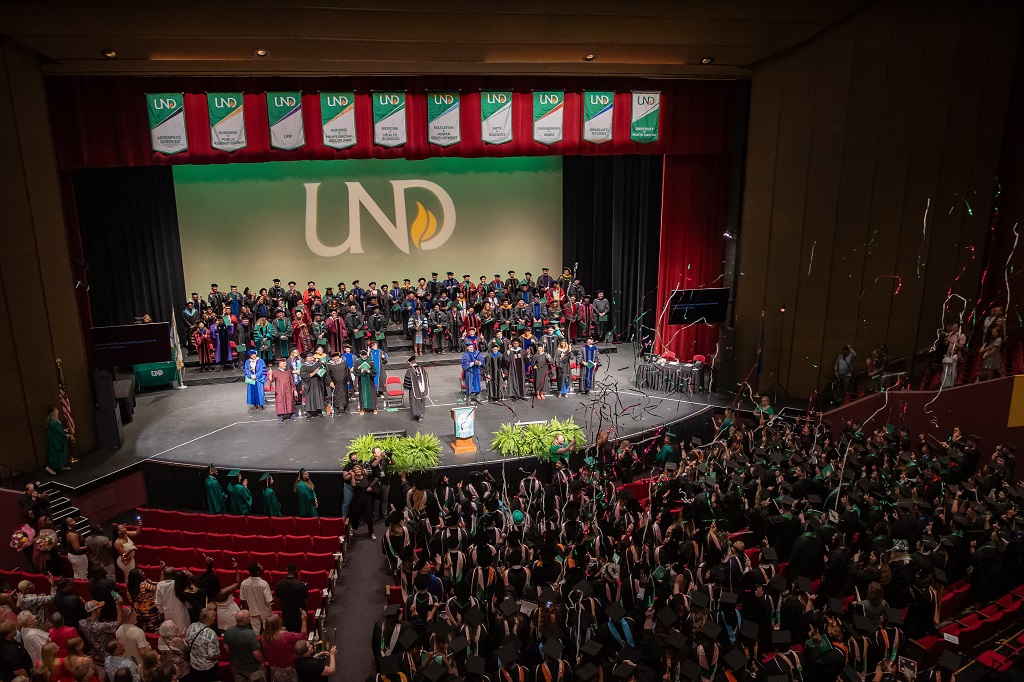
Some 535 undergraduate and graduate students were eligible to receive degrees at UND’s Summer Commencement ceremony, which was held on Aug. 2 in the Chester Fritz Performing Arts Center on campus.
The afternoon ceremony “filled seats into the upper balcony,” the Grand Forks Herald reported.
“As with his recent addresses, President Andy Armacost included his remarks as a salute to graduates of UND’s online programs, who make up a growing share of the University’s students.
“We are thrilled to have them included in today’s ceremony,” Armacost said, as quoted by the Herald. “We celebrate your achievements as well.”
Chuck Haga, veteran journalist and adjunct professor in the UND Department of Communication, was the ceremony’s guest speaker. His commencement address is below, and a video of the address can be found on UND’s YouTube page.
Also, UND photographers used Exposure software to compile an extensive photo feature of the May 11 events. Click on the link to see the photos, and enjoy.
Congratulations to all of the graduates!
* * *

‘Life hurts, and love is the only drug that works’
Editor’s note: The following is the address delivered by Chuck Haga, veteran journalist and adjunct professor in the UND Department of Communication, at UND’s Summer Commencement ceremony Aug. 2 in the Chester Fritz Performing Arts Center.
It is an honor to be with you today … and a bit of a mystery.
You may wonder — I wonder — What am I doing here? What might an old newsie have to say to you?
Well, let me begin by saying that I’ve been teaching at UND for 10 years, and through that I know something about you, and that gives me hope. Hope, and faith that you are coming to the aid of a troubled world.
So, I’m here to plead with you to do just that.
As I said, I believe I know you.
I know you’re smart.
I know you care.
I wish you read more, including newspapers, and engaged more, and had more confidence in your ability to express yourselves, in speech and writing. But I know you struggle with doubts about your ability to matter, to make a difference. Gaza and Ukraine, even Washington, D.C., seem far away and irrelevant.
Though retired, I am still a newsman. I believe fervently in democracy — and in the essential role played by a vigorous, unfettered press in sustaining our democracy, always in pursuit of a more perfect union. I don’t know if any of you are aimed that way professionally, but we really need you.
I turned to Facebook — some of you remember Facebook — and I asked my “friends” there for advice. What should I tell these college graduates, most of them half a century younger than me?
I know from brutal classroom experience that most of you are not inclined to seek or appreciate advice from the likes of me. I’m a boomer.
But my friends reassured me I had something to say, as long as I spoke from the heart, which I intend to do.
Some of their advice I quickly rejected. I am not, for example, going to moon you all on behalf of my generation.
Here are some of the more appropriate messages:
Learn to say these words: “I apologize.” “I need help.” “I didn’t know.”
Guard against complacency. Fear the growth of intolerance. Don’t be afraid to take risks. Learn from failure.
Move to Costa Rica, one of my friends said, despairing over current affairs.
Be brief, another said. I should offer congratulations, then say, “OK. Your turn.”
And one fellow declined to suggest themes for my speech but wrote, “It better be good. I’m going to be there.”
Hudson?
I’ll add a few more, and this really is from the heart, old and mangled though it may be.
Be patient.
Be kind — to each other and to yourself. Treat others with respect, including those who disagree with you.
Be open to love in all its varieties. Life hurts, a friend about to die told me years ago, and love is the only drug that works.
Take the time to notice small things: mist rising through trees at dawn. The pure silence of a forest.
Learn to listen to understand, not simply to prepare your next point in an argument doomed to go nowhere.
You have made friends here. Don’t let them slip away. When a friend loses a parent, go to the funeral. Facing serious health issues and about to turn 75, I went on a 5,000-mile road trip last month — 19 states — to see faces of distant friends who matter to me: high school classmates, college and work buddies, some aching and hobbling like me.
One of my UND colleagues said that on my behalf she asked ChatGPT for guidance. I’m sure she was smiling, knowing my deep suspicion toward artificial intelligence. Smart people believe we can handle AI, that positives will outweigh negatives. Personally, I hate that I’ll never again look at a beautiful photograph without wondering if it was real or manipulated.
ChatGPT told me to encourage resilience and adaptability. That’s good, but I was hoping for something more inspiring, more heartfelt, more human.
Another friend recommended that I consult recent commencement addresses that were highly acclaimed.
Taylor Swift, for example.
I looked it up. She started with, “The last time I was in a stadium this size, I was dancing in heels and wearing a glittery leotard.”
I’ll spare you that. But what followed were thoughtful lessons from her life. “One toxic relationship can outweigh so many wonderful, simple joys,” Taylor said. “You get to pick what your life has time and room for. Be discerning.”
The great documentary filmmaker Ken Burns talked about “contradictory human nature … all of our inherent strengths and weaknesses, our greed and generosity, our puritanism and our prurience, our virtue, and our venality parade before our eyes.”
That struck home with me, as I recently visited Monticello, Thomas Jefferson’s home, where the tour now includes an honest and deeply troubling account of Jefferson the slaveowner alongside Jefferson the champion of freedom.
In his commencement address, Burns quoted the 28-year-old Abraham Lincoln. “All the armies of Europe, Asia and Africa could not by force take a drink from the Ohio River or make a track on the Blue Ridge in a trial of a thousand years. If destruction be our lot, we must ourselves be its author and finisher.”
You must choose, Burns said: “honor over hypocrisy, virtue over vulgarity, discipline over dissipation, character over cleverness, sacrifice over self-indulgence.”
Burns spoke at Brandeis University, and he quoted the school’s famous namesake, Supreme Court Justice Louis Brandeis: “The most important political office is that of the private citizen.”
In that I agree. The late Eliot Glassheim, a state legislator, a man of learning and my dear friend, addressed me as Citizen Haga. Next to Grandpa, it is my favorite honorific.
Eliot would want me to implore you to vote.
People who know me best know that I lurch between hope and despair. When you address the graduates, they said, choose hope. And I will, because I see hope in you, and because the future of my grandchildren depends on it.
Fifty-some years ago, when I was young, we were so hopeful.
Despite the awful disappointments of those years — assassinations, the disastrous war, race riots — I held onto the belief, the hope, that things would get better.
When Kent State happened in May 1970, when young Americans in uniform opened fire on young Americans protesting an unjust war, I took part in the largest demonstration UND had ever seen, a demonstration that might have ended badly if Tom Clifford, a Marine veteran of World War II and soon to be UND’s president — if Clifford had not stood in the doorway of the ROTC Armory, listened to us and showed that he understood why we were so angry.
We were angry, but we still were so hopeful. We still believed, with Dr. (Martin Luther) King, that while the moral arc of the universe is long, it bends toward justice.
I’ve been challenged many times in the years since, mocked it seemed, for my hope, my faith that things would get better.
I’ve spent too much time fretting over mistakes and disappointments, and I urge you to resist that.
My hope endures, my faith that — with your help — we will find ways to deal with war, poverty, racism, climate change, the growing assault on higher education, our inane national gun culture ….
Our immigration problem.
I am the son of an immigrant. Lars Haga came from Norway at 18, penniless, because he saw no future for himself there, but he had hope in America.
I know how hard that decision was, for him, for his family. Ten years after my father died, I lived in Norway for a year, and an older cousin told me about how my grandmother, for three nights before my father left, moved her cot next to his … she knew she would never see him again.
My father’s story leads me to see the people seeking refuge in my country now, not as drug dealers and murderers, but as potential citizens, law-abiding and productive. It is who we are. I still tremble at the words on the Statue of Liberty: “Give me your tired, your poor. Your huddled masses yearning to breathe free.”
Yes, our immigration problem is complex. But how we deal with it will say much about who we are.
I have volunteered with Global Friends, which seeks to ease the arrival here of refugees fleeing war, famine and hopelessness, who seek nothing more than a chance, for their children at least. I often look in the face of an elder from Somalia, Bhutan, El Salvador, confused, lonely, but hopeful … and I see my father.
Be hopeful.
Congratulations, and thank you.