Lawmakers on campus hear about research, retention and more
Interim Higher Education Committee gets sneak peek at University in advance of legislative session

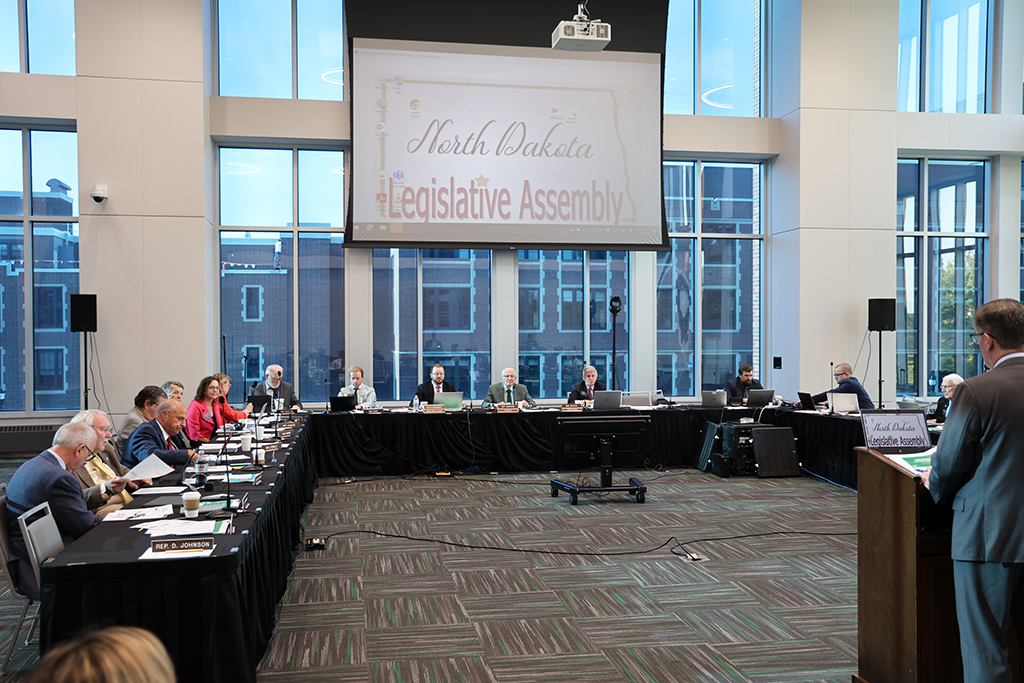
Research, facilities, the School of Medicine & Health Sciences and more were on the minds of North Dakota legislators during a visit to UND on Aug. 23.
The Interim Higher Education Committee convened the hearing, which gave lawmakers a glimpse into the state of the University, as well as understanding of how UND might approach the Legislature during the upcoming session in 2025. President Andrew Armacost, fresh off of delivering the 2024 State of the University address just the day before, and other University administrators had much to highlight.
“I truly appreciate the privilege of talking about the many things happening here at UND, and also of sharing some of the processes we have undertaken such as great facilities master planning and building our research program,” said Armacost in his welcoming remarks.
Armacost began by talking about the recent New Faculty and Administrators bus tour, an annual tradition to introduce newcomers to the state. The tour is meant not only for participants to have fun, but also to introduce them to “all that North Dakota has to offer.”
He then turned to UND’s recent reaffirmation of accreditation from the Higher Learning Commission, which is UND’s accrediting body. The HLC peer review team, which visited campus last spring, found UND’s petition to reaffirm its accreditation to have “no deficiencies or items of concern,” Armacost said.
“That’s what you call ‘as good as it gets’ when it comes to a reaffirmation of accreditation visit,” he told the committee members.
The morning portion of the meeting, which took about two hours, also covered other data-heavy topics, including:
- Student retention. From fall of 2022 to fall of 2023, UND retained 83% of its students, the highest rate of any state institution since the North Dakota University System started keeping track in 1990. Rates from fall of 2023 to spring of 2024 were even higher, Armacost said.
- Legislative funding sources, such as from the Challenge Grant Fund, which pair donor funds with state dollars. UND has seen $52 million in private support, and that has unlocked $25 million in state funding. And while those figures were just for UND, other NDUS institutions also benefit from the program, Armacost said.
- Endowments funded in part by the Challenge Grants. Funds have supported 319 endowments, mostly in the form of scholarships, but also through endowed positions for faculty members. Armacost said those endowments were “initiated and catalyzed” by the decision of the State Legislature to stand up the program.
- Promoting a sense of discovery and creativity across campus —a process that begins with faculty members and their research. Ideas and commercialized products that come from research “make the world a better place,” Armacost said.
- Research funding levels. The 2020 fiscal year saw research expenditures at $112 million, and those numbers have steadily climbed to $182 million today. The increase comes from “deliberate efforts” of faculty members, as well as those in the office of the UND vice president for Research and Economic Development.
- Generous state funding for space and national security research, coming in the areas such as satellite development, nanotechnology and the creation of a secure facility for classified work, among other areas. Later in the day, committee members toured UND’s soon-to-open National Security Corridor.
- The Economic Diversification Research Funds, appropriated during the 2023 North Dakota Legislative session. Armacost suggested a systemwide increase to those funds, which can enhance collaborative research efforts by institutions across the NDUS, including with Tribal Colleges.
The list of topics grew to include the UND Connect program, which seeks to offer faculty members the chance to make a meaningful difference in their community.
Facilities
Armacost then discussed the campus master plan, created in 2016. The plan guides the University on what facilities or buildings need to be replaced or repaired. Key points include reducing the square footage of buildings on campus, which in turn, would reduce deferred maintenance costs.
As of now, UND has reduced its footprint by about 250,000 square feet. The planned demolition of Columbia, Gamble, Babcock and Whitmer halls plus the Hyslop Sports Center would reduce that footprint (and its associated deferred maintenance costs) by another 850,000 feet.
Many initiatives already have been accomplished. Moreover, several new buildings were constructed through not only state appropriations, but also copious donor support and, frequently, partnerships with private entities. The latter includes UND’s partnership with Johnson Controls, through which the new steam plant was built at no cost to taxpayers.
On the topic of deferred maintenance costs, Sen. Curt Kreun, R-Grand Forks, wondered about the plan for new buildings such as Nistler Hall, and how they would be more regularly maintained than perhaps other buildings had been in the past.
“I think we should put as much thought into the maintenance of these facilities down the road, as we do in replacing them,” Kreun said.
Armacost agreed. He explained that the process of addressing deferred maintenance at UND comes through an assessment program, carried out by a third party on a rolling, four-year basis. That gives administrators a picture of what they need to do, and what they can afford to do as well.
The goal is to cycle through the entire campus every four years to create the picture.
UND places a portion of tuition increases into a maintenance fund, to supplement state appropriations for that purpose, Armacost said.
“The idea is to do exactly that: take great care on the front end, so you don’t amass deferred maintenance. It’s important to have this type of third-party assessment so we have that information,” Armacost said.
Also speaking that Friday was Joshua Wynne, vice president of Health Affairs and dean of the School of Medicine & Health Sciences. Like Armacost, Wynne gave an overview of his school and a summary of its operations, including:
- A major reduction in student debt at graduation, plus major increases in retention of doctors for practice in the state over past decade. This is due to the RuralMed program and strong support from both the Legislature and donors.
- The School of Medicine & Health Sciences provides half of all healthcare providers to state, though that percentage varies somewhat by specialty.
- A big growth in programs and graduating classes since the start of a health care workforce initiative in 2011.