UND professors receive NSF funding for national security research
Thanks in part to North Dakota Legislature, UND will expand research to include quantum technologies
Editor’s note: In the UND LEADS Strategic Plan, the Discovery core value calls on UND to “enhance and deepen UND’s Grand Challenge areas … (via) cross-disciplinary teams dedicated to identifying solutions to pressing challenges.”
With that in mind, this story, which was originally published on Jan. 16, calls attention to an ongoing, collaborative effort to strengthen UND’s contribution to the Grand Challenge area of national security.
****
Two UND professors have received grants from the National Science Foundation (NSF), in fields vital to the University’s national security initiative.
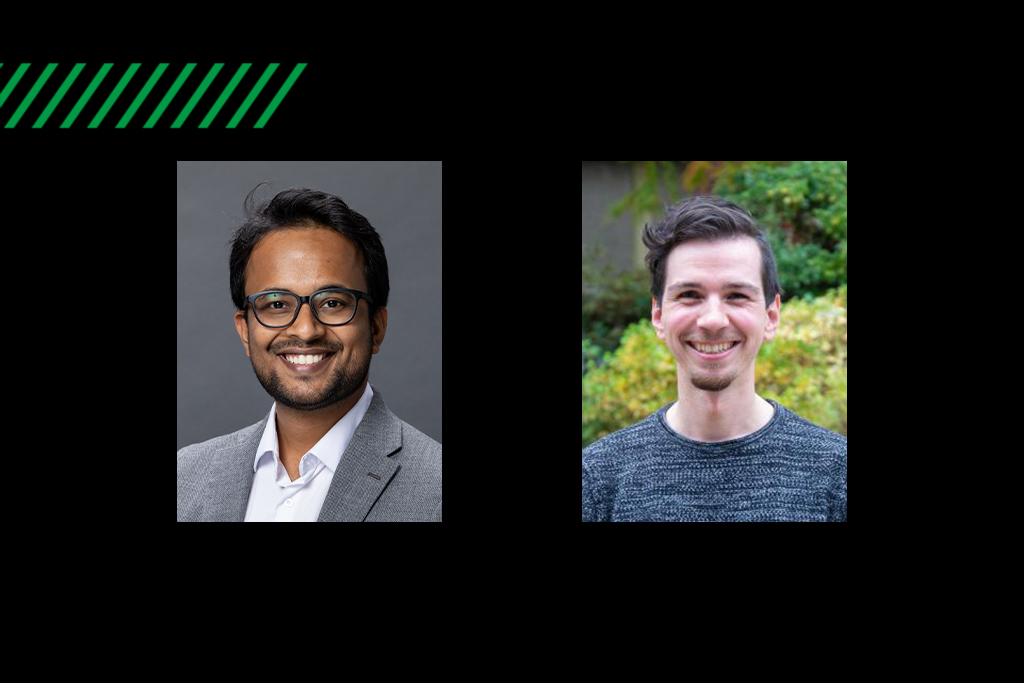
Markus Allgaier, assistant professor of physics and astrophysics, and Ayush Asthana, assistant professor of chemistry, each received $800,000 in funding from the NSF. Their research is in the fields of quantum sensing and quantum computing, respectively, and supports a host of applications.
The funding was awarded through the NSF’s Expanding Capacity in Quantum Information Science and Engineering (Expand QISE) Program. The initiative, according to Allgaier, is meant to build the capacity of non-R1 or “doctoral universities,” to conduct research in the discipline.
Recipients of grants under the program will work in collaboration with a leading research group, which will serve as co-principal investigator.
A major component of Expand QISE, Allgaier added, is promoting workforce development – particularly in regions of the country such as the Great Plains that are underserved in this field.
“You don’t need investments like this in big metropolitan areas with several R1 schools that have publicly traded quantum computing startups, and pipelines from university to industry,” he said. “Here we don’t have that. That’s been noted in the literature in workforce development about STEM – one of the untapped markets is more rural parts of the U.S.”
Asthana will be mentored by co-principal investigator Edwin Barnes, professor of physics at Virginia Tech University. Allgaier will work with Brian Smith, professor of physics at the University of Oregon – who was Allgaier’s post-doctoral advisor at the University.
Asthana’s research team will also include one postdoctoral scholar, one graduate student and one undergraduate, while Allgaier will be assisted by two graduate students.
Although Allgaier and Asthana’s research will be conducted separately, the efforts are complementary.
“We are both trying to make use of new quantum technologies to advance science and engineering,” Asthana said. “We want to talk about it together, because we want to generate more awareness among the UND community about opportunities in quantum information science.”
Allgaier’s research will focus on using quantum features of light to create certified, secure communication networks.
“What I mean by certified security, is that you have a guarantee that the channel you establish is secure,” he said. “Which is different from encryption that we currently use, where that is an assumption.”
Asthana added that the methods developed by the two teams will have applications in a range of disciplines, including physics, pharmaceuticals and data science. The grant will also allow Asthana and Allgaier’s teams to invest in on-campus infrastructure vital to conducting their research – including UND’s newly constructed Nanofoundry.
“We will develop processes that we need to make these devices,” Allgaier said. “Specifically, optical thin-film coatings, which is a very important technology to have for making any kind of optical device – not just for me, but for other faculty members as well.”
Allgaier opined that the North Dakota Legislature’s steadfast support for national security initiatives on campus – including appropriating $14 million for the construction of the National Security Corridor during the 2021-23 biennium – has caught the attention of the National Science Foundation.
“I don’t think that has gone unnoticed by the funding agency,” he said. “They see a commitment here that’s worth taking advantage of.”
****
>> QUESTIONS OR COMMENTS about the UND LEADS Strategic Plan? Your thoughts are welcome! Please contact Mike Wozniak, coordinator of Leadership & Programming, and/or Ryan Zerr, associate vice president for Strategy & Implementation, the co-chairs of the UND LEADS Implementation Committee.
You also may offer your thoughts by visiting the UND LEADS Strategic Plan home page and clicking on the “Provide your feedback” link that you’ll find there.
Thank you for your support of the UND LEADS Strategic Plan!