‘Hallo’ from House of Habsburg
UND study-abroad program immerses students in Austrian culture, history
Editor’s note: In the UND LEADS Strategic Plan, the “Learning” core value calls on the University to “foster a global perspective to prepare students for engagement and leadership, by promoting experiences that expand horizons even as they build skills.”
The following story, which was first published in UND Today on July 8, describes a summer-abroad experience that clearly served the above purpose in accordance with the Strategic Plan.
****
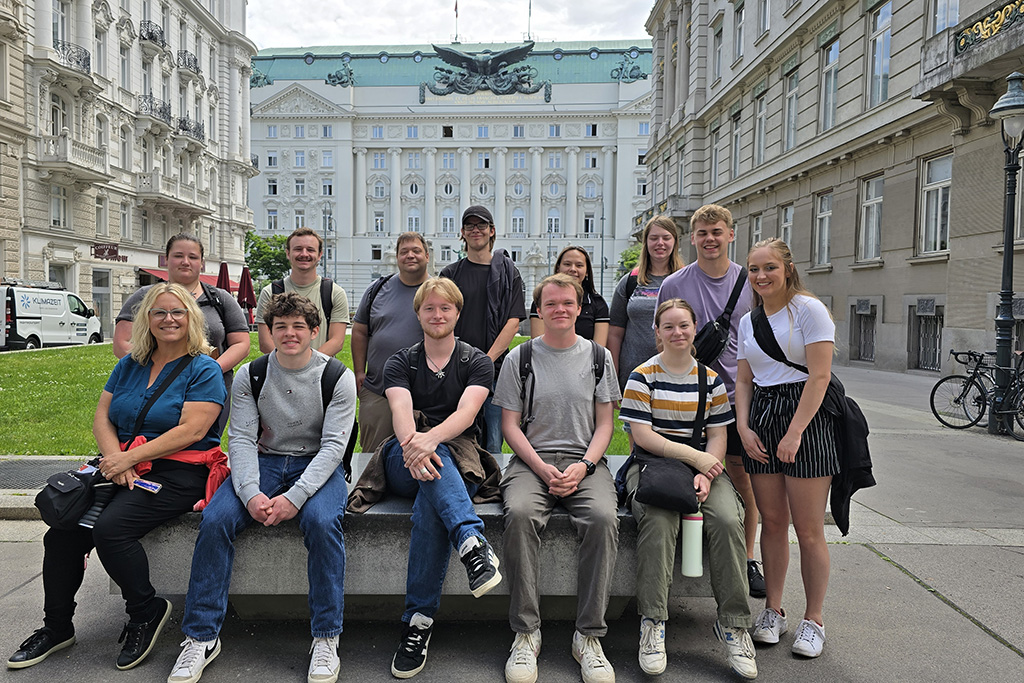
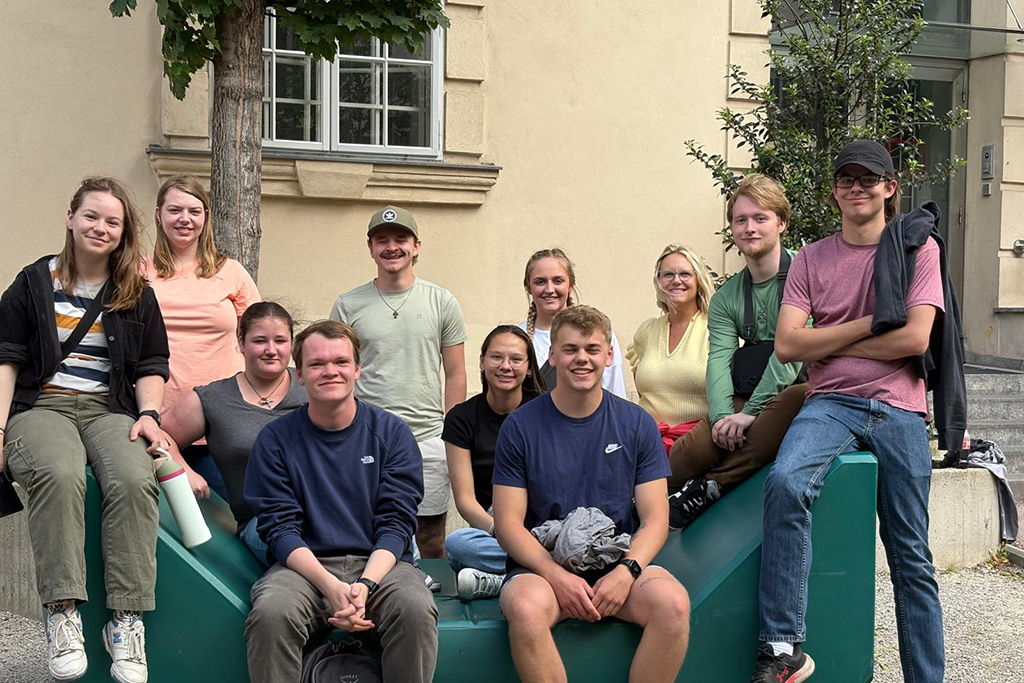
In June, 10 UND students spent two weeks exploring the cultural riches of Vienna, while also enhancing their German language skills.
The three-credit study abroad program, titled “Vienna: A Cultural Center of Modernity,” introduces participants to the art, architecture, music and rulers that put Austria on the map.
Amanda Nagy, associate professor of German and director of UND’s Global Studies program, co-led the program with Eric Peterson, assistant director of UND’s Shared Service Center. A major theme of the program is analyzing the way Vienna – and Austria as a whole – presents itself to the world, Nagy said.
“They are looking to distance themselves from their Nazi past and trying to highlight a period of innovation – both technologically and artistically,” Nagy said. “Reminding people that Austria is not Germany, it was annexed by Germany and should not be defined by the horrific events of World War II.”
Indeed, Austria has exerted outsized influence on world history and culture since the early Middle Ages.
In addition to cultivating some of the most influential classical composers spanning multiple eras (think Mozart, Haydn and Schubert), Austria ruled vast swaths of Western and Central Europe as seat of the Habsburg Empire. From the mid-15th to early 19th century, a succession of Habsburg royals also held the title of Holy Roman Emperor.
The reign of Emperor Franz Joseph I from 1848 to 1916, Nagy said, is a period especially venerated by the Viennese for its high culture and intellect. It was during this time that Sigmund Freud, the father of psychoanalysis, and Romantic Era composers Gustav Mahler and Johann Strauss, among others, called Vienna home.
Then, world politics drastically changed Austria’s course. During a 1914 visit to Sarajevo, Bosnia and Herzegovina, Archduke Franz Ferdinand – Franz Joseph’s nephew and heir apparent to the Habsburg throne – was assassinated, sparking World War I and ultimately, the Habsburgs’ downfall.
Madison Dame, a rising senior majoring in Communications, said she enjoyed touring sites such as the Schönbrunn and Hofburg palaces – summer and winter residences of the Habsburg emperor, respectively. Additionally, the trip was invaluable for improving her German skills, she said.
“For the longest time, when I was speaking German in my classes, it didn’t feel real to me,” she said. “I thought, ‘well, I’m just learning this from a textbook.’ Going to Vienna and hearing these phrases I’ve learnt over the past five or six years was interesting.”
The Viennese, Dame added, were accommodating and appreciative of her efforts to speak German.
“People are very nice there,” she said. “They’ll eventually speak English to you, but they’ll also let you struggle through it for a bit first.”
During her free time, Dame visited the Alpine city of Salzburg, Mozart’s birthplace and setting of the 1965 musical, “The Sound of Music.”
Other site visits in Vienna included the House of Music, which pays homage to the city’s renowned philharmonic orchestra and native composers, and a walking tour of the city’s Art Nouveau district — an architectural style that developed across Europe in the last decades of the 19th century.
Dame unequivocally recommends the program, which is open to students of all majors.
“I think it’s a great experience, even if you don’t know the language,” she said. “If you’re someone who enjoys art and music, that would be another reason to go.”
Study abroad programs can be a stepping stone toward developing an interest in global affairs, Nagy added.
“A university-led study abroad program is a great gateway to experiencing travel abroad,” she said. “So many students who are a little leery of going abroad at first, come to me after the trip and say, ‘This opened the door for me, now I want to go back.’”
Additionally, Nagy said, studying abroad does not have to be cost prohibitive, as scholarship opportunities for UND students abound.
“The German studies program has a long history of giving students generous financial support,” she said. “Every one of our students had at least half of their trip covered by scholarships.”
****
>> Questions or comments about the UND LEADS Strategic Plan? Your thoughts are welcome! Please contact Ryan Zerr, associate vice president for Strategy & Implementation, or Anna Marie Kinney, coordinator of the University Writing Program, the co-chairs of the UND LEADS Implementation Committee. You also may offer your thoughts by visiting the UND LEADS Strategic Plan home page and clicking on the “Provide your feedback” link.
Thank you for your support of the UND LEADS Strategic Plan!