UND Aerospace inducts three members into Hall of Fame
Alan Palmer, ’84, Steven Stock, ’87, and Arnold Vasenden, ’80, honored for distinguished service to aerospace industry and UND
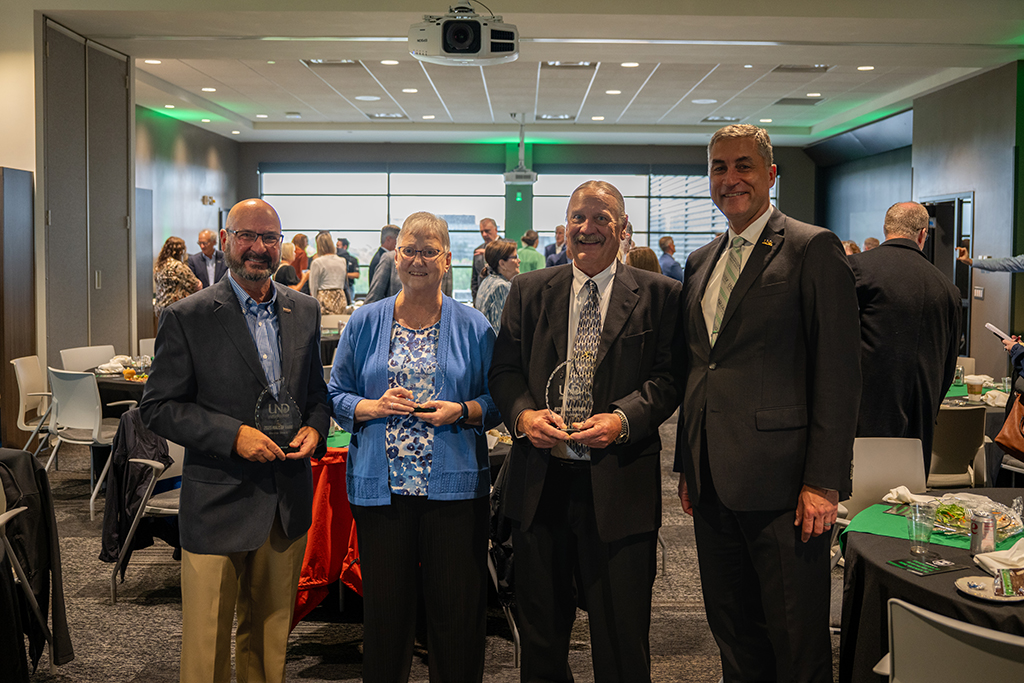
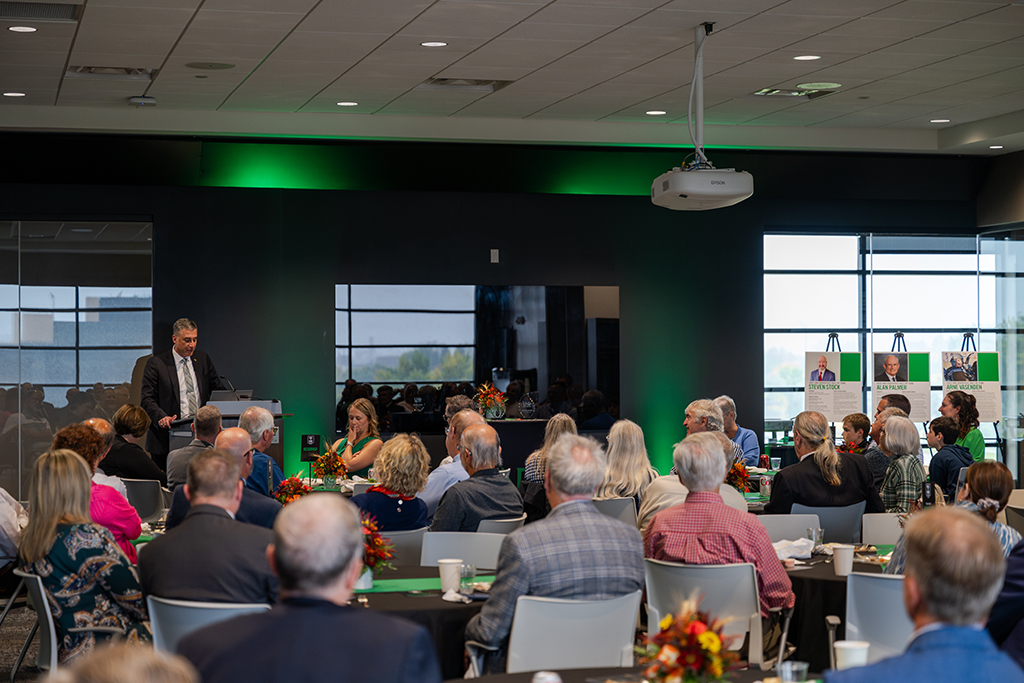
On Sept. 19, UND’s John D. Odegard School of Aerospace Sciences inducted three new alumni into the UND Aerospace Hall of Fame.
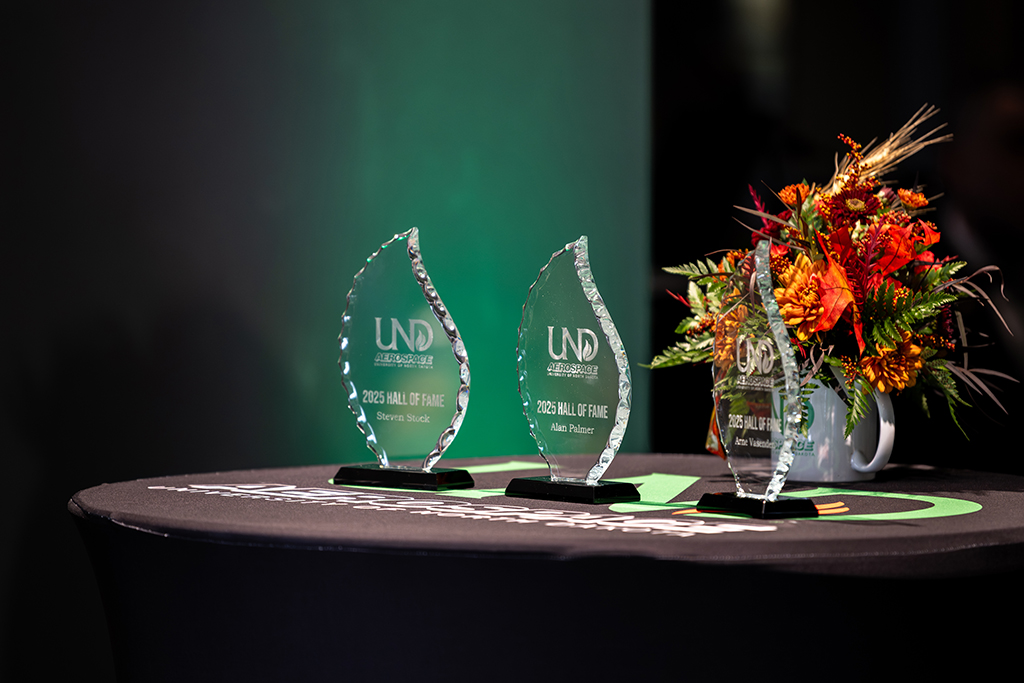
Created in 2018 to recognize distinguished UND grads for their significant contributions to the aerospace industry, the three join 20 previous members who have received the award. Each inductee is recognized with a plaque signifying their place among UND Aerospace Hall of Famers.
This year, UND Aerospace alumni Alan Palmer, Steven Stock and Arne Vasenden were honored at the event.
Alan Palmer, Class of 1984
After serving in the U.S. Air Force as a B-52 electronics warfare specialist during the Vietnam War, Alan Palmer’s time at UND began when he sought to complete the degree he had put on hold when he was drafted. Taking night classes under the instruction of John Odegard, Palmer’s time as a student propelled him into a long career at UND and beyond.
Flying close to 6,000 hours as an instructor pilot, Palmer was heavily involved in establishing UND’s first international training programs. During his time at UND, he served in many roles, including chief of Flight Simulator Training, chief flight instructor, senior aviation manager and eventually, director of Flight Operations.
“[Palmer] is one of the original John D. Odegard young guns, flying the jets and living the ‘Aviation Dream’,” says Chuck Pineo, CEO of the UND Aerospace Foundation. “By the time I met Al, he was director of Flight Operations and was visibly excited to help us rebuild those international programs, but this time with Japan, Saudi Arabia and China.
“Al’s willingness and enthusiasm to chase new projects and customers was a big part of UND Aerospace’s success.”
Palmer’s first “retirement” from UND as director of Flight Operations occurred in 2010. That same year, he retired from military service — having achieved the rank of brigadier general, and having served in many leadership posts including as the North Dakota Air National Guard chief of staff, assistant adjutant general and Logisitics and Support Group Commander for the 119th Fighter Wing.
Palmer’s career did not end then, as later that same year, he answered the call to return to UND as the director of what was then known as the UAS Center for Education, Research and Training. In this position, Palmer would help to put UND and North Dakota on the map, as the first university in the nation to offer a four-year UAS operations degree and a state with one of six national UAS test sites.
“He always had a vision and worked tirelessly to carry it out,” said Paul Snyder, current director of UND’s UAS program. “He was able to leverage what he already knew about safely and effectively operating in the national airspace system while at the same time keeping UND Aerospace focused on the future needs of the UAS industry, regarding education, research and training.”
Palmer’s impact can also be seen throughout the Grand Forks community. He led the group responsible for the development of Veterans Memorial Park, co-chaired the military affairs committee of the Grand Forks Chamber of Commerce, volunteered with the Employer Support of the Guard and Reserve, and served on the governor’s Task Force for Veterans Affairs.
When Palmer retired from UND in 2017, he told UND Today, “I’ve been blessed with a great career. I did everything I wanted to do in aviation, except go into space.” Even years later, it’s clear that his dedication to flight training and UAS programs at UND left a lasting impact.
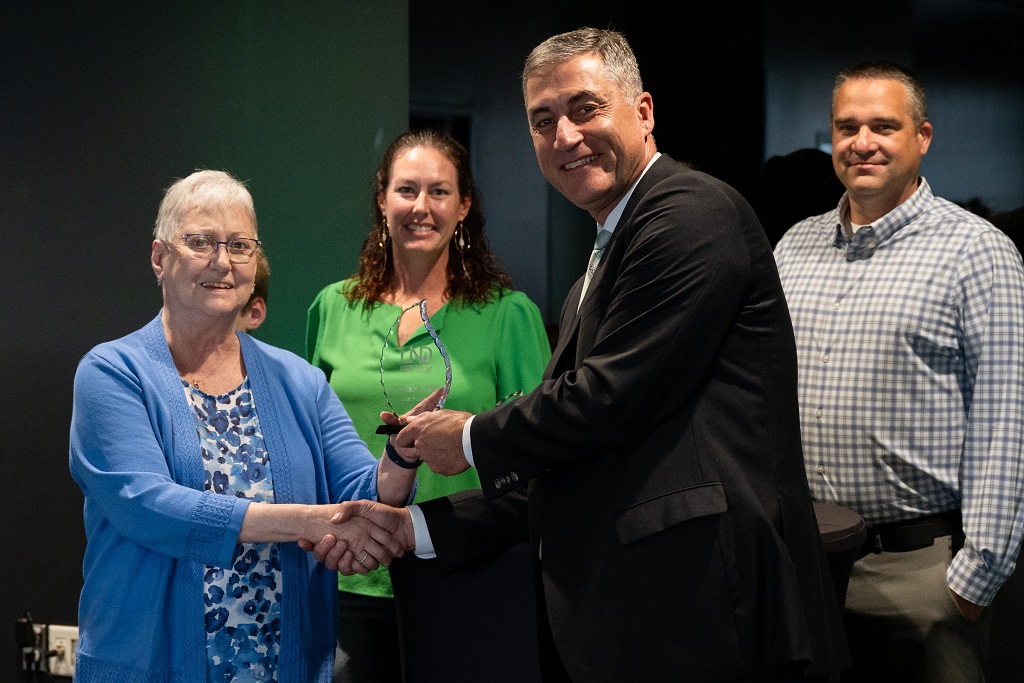
Alan Palmer “flew west” in November of 2021. His wife of 48 years, Peg, accompanied by their son Randy and daughter Alison, accepted the award on his behalf.
Steven Stock, Class of 1987
Born and raised in Rugby, N.D., Steven Stock has had a lifelong passion about weather. But when he originally began his college journey in 1977, UND did not offer a degree in meteorology.
He then chose to enlist in the U.S. Navy, where he trained as an Aerographer’s Mate and learned to analyze weather patterns and create forecasts. This led him to specialize as an aviation weather briefer to support critical missions and brief personal.
During his career in the Navy, Stock became adept at delivering accurate forecasts, leading him to receive the Navy Achievement Medal for his forecasting work during Operational Eagle Claw. During a visit to UND while on leave, Stock discovered the new meteorology department and decided to return to North Dakota to finish his degree.
During his time at UND, Stock became a highly active research associate in the Meteorology department. He played a key role in the development of Terminal Doppler Weather Radar (TDWR), which helps to detect hazardous wind shear and microbursts near airports. Stock’s contributions helped to provide real-time alerts to air-traffic control and pilots, improving safety in flight.
This system remains integral to aircraft safety, operating in 46 major airports across the United States and Puerto Rico.
In 1991, Stock began a career as a meteorologist at Northwest Airlines, drawing weather maps by hand. With Stock’s help, Northwest gained a reputation for having one of the most advanced weather departments in the industry, a legacy that would continue when Northwest merged with Delta Air Lines in 2008.
During his career as an aviation meteorologist, Stock helped to advance technological achievements and forecasting. He leaves a lasting impact on the aviation industry, helping to advance aircraft safety and weather forecasting systems.
Arnold Vasenden, Class of 1980
To Arnold “Arne” Vasenden, aviation was a way of life. Growing up in Fertile, Minn., as one of five siblings, Vasenden’s whole family learned to fly when their father introduced the family to flying through a local club and eventually, their own aircraft.
When Vasenden arrived at UND with his instrument rating and both single- and multi-engine commercial certificates, he began his freshman year in the flight instructor course. He graduated in 1980 as one of the last students to complete the original curriculum and went on to work as a certified flight instructor at UND.
During his time in school, Vasenden began working with the Weather Modification program. When he faced a challenging job market following his graduation, this training would help him make the decision to relocate to South Africa to work on Weather Modification. After 11 seasons there, he began a new chapter conducting marine mammal surveys throughout Alaska, the Arctic and the Gulf of Mexico.
Vasenden would go on to corporate aviation, flying cancelled bank checks in a Learjet before moving to airline operations with SkyBus. After that airline went under, he moved to a new role flying the Lockheed T-33 at Hanscom Air Force Base – a position that would test his precision and skill as he flew at high speeds just 30 feet above the ocean to jam missile sensors.
Eventually, Vasenden returned to corporate flying and the airlines, flying several aircraft including the Lear 35, Gulfstream II, DC-9 and 737. While working for Legend Airlines, Vasenden founded his own company supporting emergency response missions, using hyperspectral sensors to detect chemical plumes.
This would lead to collaborations with the National Geospatial-Intelligence Agency, where he met his wife, Roberta. Together, they developed the Airborne Spectral Photometrical Environmental Collection Technology (ASPECT), which is used by the EPA for hazardous substance response.
Since, 2018, Vasenden played a key role in the Perlan Project, helping to launch a specialized sailplane into the stratosphere over Argentina. It was while doing this word that he would set the world record for the highest glider tow at 47,100 feet. Vasenden has also worked with Germany’s DLR on hydrogen engine research, where he towed two gliders simultaneously.
“With over 23,000 flight hours across an extraordinary range of aircraft and missions, Arne Vasenden may have the most diverse flying career we’ve ever seen,” said Robert Kraus, Dean of Aerospace. “He exemplifies the spirit of aviation excellence, innovation and adventure.”
In presence of family and friends
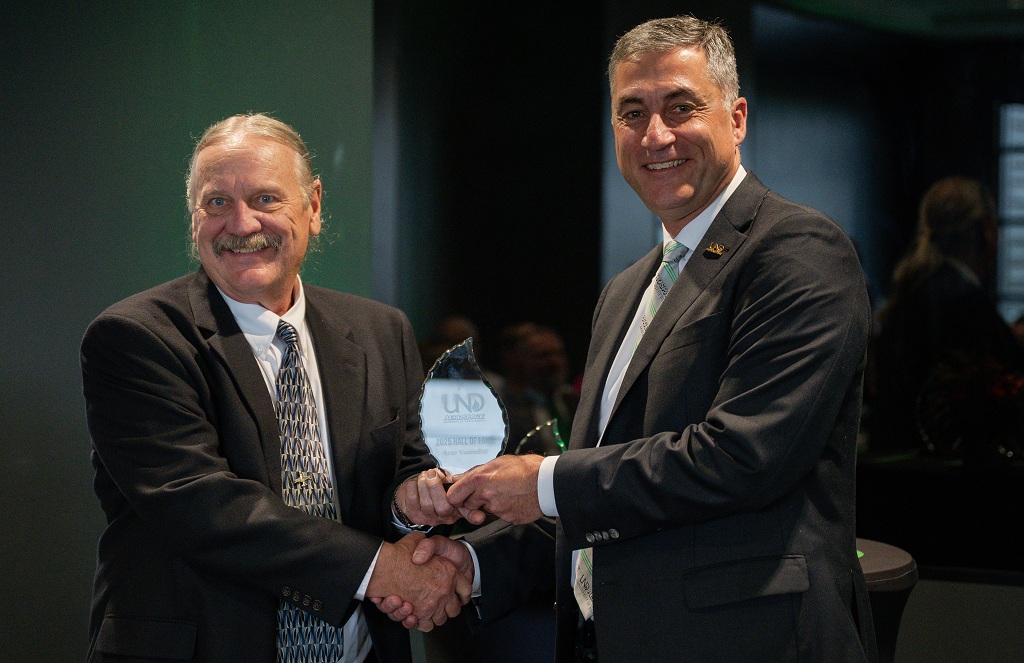
At the event, the three recipients were joined by friends and family as they received their awards. Also in attendance were many previous UND Aerospace Hall of Famers as well as the Odegard family.
Nominations for the Class of 2026 Hall of Fame are now open. Nominations can be submitted via UND Aerospace’s online form.