18:83 Speaker Series: Erik Martinson’s journey from student worker to COO
UND Athletics’ deputy director and chief operating officer shares career shaped by University’s culture and growth
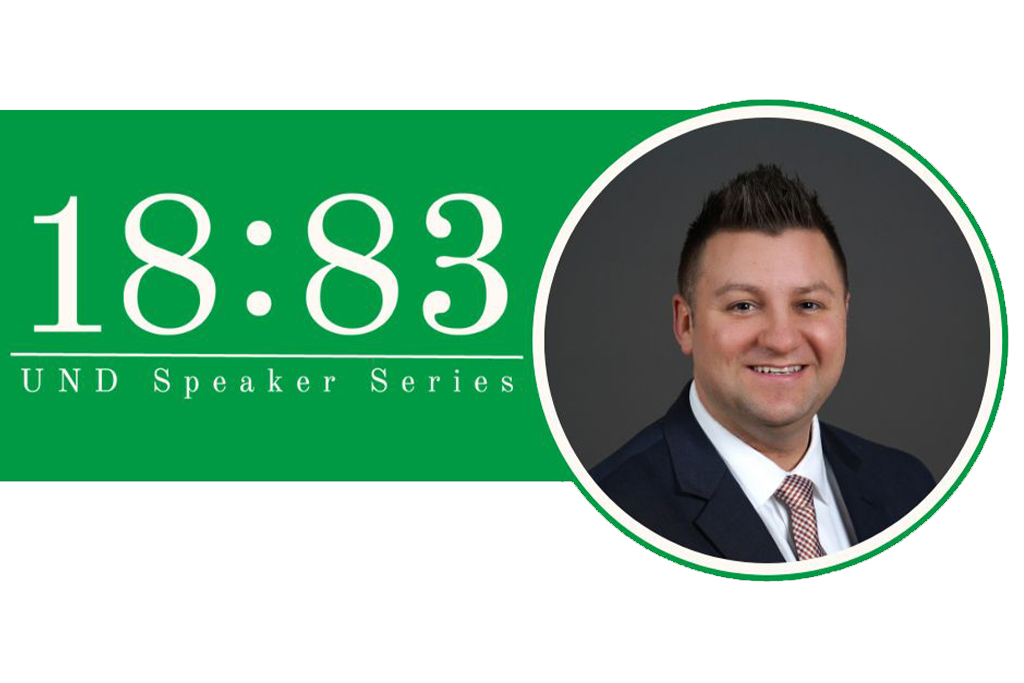
Erik Martinson, chief operating officer and deputy athletics director, has worked for UND Athletics since 2005.
But Martinson is the kind of person who might not think of it that way.
During that summer of ‘05, at the age of 18, Martinson’s first stop on campus was to ask for a job at the Hyslop Sports Center.
As surprised as the front-office staff was to have a student so eager to work, they took him on after an impromptu interview.
This all happened weeks before he would step foot in his first class at UND.
Martinson recalled stuffing 3,000 envelopes on his first day at the Hyslop.
“I remember thinking, ‘Holy cow. What did I get myself into?’” he said. “But I knew that I was willing to do anything and everything to be a part of something special and bigger than myself.
“That started my trajectory with Athletics.”
Over 20 years, he’s done just about everything in the business and operations of UND’s Department of Athletics.
“Choose a job you love, and you will never have to work a day in your life,” Martinson said. “I’ve been here since 2005, and I feel like I’ve never worked a day in my life.”
‘Find your own path’
Martinson appeared on Wednesday as the first speaker for this semester’s run of the 18:83 Speaker Series. The series invites leaders from the University and Grand Forks communities to speak about leadership from their own career perspectives. The timing of 18 minutes and 83 seconds coincides with UND’s founding year.
On the small scoreboard behind him (keeping on theme) the timer started as he explained how he arrived at UND.
Martinson spent much of his youth with big league dreams, attending local sporting events in Roseau, Minn.
“At a hockey game, I was given a puck and a media guide by one of the people working at the event,” Martinson said. “I thought it was the coolest thing in the world to get something like that, getting something you thought no one else had.”
His other life-changing moment was playing hockey at 17. At goalie, he got a puck to the back of the leg that paralyzed it. The injury dashed his hopes of playing junior hockey and trying to go pro.
“Scouts, agents and coaches stop calling after something like that,” he remarked. “Things happen for a reason that change your trajectory, and you have to go with what’s been dealt and find your own path.”
For Martinson, that path turned into paying forward the feeling he had when he was handed that puck.
Tips for success in the people business
Throughout his talk, Martinson leveraged the years of experience he’s had across the business and operations side of an athletics department that’s moved from NCAA Division II to Division I during his tenure.
“We do so many things in Athletics,” he said. “Every day is different.”
For Martinson, UND and its culture helped to codify that when there’s drive, motivation and goals, anything is possible.
He styled himself as a builder, fixer, decision-maker and dreamer. When people ask about his day-to-day, that’s the best way he can describe it.
UND Athletics is made up of several programs, hundreds of student athletes, internal and external operations and facilities, but the most important thing is relationships, Martinson said. UND Athletics is a people business.
In his role guiding the organization, he understood leadership to be much more collaborative than “being in charge.”
He quoted author Simon Sinek in saying, “Leadership is not about being in charge, it is about taking care of those in your charge.”
“It’s important when you can flip the script to say, ‘I’m not in charge of these people, I need to help them do what they need to do,’” Martinson added.
Martinson also called up several adages and idioms from his coaching colleagues:
- Be where your two feet are — be present and enjoy the moment you’re in.
- Be a star in your role — a team of stars can do amazing things.
- The work works — when you have a process and standards, you’ll get results.
Just a short time after the buzzer, he closed with a particular piece of advice for students: work in the restaurant industry and officiate sports.
“It teaches you to think on your feet, make decisions and develop time management skills,” Martinson said. “I attribute a lot of what I learned today to the Ground Round and from officiating sports.”