UND Law alum, senior appellate judge delivers Eye of the Hawk lecture
In an age of constant information, critical thinking and engaging with opposing viewpoints is paramount, says U.S. circuit judge Ralph Erickson
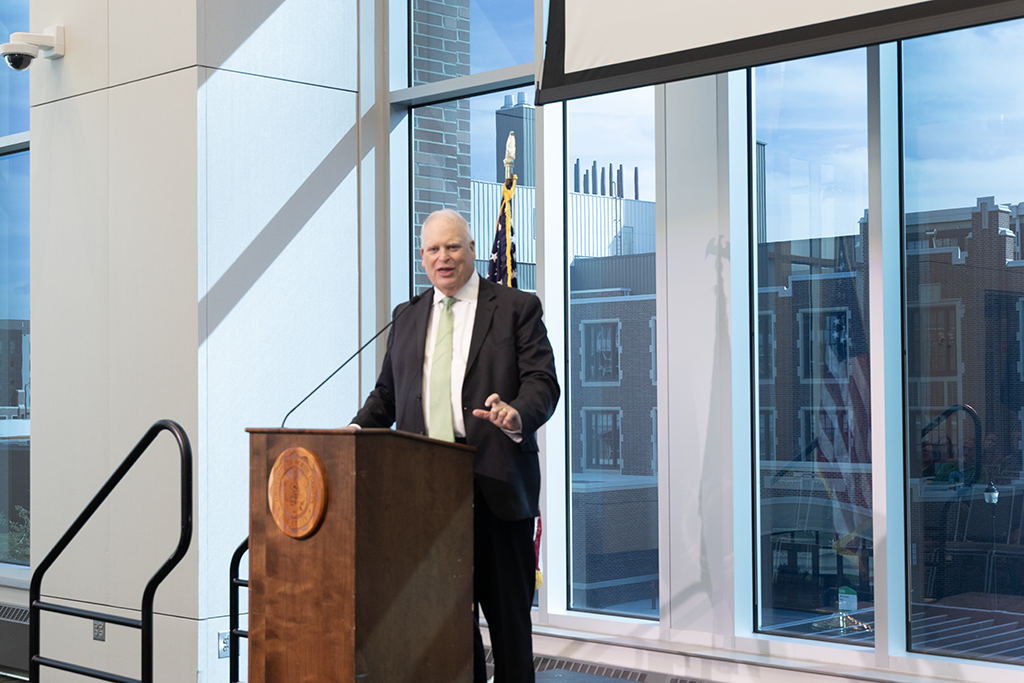
Last week, a prominent UND Law alumnus returned to campus to offer his insight on the political and media landscape of the United States, and its implications for the future of the republic.
On Thursday, Sept. 17 – as part of UND’s Constitution Day celebration – Ralph Erickson, senior United States circuit judge of the United States Court of Appeals for the Eighth Circuit, delivered the first of four lectures for this year’s run of the Eye of the Hawk Lecture Series.
Erickson’s legal career spans more than four decades. After earning his Juris Doctorate from UND’s School of Law in 1984, he spent nine years in private practice before serving as a county and state magistrate.
In 2003, former President George W. Bush appointed Erickson to the United States District Court for the District of North Dakota where he served until his appointment to the Eighth Circuit in 2017.
Erickson’s lecture, titled “Drowning in Information: How Our Arrogance, Superficiality, and Partisanship Undermine the Constitution,” examined the current 24-hour news cycle and its impact on civic engagement and political discourse.
Erickson opined that despite living in an age of abundant information, overreliance on algorithms tailored to users’ biases and preferences is eroding critical thinking and reasoning skills.
“On your phone or computer, you have access to the greatest library the world has ever known,” he said. “You can find something instantaneously; search engines driven by artificial intelligence will lead you to what you perceive to be the answer and is, on its face, persuasive and accurate. And as far as you know, it could very well be neither.”
“This leads to sloppy thinking, snap decision-making and the inability to weigh evidence and draw conclusions necessary for a self-governing people,” Erickson continued.
The constant bombardment with fragmented bits of information, Erickson added, means more time spent on devices at a cost of engaging deeply with arguments, ideas and, most significantly, each other.
“Since we live in a 24-hour news cycle, every seven seconds, your phone will alert you that something of unbelievable importance has just happened,” he said. “You’re tempted all the time. The average American spends five and a half hours on their phone every day. This is 60% of your non-working, non-sleeping hours. How bad is it? Go to any restaurant and look at how many people are on their phones and not talking to each other.”
Erickson added that with news outlets increasingly vying for readers’ attention – and the revenue such engagement brings – there is an incentive to publish “ragebait and clickbait” content over objective, reasoned reporting.
“We’re constantly being bombarded with information that is extreme,” he said. “By definition, none of these things are moderate or well-informed. They are designed with only one purpose: to get you motivated.”
Erickson also argued that civic engagement is declining in the U.S., citing falling rates of participation in community organizations – particularly amongst younger generations.
“The average age of membership in a service club or fraternal organization in the U.S. is 65 for men, and 59 for women,” he said. “And 61% of millennials who joined a service club in 2016 quit before 2020. I think it’s not just these organizations; we’re just disconnected. We don’t hang out as we used to.”
A major consequence of not engaging with others and opposing viewpoints, Erickson said, is polarization and political gridlock.
“We go through long periods with a divided government where nothing gets done, and then we get to a point where everyone tries to cram the next three years of legislation into six months,” he said. “That gives you stuff that isn’t very well thought-out and is ineffective. It isn’t a partisan issue, it’s the process.”
A hamstrung Congress, Erickson said, erodes the system of checks and balances by ceding too much power to the executive branch. When lawmaking stalls, the result is more governance by executive order – a practice Erickson called especially problematic in an age of complex legislation.
One remedy Erickson suggested for reforming the system of checks and balances is delegating powers to the appropriate branches and government agencies.
“The regulatory agencies have experts. We’d rather have nuclear scientists regulating nuclear power plants than Ralph,” he joked. “They should have left the power to write regulations in an organization that answers to Congress.
“Let’s take the EPA. You’d have the EPA regulatory board that writes regulations. Congress would then have the authority to adopt them or not. You don’t just let the president write executive orders and tell folks what to do. The executive branch – with its many law enforcement agencies – would oversee investigations. Courts decide at hearings based on evidence when to levy fines and penalties. Then, the government is back in balance the way it needs to be.”