Seeking ‘the human advantage’ at UND
UND is at forefront of debate surrounding intersection of AI and humanity, says President Andy Armacost during annual ‘Wake up to UND’ breakfast

Last week, UND’s president highlighted UND’s efforts in fields vital to the region and state’s growth during the annual “Wake Up to UND” breakfast. The event is a joint initiative between the University and The Chamber of Grand Forks-East Grand Forks, intended to apprise business and community leaders of on-campus developments.
On Friday, Oct. 9, more than 450 attendees celebrated the strong partnership between UND and the Chamber, which works to enhance economic development and quality of life in the region. According to Derek Holt, chair of the Chamber’s executive committee, this relationship has generated more than $1 billion in state investments to the region over the past decade.
“When UND and Grand Forks succeed together, both grow stronger,” Holt said. “The shared commitment has helped drive extraordinary creative progress and momentum.”
UND President Andy Armacost served as the event’s host, proclaiming its title as “the human advantage.” Befitting the event’s theme, he reaffirmed UND’s commitment to tackling the myriad ethical questions surrounding the implementation of artificial intelligence – a commitment Armacost made during last year’s event as part of his moonshot initiative.
“The University of North Dakota is playing an important role across the state and nation to ensure that, as we develop new methods of AI and apply it to various areas of discovery, we’re doing so in the right way,” Armacost said. “We want to keep humanity at the forefront of what we do.”
Armacost then welcomed two faculty members for an onstage discussion on the future of AI, whose work he said epitomizes “the intersection of AI and humanity:” Anna Kinney, AI instructional manager at the Teaching Transformation & Development Academy, and Justin Montigne, assistant professor of Music.
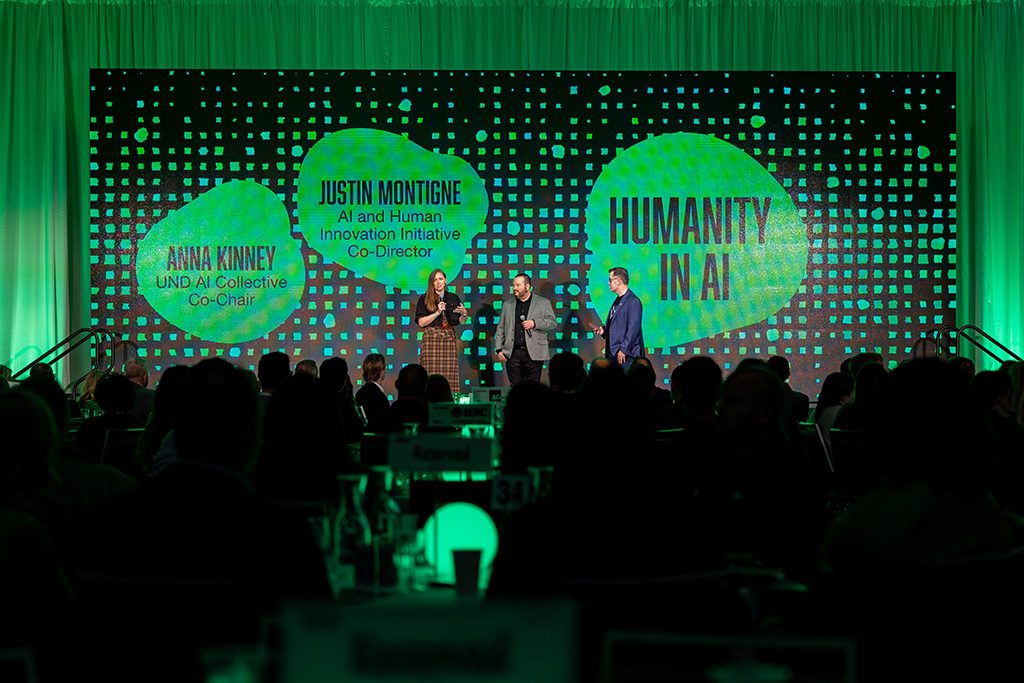
Despite hearing concerns from students about the omnipresence of AI in their daily lives, Montigne and Kinney expressed optimism that UND is working toward incorporating the technology ethically and responsibly.
“I think that the leadership of AI is going to be part of what we do here,” Montigne said. “Moving beyond that frustration and fatigue into some positive and proactive steps is important. I hope that the students, faculty, staff and community around us understand UND’s commitment.”
“I hope UND is known as a place that meets AI with humility and curiosity, instead of fear,” Kinney added. “I hope we are a front door for the important conversations we need to have, because nobody has all the answers – we need to work together.”
The three speakers agreed with Montigne’s statement of “AI is us,” meaning that as the technology’s creators, humans have an obligation to oversee its ethical implementation. This sentiment was symbolized by Armacost’s t-shirt, which read “I am AI,” styled in lettering paying homage to English rock band Def Leppard.
“This is a statement about the humanity – that I being a human, need to have agency in the decisions about how we use AI,” Armacost said. “With the ethical framework and responsibility necessary to use these powerful tools to make a difference in the lives of others.”
Kinney also said that rapid innovation in AI provides an opportunity to view the arts and humanities through a new lens and engage more deeply with them.
“A fundamental question of the arts and humanities is ‘what if?’” she said. “It’s the foundation that we have this pursuit of creativity, understanding the past and navigating what might happen in the future. I think the arts and humanities have never been more vibrant, important and engaging for folks grappling with what this emerging technology means for their lives.”
Armacost also revisited the word of the year he unveiled during August’s State of the University address. Generosity, he said, represents the campus’ commitment to serve each other and the community.
“The spirit of the word ‘generosity’ goes into everything we do here at UND,” Armacost said. “The way we give generously to our students through our time and effort, the way that we give to one another and the way we give to the Grand Forks community, really matters.”
The event concluded with a look into the College of Education & Human Development’s “Joyful Dance” initiative.
The project, led by Harry Liu, assistant professor of Education, Health & Behavior Studies, and Tanis Walch, department chair and professor of Education, Health & Behavior Studies, places students and faculty in early childhood classrooms in the greater Grand Forks region, with the goal of forming lifelong habits of movement and play.
Walch encouraged attendees to be active – a simple walk has strong health benefits – and reduce screen time.
“Children are meant to move – we are born to move our bodies,” she said. “This is one great opportunity; early childhood is a key piece to increase enjoyment and our confidence in our ability to move. I challenge all of you to put your phones down when you’re around others; children are watching.”