From the prairie to New York: Michael Conlan brings new perspectives back to UND
By Mason Clobes
For Michael Conlan, assistant professor of Art & Design at the University of North Dakota, making art is an ongoing exploration.
As an interdisciplinary artist working across sculpture, printmaking, photography and installation, Conlan’s practice is driven by a desire to investigate ideas of place, memory and nostalgia — particularly his relationship with the Northern Plains.
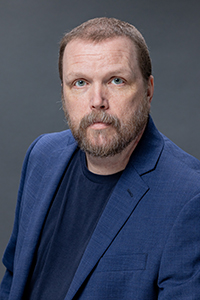
That practice recently took him from UND to New York City as one of 10 artists selected for Art 14C’s Back to the Studio Residency, a six-week residency designed specifically for educators. The residency provided Conlan with something particularly valuable: dedicated time and space to make art without expectations.
During the Back to the Studio Residency, Conlan immersed himself in his studio practice. Over six weeks, he created seven sculptures, ranging from tabletop works to pieces more than six feet tall, along with several installations and a painting. The residency also gave him the opportunity to step outside the studio and engage directly with the broader art world.
Conlan visited major museums and galleries throughout New York City and upstate New York, seeing works that he had previously encountered only through textbooks or digital images. He was able to photograph those works himself and plans to bring those firsthand experiences back into his classroom.
For Conlan, seeing artwork in person offered a different kind of educational value. Experiencing a work firsthand — rather than through a photograph — allows students to consider scale, material, physical presence and the experience of standing in front of an original work. The residency also connected him with artists and curators, expanding the professional relationships and perspectives he can bring back to UND.
The residency ultimately became more than an opportunity to produce new work. It became an opportunity to see, experience and participate in the larger art community — experiences Conlan can now share with his students.
Students in Conlan’s sculpture and printmaking courses learn traditional processes before being encouraged to push those techniques into contemporary practices. Printmaking students may begin with historical processes such as etching and woodcut before exploring combinations of digital and hand-created elements. Sculpture students work with materials and techniques ranging from formal studies of line and planes to bronze casting, mold making and carving.
Perhaps one of the most important lessons Conlan brings to his students is that failure is part of the creative process.
In his classes, students are encouraged to embrace unsuccessful attempts rather than view them as setbacks. A print or sculpture that does not turn out as expected can provide information that makes the next project stronger.
Much of Conlan’s work is rooted in his relationship with the prairie. Having lived in different parts of the country and returned to North Dakota multiple times, he is interested in how distance changes our perception of a place. The prairie can become romanticized when viewed from afar, while returning to it creates a different relationship between memory and reality.
Being at UND places that landscape directly within reach of his studio practice. That proximity allows Conlan to continue exploring the Northern Plains not simply as a physical landscape, but as a place shaped by memory, nostalgia and personal experience.
His work has also become increasingly expressive during his time at UND. He describes becoming looser in his making and moving away from more rigid approaches, a transition that parallels his changing understanding of the prairie itself.
Ultimately, Conlan’s work demonstrates how faculty research and creative activity can become an extension of the classroom. His students benefit not only from the techniques he teaches, but from an instructor who is actively making, experimenting, visiting institutions, connecting with artists and continually questioning his own practice.
As Conlan puts it, even without his position at UND, he would continue to make art. But the University gives him access to the facilities, students and creative environment that allow that practice to grow, and his students become part of that process along the way.