Mapping the future of the Arctic: UND research takes students to the frontiers of science
By Mason Clobes
For more than 25 years, Timothy Pasch, Charles R. “Chuck” Johnson Endowed Professor of Communication, has studied the Arctic, building a career around understanding a region undergoing rapid transformation. Today, his work at the University of North Dakota brings together researchers and students from across disciplines to develop new ways of observing, mapping and predicting conditions across the Arctic and other remote regions.
That work is taking UND students far beyond the classroom — including into the field along the Dalton Highway in Alaska, where Pasch’s research team maintains 11 field stations stretching from Fairbanks toward the Arctic Ocean. Working under a contract with the Cold Regions Research and Engineering Laboratory, and including researchers at Virginia Tech, SUNY Stony Brook and UCSB/NCEAS, the team collects detailed environmental data that can help predict ground stability, permafrost conditions and other challenges affecting Arctic infrastructure and geological/geospatial transformation.
Pasch’s research combines field science, remote sensing, artificial intelligence and high-performance computing. The scale of the project requires researchers to work with enormous datasets, incorporating data from satellites in space (including NASA’s Sentinel-1 and NISAR missions), to fixed wing aircraft (working with UND Aerospace), to UAS (in partnership with UND RIAS) to data collected from field stations (UND Geology/Geography and ESSP), and even subsurface data leveraging ground penetrating radar and ERT technology.
One recent dataset transferred by the team from Virginia Tech was approximately 70 terabytes — far too big to handle efficiently through traditional methods and required significant computational innovation at UND to make possible.
To address this challenge, Pasch and his collaborators at UND developed a computational infrastructure capable of processing these massive datasets. Working with Naima Kaabouch, Chester Fritz Professor of Computer Science, and Aaron Bergstrom, advanced cyberinfrastructure manager, DREAM Lab, CRC; the team established a Kubernetes computing cluster on campus and connected it with cloud computing and national supercomputing resources. This allows researchers to move data and computational jobs between UND, cloud infrastructure and the Delta supercomputer at the National Center for Supercomputing Applications at the University of Illinois. The result is a research pipeline that connects observations collected in remote Arctic environments with advanced computational analysis.
The team has also developed tools such as “FrostDS,” a predictive analytics engine that can use satellite and field data to analyze conditions at specific locations in Alaska. Researchers can use the system to examine factors such as fire risk, ground stability and permafrost active-layer thickness.
One of the defining characteristics of Pasch’s research is its interdisciplinary nature. Students and faculty from communication, engineering, computer science, geology and other areas contribute to different components of the project. Pasch emphasized that the project provides significant opportunities for students throughout the College of Arts & Sciences while also connecting them with researchers across UND. Students have participated in field research, computational work, communication and data analysis, while collaborations extend to institutions including Virginia Tech, SUNY Stony Brook, the University of Minnesota, the University of California, Santa Barbara and the University of Alaska Fairbanks, among others.
This interdisciplinary structure also allows students to see how different areas of expertise come together to solve complex problems. For students in communication, for example, the project provides experience communicating science to broader audiences. Students have co-authored high-impact peer-reviewed publications, created multimedia and social media content and analyzed engagement data to understand how audiences respond to scientific information.
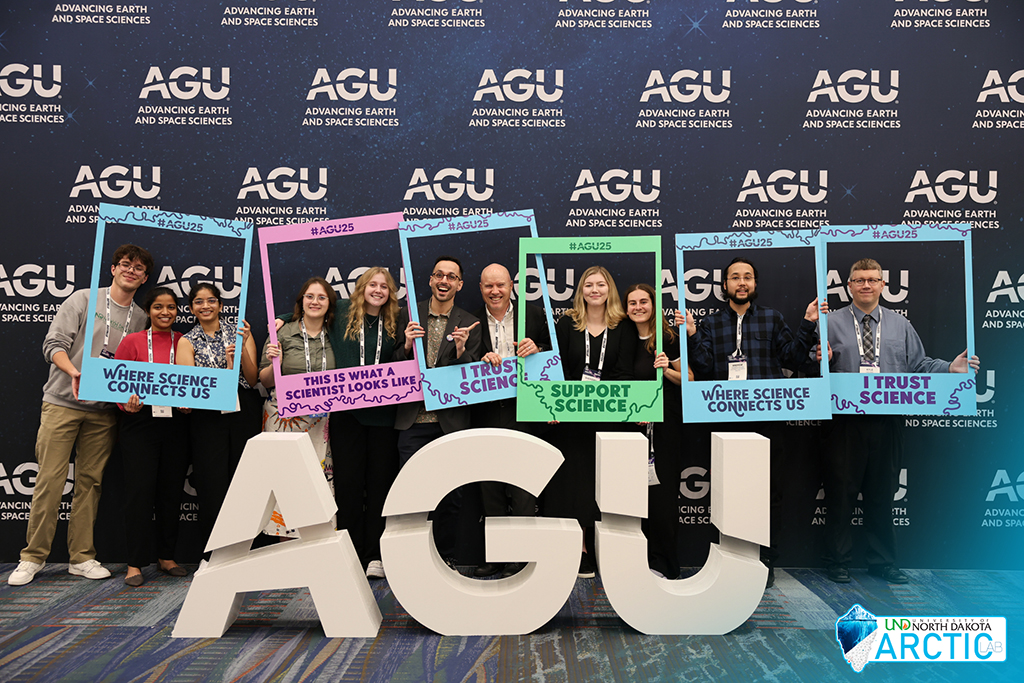
Perhaps the most significant impact of Pasch’s research is the opportunity for students to participate directly in the research process. Undergraduate students have traveled to Alaska to work alongside researchers in the field. Others have traveled to collaborating institutions and conferences, gaining experience presenting their work and interacting with researchers from around the country. Pasch noted that students participate in quarterly and monthly project reports and meetings, giving them opportunities to develop their presentation skills while engaging with collaborators at institutions across the country. The research also incorporates technologies that allow students to investigate Arctic environments from multiple perspectives. At field sites, the team collects highly precise geological sensor data, geographic coordinate data, LiDAR point clouds, digital elevation models, and even (for one study), immersive virtual reality data. The UND ARCTIC team has developed detailed digital representations of its Arctic field sites and continues to improve those environments.
The team is also using transient electromagnetic technology to examine conditions beneath the surface, helping map the stability of permafrost environments. Ground-penetrating radar mounted on drones provides another layer of information, ultimately allowing researchers to build unified maps of field sites for integration into predictive models.
For students, this means exposure to technologies and research methods that transcend traditional disciplinary boundaries — blending research methods from environmental science and geospatial mapping to artificial intelligence, high-performance computing and science communication.
For Pasch, the value of the project extends beyond the data collected or technologies developed. It is also about creating opportunities for students to become researchers themselves.
“The Arctic was a frontier that most people didn’t really think was important when I was a Ph.D. student,” Pasch reflected. After decades of working in the region, he sees UND’s involvement in Arctic research as an opportunity to place students at the forefront of an international research effort.
What excites him most is seeing students from different disciplines become invested in the work. The project, he said, has a place for students across disciplines, creating a research environment where faculty and student scientists, engineers, programmers, pilots, science communicators, and collaborators from a multitude of other disciplines and approaches can contribute to a shared goal.
Through Pasch’s Arctic research, UND students aren’t simply learning about cutting-edge science — they are helping conduct it. From remote field stations along the Dalton Highway to supercomputing systems on campus and across the country, students are gaining hands-on experience with the tools, collaboration and problem-solving required to address some of the world’s most complex environmental and technological challenges.