‘I loved every day as a physician’
UND med school Class of 1976 grads reflect on the massive shifts in medical education, clinical practice over past 50 years
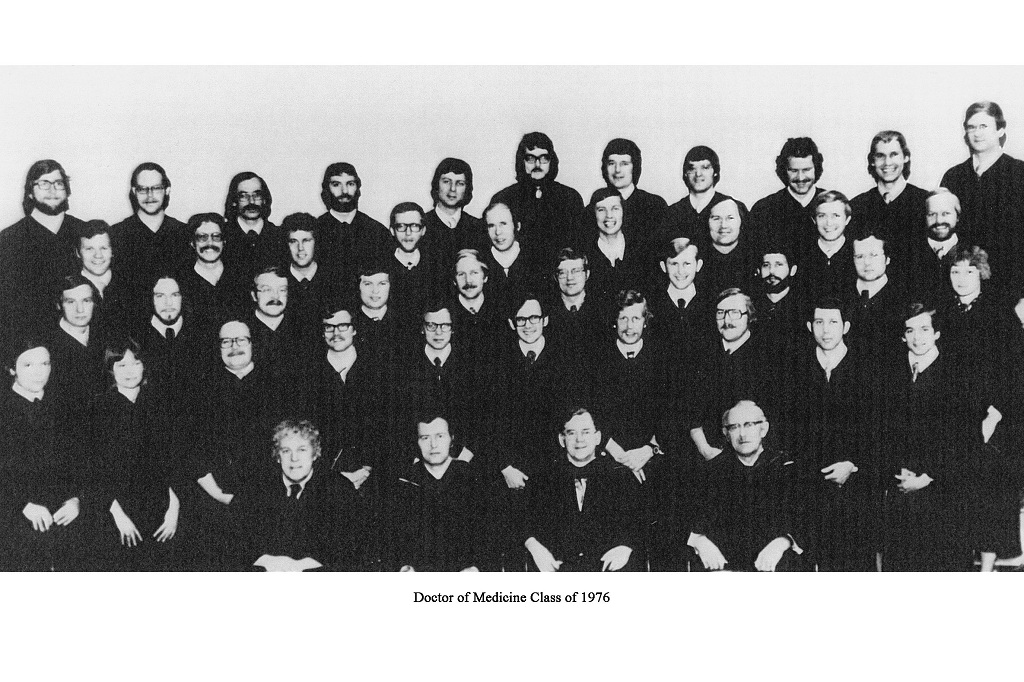
Editor’s note: In May 2025, the 50th class of UND School of Medicine & Health Sciences medical students crossed the stage to accept their diplomas as new physicians. The story below originally appeared in North Dakota Medicine, the quarterly print publication of the UND School of Medicine & Health Sciences. It’s the first of several stories in North Dakota Medicine that will reflect on 50 years of full scope of practice M.D. education at UND.
****
Fifty years is a long time.
Such a chestnut is particularly true for partisans of health care and medical education.
Just as practicing physicians prescribe very different treatments for a variety of illnesses today, relative to even 25 years ago, today’s medical students are taught very different things about biochemistry, differential diagnoses, and health system management than were their antecedents.
Reflecting on this fact, Dr. Pat Moore (M.D. ’76) recalled how his first block of medical school at UND began rather portentously in the 1970s.
After losing a close friend and university housing neighbor unexpectedly to aneurysm, Moore said that he “ended up hospitalized with severe acute abdominal pain, which turned out to be a duodenal ulcer.”
Fortunately, Moore added, “at that time, frequent milk, cookies and ice cream got me back on track and back in school.”
Medicine has indeed come a long way.
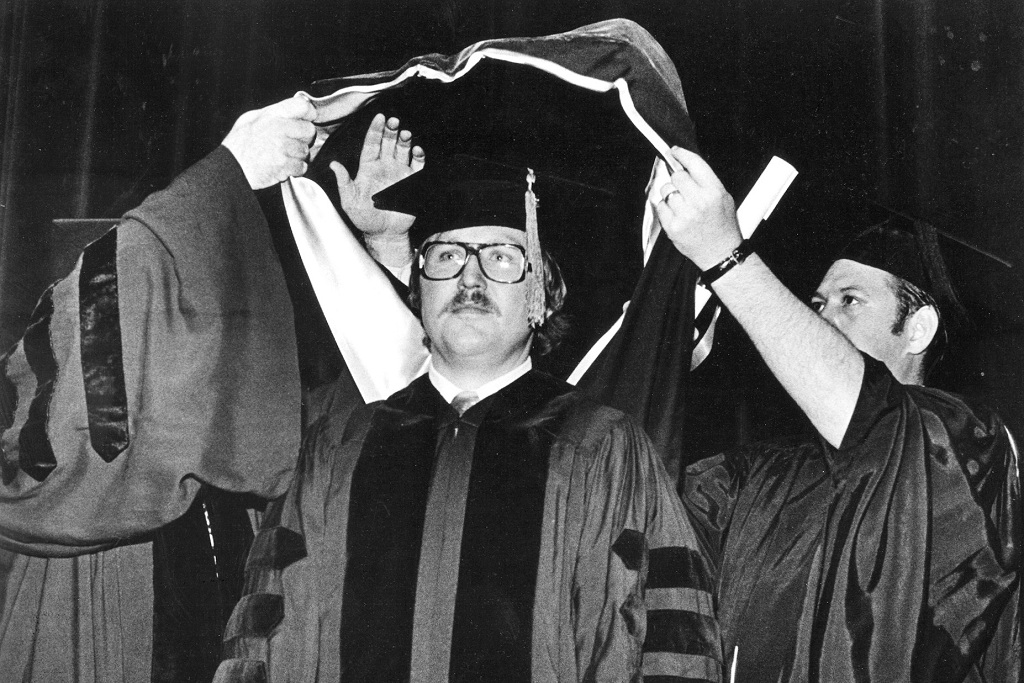
50 years and counting
“Looking back to the education I experienced, and comparing it to the style that students are exposed to now, I feel that today’s curriculum is so much better in helping students understand the human body,” confessed Moore, “how it functions and how so many different body systems are interconnected.”
Moore is not alone is his assessment that today’s medical students begin their professions more prepared to interact with complex humans and their complex health challenges than were students of the 1970s.
To get a sense of just how far medical education has come in half a century, North Dakota Medicine reached out to several graduates of UND’s first four-year M.D. cohort – the Class of 1976 – for their memories and reflections on the past half century.
Today’s higher cost of medical education notwithstanding, alumni comments tended to revolve around three main differences between old and new medical training programs: the earlier and increased clinical time today’s students enjoy, the wider variety of elective options, and the bump in training on bedside manner and communication (or what UND calls patient-centered learning or PCL).
On this last point, said Bismarck physician Dr. Ron Tello (M.D. ’76), there is really no comparison between his training and that of today’s students.
“We were in class studying biomedical things until the last semester of our second year,” said the Bismarck native. “Then they would assign us a patient at the hospital in Grand Forks so you could go take the history and physical on the patient and present to an attending physician what your differential diagnosis would be.”
Other than this, Tello said, “it was all classroom.”
By way of comparison, today’s medical students are thrust into patient interviews, team training and differential diagnoses their first week. In other words, current UND medical students are effectively thrown into the deep end almost before they know their preceptors’ and classmates’ names.
Although there are many reasons behind this change in protocol, the bottom line is that more and better clinical training sooner – along with more elective options and a better integration of biomedical science with clinical practice – better prepares SMHS students to compete for top residency programs and pass their three U.S. Medical Licensing Examination (USMLE) “step” exams.
“They get you into patient care much earlier, which I think is excellent,” said Tello, who took on his share of medical students when they rotated at hospitals in Bismarck. “Now they get into clinics and explore taking care of patients, interviewing patients and working with doctors much sooner.”
Better technology and bedside manner
The result of this curricular change is a revision in how students are taught to relate to patients, added Tello.
Describing the hours he spent jawing about medicine with then-Associate Dean for Student Affairs Wallace Nelson in the 1970s, Tello admitted that much of what he learned about patient care came from conversations he’d had with faculty outside of class.
“Nelson just called me into his office, and he would visit with me about medical school and being a doctor,” Tello said of his pre-clinical training. “I thought that was revealing – him talking about medicine. I learned things I wouldn’t have gotten in the classroom, or even in my residency training and my fellowship.”
Through a variety of hospital- and clinic-based simulation scenarios, coupled with better training on communication and professionalism, today’s students enter clinical practice much better prepared to engage patients with often complex personal, medical, and social histories.
“I think the way people learn has changed too, and probably for the better,” added Dr. Robert Arusell (M.D. ’76), thinking of patient-centered learning and the interprofessional simulations medical students perform with nursing, social work and other health students in their first year. “They do the small group thing, and they learn how to work together, which is important to make sure something isn’t overlooked.”
Then the first official M.D. graduate from UND – by virtue of his surname – emphasized the value of team-based teaching and practice.
“Look, you can’t rely on what you were doing 10-20 years ago,” asserted Arusell, who practiced radiation oncology in Fargo for decades. “It’s almost scary not to be part of a group practice now. A lot has changed since my wife and I went to med school, where we had to memorize everything.”
And even then, he said, students were “studying someone’s opinion of what to do.” Thank goodness, Arusell added, that today’s students are taught “evidence-based data on how to proceed.”
Recalling the months he was Arusell’s roommate in Minneapolis, Minn., when the pair completed rotations at the VA hospital, the University of Minnesota hospital and what is now Regions Hospital in St. Paul, Tello agreed, noting that evidence-based policy changes in the U.S. and across several states have improved population health generally.
“If an injured worker is at home recovering from a surgical procedure, and you bring them back full time too soon, they’re going to injure themselves again because they’re not in shape anymore for that job,” said Tello, who took on an accelerated fellowship in occupational medicine at the University of California – San Francisco in order to help establish the Department of Occupational Medicine at Sanford Health in Bismarck.
“You bring them back in a limited capacity, and industry does that now,” he said. “When I first started, workers got to come back with no restrictions, so I had to visit with the companies and say, ‘That’s not good policy. Let me bring them back in a limited way.’ And they understood that. Industry does that now, and that’s really excellent for the worker.”
The more things change…
Bottom line: Whether medical education, clinical practice or health policy, health care is changing quickly, all the time. So quickly, in fact, that it can be hard for not only patients but providers to keep up.
Even so, 50 years after graduating, Arusell, Moore, and Tello say there is nothing they would have rather done with their lives – and careers.
“My father was a bacteriologist, and he was always talking about things in his laboratory,” Tello explained. “When I was growing up, on weekends, he would go down to the clinic and review his cultures, and I would go with him on occasion. My sister and I would look under the microscope with him, and I just found it fascinating.”
He decided then and there, said Tello, “This is what I want to do.”
Steele, N.D., native Arusell feels much the same way, although he admitted that medicine was an easier decision when tuition was only $600 per semester.
“Staying in North Dakota was a great move for us and provided us with having some great careers,” he said.
This is why Arusell, Tello, and Moore have all continued to give back to UND, not only financially but by being generous with their time.
“I loved every day as a physician,” concluded Moore, who came to Grand Forks from Dickinson, N.D. “Granted, there were good days and bad days, but I was part of a profession – a vocation – that connected you with people in a very special way, like no other. Thank you, UND.”