Computing the future at UND
By Mason Clobes
For generations, scientific breakthroughs relied on two pillars: theory and experiment. Today, a third pillar — computation — is transforming how researchers understand the world. At the University of North Dakota, students have the opportunity to be part of that transformation.
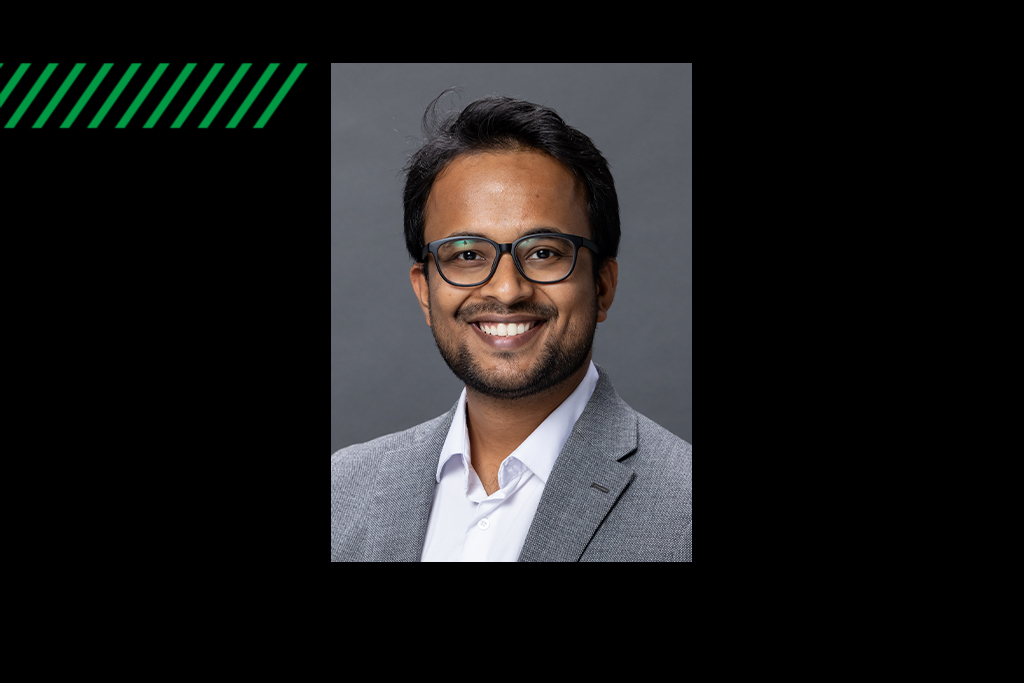
“Quantum is the future,” said Ayush Asthana, assistant professor of Chemistry.
Asthana came to UND because of its longstanding reputation in theoretical and computational chemistry, built in part by renowned computational chemist Mark Hoffman, professor of Chemistry and associate dean for research at the College of Arts & Sciences.
Today, that legacy continues as the University invests heavily in advanced computing infrastructure and interdisciplinary research.
UND researchers have access to a growing suite of computational resources, including the Talon and Medora high-performance computing clusters equipped with state-of-the-art GPUs. Beyond campus, faculty and students also utilize national NSF ACCESS computing facilities, cutting-edge IBM quantum computers and systems at Oak Ridge National Laboratory.
“We have all the hardware we need to do our best scientific work,” Asthana said. “We never have to wait for resources.”
Traditional computers process information using bits that exist as either a 0 or a 1. Quantum computers operate differently. By leveraging the principles of quantum mechanics — such as superposition and entanglement — quantum bits, or qubits, can represent many possibilities simultaneously. That capability makes quantum computers especially powerful for problems that become exponentially more complex.
For chemistry, the potential is enormous. Understanding how molecules interact, predicting chemical reactions, designing catalysts and discovering new drugs all require solving extraordinarily complex quantum mechanical problems. Many of these calculations quickly overwhelm even the world’s fastest classical computers.
“Our goal is to make chemistry computationally predictive,” Asthana said. “We want to reliably predict new materials, new molecules, drug applications and catalysts before they are made.”
His research group develops new algorithms for both classical and quantum computers, pushing computational methods beyond the limits of existing techniques.
Asthana’s laboratory collaborates with national laboratories including Oak Ridge National Laboratory and Pacific Northwest National Laboratory, as well as Virginia Tech, pharmaceutical companies, quantum hardware developers and Amazon.
One of Asthana’s priorities is making cutting-edge research accessible to students. Rather than expecting students to arrive with extensive expertise, his mentoring philosophy centers on curiosity, collaboration and gradual independence. Students work closely with experienced researchers as they build confidence, develop technical skills and eventually take ownership of their own research projects. Because quantum computing remains an emerging field, Asthana believes today’s students have an unusual opportunity.
“When there are open problems, you can make a name for yourself,” he said. “This is the right time to get involved.”
His advice for students interested in research is simple: don’t let intimidation keep you away.
“Be enthusiastic and get involved,” Asthana said. “Sometimes people think they’re not smart enough or that it’s too complicated. Just be curious. There’s too much to gain and nothing to lose.”
UND is also expanding educational opportunities in quantum science. Asthana is developing a new Applied Quantum Computing course in collaboration with Amazon, where students will learn to program real quantum computers while solving scientific and engineering problems. Amazon engineers and guest lecturers will work directly with students, who will have access to industry-leading quantum computing platforms.
For Asthana, the greatest measure of success isn’t simply publishing research papers or developing new algorithms. It’s preparing students to solve tomorrow’s biggest challenges.
“If my lab produces people who contribute positively to society, who think deeply, simplify complex scientific and engineering problems, and make the world better,” he said, “that’s more important than my direct work.”