Protecting pollinators, inspiring scientists: Research with impact at UND
By Mason Clobes
For Rebecca Simmons, professor of Biology, curiosity started early — with insects. Growing up in Virginia’s Shenandoah Valley, Simmons spent her childhood fascinated by the insects around her. That curiosity eventually led her from studying moth mating behavior to evolutionary biology, genomics and, more recently, the critical role of pollinators in North Dakota’s ecosystems and agriculture.
Now, more than two decades into her career at the University of North Dakota, Simmons is using evolutionary and genomic approaches to better understand the organisms that quietly support our food systems — and giving students opportunities to become researchers alongside her.
Simmons’ research career began with moths. During her master’s work, she studied the mating behavior of woolly bears and later investigated the milkweed dagger moth, discovering and documenting previously unrecorded aspects of its mating behavior.
“I catalog life,” Simmons explained. “It’s sort of like being biology’s librarian.”
At UND, her research has expanded into genomics and microbiomes, particularly in pollinators and agricultural systems. Pollinators play a fundamental role in producing much of the food people depend on, from fruits and vegetables to crops that support dairy and meat production. While honeybees receive much of the attention, Simmons emphasizes the importance of native bees and other pollinators that are critical to healthy prairie and agricultural ecosystems.
North Dakota is particularly important to this research. A large portion of the nation’s honeybee colonies spend the summer in the region, where they contribute to agricultural production. At the same time, native pollinators face threats that are not always as visible or well-studied. Simmons and her students are working to better understand those threats, including diseases and changes within pollinator microbiomes.
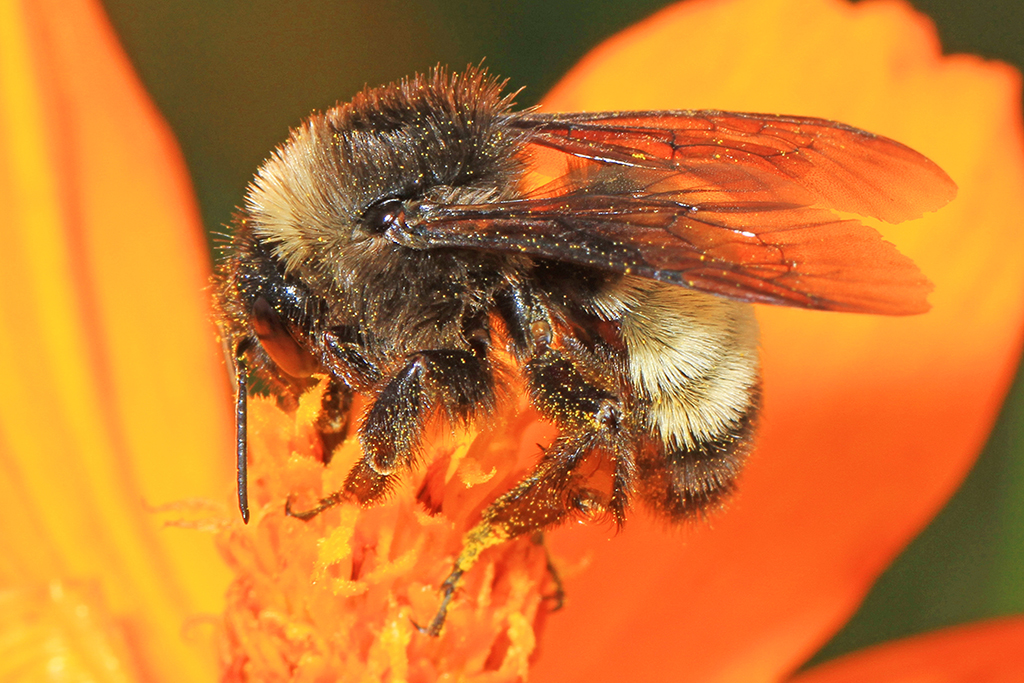
One recent student project focused on fungal diseases and pathogens affecting bumblebees. By using genomic sequencing and other molecular approaches, the research team can identify organisms associated with pollinators and begin understanding how those relationships may affect their health.
“Pollinators are essential to your life,” Simmons said. “If you don’t have pollinators, you’re not going to eat.”
A defining part of Simmons’s work at UND is that students are not simply watching research happen — they are doing it. Simmons regularly works with undergraduate and graduate students, giving them opportunities to develop their own projects, learn laboratory and computational techniques, analyze data and communicate their findings.
She is also a co-principal investigator for UND’s Genes in the Environment Research Experiences for Undergraduates program, which gives students an intensive summer research experience. The program provides students with hands-on opportunities to work alongside faculty and engage in authentic scientific research.
Simmons also helps lead a related Research Experiences for Teachers program, allowing science teachers to spend time conducting research so they can bring those experiences back into their classrooms.
The impact of these programs can be significant. Simmons notes that the REU program received hundreds of applications for a limited number of positions, reflecting both the demand for research opportunities and the value students place on hands-on experience.
For students pursuing careers in medicine, dentistry and other professional fields, the experience offers practical benefits as well. Students learn how to collaborate, troubleshoot problems, communicate science, take ownership of a project and mentor others — skills that can follow them into virtually any career.
Simmons’ research also illustrates how modern biology increasingly crosses disciplinary boundaries. She collaborates with researchers working in areas ranging from biostatistics and artificial intelligence to endocrinology, wildlife biology, and agriculture.
One collaboration examines deer and their food choices, asking how what they eat may influence stress hormones. Simmons contributes expertise in microbiomes and plant identification using genomic approaches.
That collaborative approach has become increasingly important as biological research generates enormous amounts of genomic and ecological data. Simmons has even taught herself new bioinformatics and data-processing techniques, using modern computational tools to expand the kinds of questions she can investigate.
For Simmons, mentoring is the ultimate purpose of being a scientist. She recalls a professor telling her that, if scientists are lucky, they might one day become a sentence in a textbook. Simmons has a different measure of success.
Her goal is to help the next generation of scientists become better than she is—to give them the knowledge, confidence and opportunities to pursue questions she may never have the chance to answer herself.
“I want to mentor the next generation of scientists,” Simmons said. “And see their greatness and know that they’re going to do better things than I could ever do.”
At UND, that philosophy connects research in the laboratory to something much larger: students discovering what they are capable of, teachers bringing research into their classrooms and communities gaining a deeper understanding of the organisms that sustain their ecosystems and food systems.